
At an Arab coffee bar in New Jersey that we manage, a printed card in the delivery bag took Uber Eats reviews from 2 to 24 in one month (February to March 2026). The store's review rate hit 16.1%. Three sister stores without the card sat between 4.5% and 6.4%.
Printed cards cost about $1 each. No ad budget, no help from the algorithm. The card went to people who had already ordered, and it changed what the next customer saw on the store page. That's the kind of thing I mean when I talk about getting delivery orders outside the algorithm.
Can you get delivery orders without relying on the algorithm?
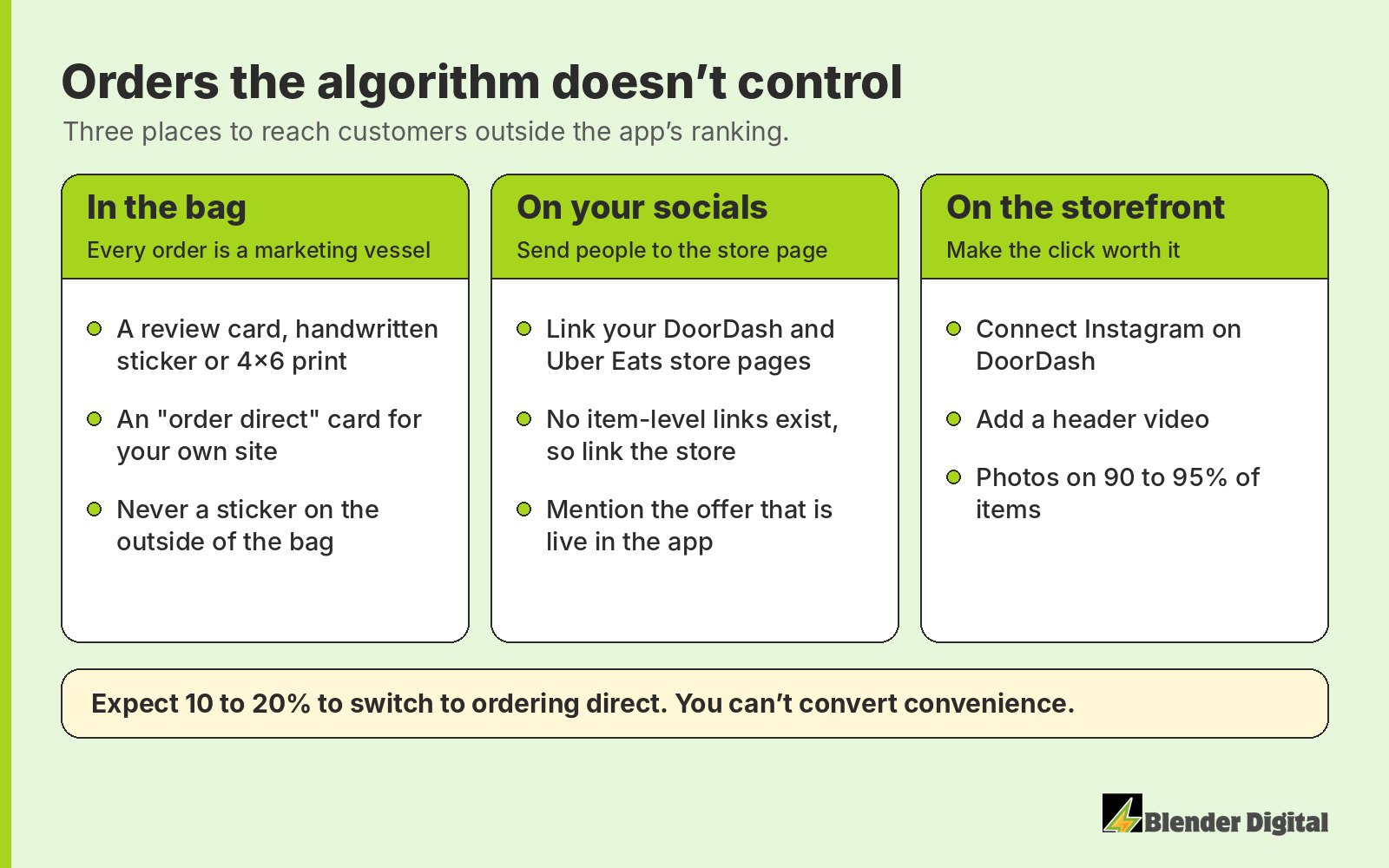
Some, yes. Three places are fully in your hands: the bag that goes out with every order, your own social accounts, and what your storefront page shows when someone lands on it. None of them depend on where DoorDash or Uber Eats decides to rank you today.
I'll be straight about the limits, though. Most delivery demand lives inside the apps, and the algorithm still decides most of your traffic. It favors you one day and then all of a sudden it disfavors you the next. The outside work won't replace that. It gives you a steady base the algorithm can't take away, and some of it (reviews especially) feeds back into how the apps rank you.
How do you use the delivery bag as marketing?
Anytime you send out a delivery package, that's your marketing vessel. The person holding it already chose you once. I use the bag for two things.
A review card. Something like "Leave us a review and get $5 off your next order," made specific to the platform the order came from. Review rates on delivery are low for a simple reason: when you're leaving a review, you're competing against leaving a review for the courier. The app asks about the driver first. A card in the bag gets in ahead of that.
- Handwritten round stickers work. Printed 4x6 cards cost about $1 each.
- Put it inside the bag. Never a sticker on the outside.
- Skip the QR code. It can't open the review page for that specific order.
- Run it until you have about 100 reviews, then taper off.
Typical review rates run 3 to 6% of orders. With bag cards I've seen 12 to 16%. My guide to getting your first 100 reviews has the full setup.
An "order direct" card. A card or QR code pointing to your own online ordering, with a simple ask: order direct, save us the commission, support a small business. Set your expectations, though. Only about 10 to 20% of people switch. You can't convert the convenience factor. Most people will keep ordering in the app they already use, and that's fine. Third party is your acquisition channel. Your own ordering is the profit channel. More on that split in third-party vs first-party delivery.
What not to put in the bag? I had a client ask about a small thank-you vase in every order. I'd skip it. It adds cost, it can break in transit, and customers are unlikely to connect it with the food. A small food extra is a better test.
Can you link straight to a menu item on DoorDash?
No. There are no item-level links, so when you post on social, link the store page. If you're on more than one app, share each store link so people can use the one they already have.
A few things that help social posts actually send orders:
- Mention the offer that's live. If a new-customer BOGO is running, say so. First-timers will see it when they land on the store.
- Show real food and real people. From my own content, original clips beat stock footage, and putting your face on is literally the best thing to do.
- Be consistent over viral. Most posts won't go viral, and that doesn't matter. The steady stream of posts with a working store link is what adds up.
We do offer social as an add-on for the restaurants we manage. For most single stores, though, I'd start with the bag. It reaches people who already bought from you, and it costs a dollar.
What should your storefront show before you send traffic to it?
If you're going to send people from Instagram or a bag card to your store page, make sure the page converts them. The first thing people look at is price. Picture comes second, description comes third.
- Connect Instagram and add a header video on your DoorDash storefront. Both take a few minutes.
- Photos on 90 to 95% of items. It's an online medium, you have to have pictures in order to sell items. On DoorDash, items without a photo can't even carry a BOGO. Use the image resizer to get each platform's sizes right.
- Ratings people trust. 4.5 stars or better with 100+ reviews is the milestone I aim for. If you have 1,000 reviews and a 4.2, that's an average store. If you have 150 reviews and a 4.5, that basically means customers are happy.
Do orders from outside the app help your ranking?
The platforms don't publish how ranking works, so I won't pretend to know the exact formula. What I can tell you is what I see across the stores we manage: operations and reviews move the needle. If you have no errors, no inaccurate orders and no taste and quality issues, the algorithm is happy and it keeps pushing you forward. DoorDash in particular measures your error rate against your peers and will push you down if your kitchen keeps making mistakes.
So the outside work that pays off most is the work that ends up as reviews and clean orders. The bag card does that directly.
There's one more way to reach customers without the ranking, and it lives inside the app: review replies. When you reply to a review with an offer, the customer gets it like a de facto push notification. On Uber Eats, about 30% of customers who receive an offer come back within 30 days. On DoorDash, a loyalty program does a similar job and only costs you when someone redeems.
Should you leave the apps and build your own ordering?
I hear this a lot, and I understand it. The fees hurt. But you'd give up the marketplace audience, and nobody downloads an app for every restaurant. What about the more casual eater? They're on DoorDash or Uber Eats deciding what to eat right now.
I'd rather manage the apps than quit them. Use the marketplaces to find new customers, use the bag to turn a few of them into direct customers, and keep both running.
Quick answers
Can I share a link to a specific item on DoorDash?
No. DoorDash has no item-level links, so share your store link and mention the item or offer in the post.
Should I put a QR code on my review card?
No. A QR code can't open the review page for that specific order. Use a plain card or sticker inside the bag that tells people where to leave the review.
How many delivery customers will switch to ordering direct?
Expect about 10 to 20% with an "order direct" card in the bag. Most people stay in the app for the convenience.
Does a review card in the bag really work?
At an Arab coffee bar in New Jersey we manage, it took Uber Eats reviews from 2 to 24 in one month (February to March 2026), with a 16.1% review rate.
If you want a second set of eyes on your storefront before you start sending people to it, reach out. Looking at store pages is a big part of what we do every week, and if you run several locations, here's how we work with restaurant groups.