
In September, a taco shop I manage on Long Island grew delivery sales 50.4% over August, from $6,291 to $9,463 across Uber Eats, DoorDash and Grubhub. In the same month, its Uber Eats store views fell 14.8%, from 7,897 to 6,725.
So sales were up and fewer people were opening the store. The monthly report I sent the owner named store views as the first thing to fix. Good month or bad month, that's the split I look at whenever an owner tells me nobody can find them on DoorDash or Uber Eats.
Why isn't my restaurant showing up on DoorDash or Uber Eats?
Usually it's one of two things. Either not enough people are seeing your store, which is a traffic problem, or people see it and don't order, which is a conversion problem. The fix for each one is different, so figure out which one you have before you spend a dollar.
The two also feed each other. Errors, ratings and reviews feed the algorithm. A store that keeps disappointing customers gets pushed less, so a conversion problem left alone turns into a traffic problem.
Before either one, rule out the boring stuff.
Are you actually live and findable?
Open the app on a phone, set the address to somewhere inside your delivery zone, and search for yourself. Do it at lunch and again at dinner. If you don't come up, it's usually one of these:
- Hours or a pause. The hours in the portal don't match when you're open, or someone paused the store during a rush. Pausing in a rush is fine. Just remember to turn it back on.
- Category tags. If your tags are wrong you won't show up when people browse your cuisine.
- A menu or integration break. If you run Toast, editing items in the POS changes their item IDs and can silently break item-level campaigns. I learned this one the expensive way, when a BOGO campaign just went flat.
- Virtual brands. DoorDash wants at least 50% of a new brand's menu to be different from your other brands. I've seen an operator lose 6 of 9 concepts without notice over this rule.
Is it a traffic problem or a conversion problem?
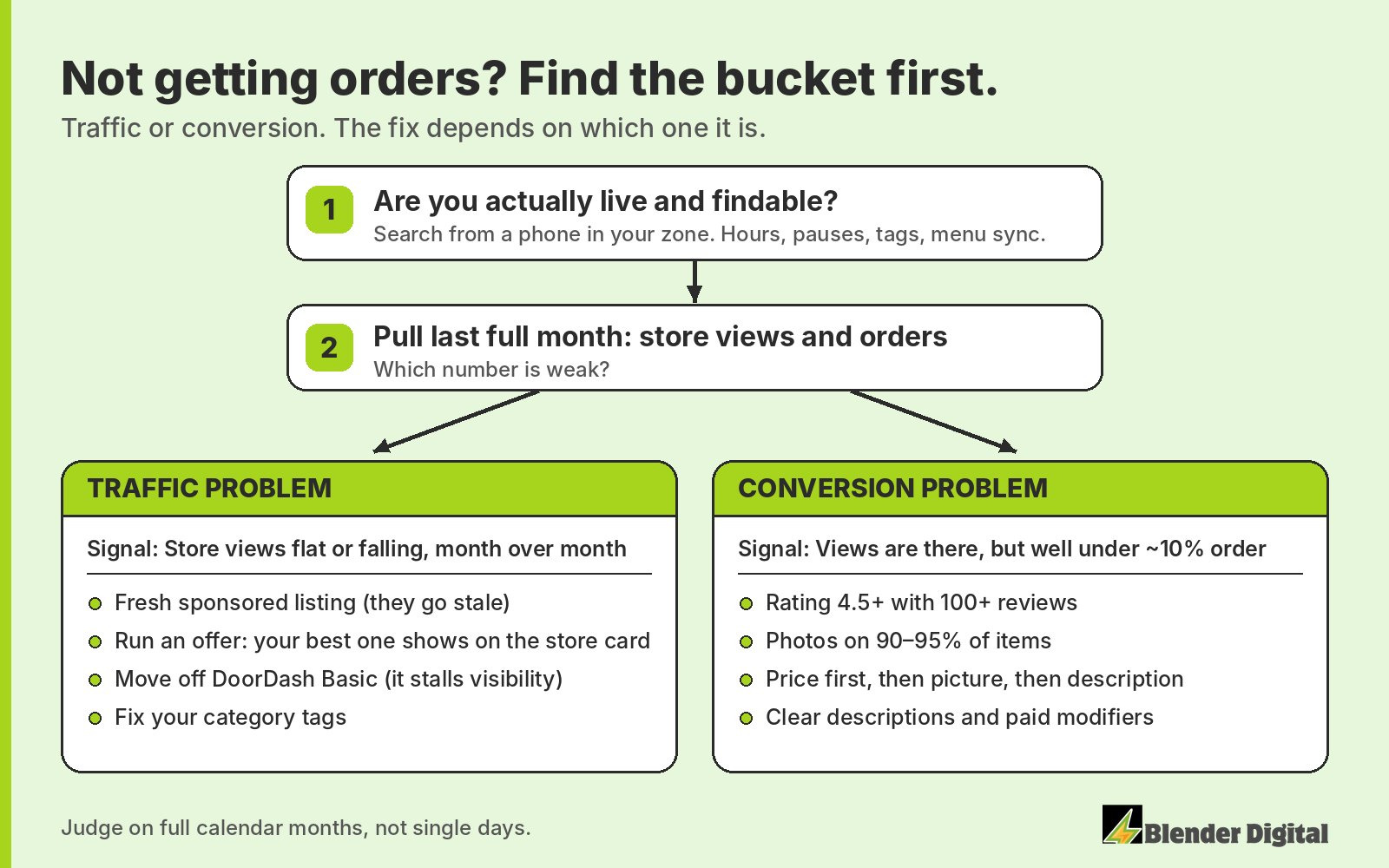
Pull the last full month, not the last few days. You need two numbers: how many people opened your store, and how many of them ordered.
Uber Eats makes this easy. It shows impressions, click-through rate (about 5% is typical) and click-to-order (11 to 12% is healthy). For store views to orders, I see about 10 to 11% as healthy for a burger store and 10 to 12% for coffee. 20% is very high.
If store views are flat or falling month over month, it's traffic. If views are there but well under 10% of them order, it's conversion. If it's both, start with conversion. Ads multiply what's already there, so paying to send more people into a store that doesn't convert mostly helps the platform.
How do I get more visibility on DoorDash?
Check your commission plan first. DoorDash Basic is 15%, Plus is 25% and Premier is 30%. Basic is cheap, and it stalls visibility. A Yemeni coffee house I work with in Atlanta sat on Basic and its DoorDash sales went flat until we upgraded. I put most stores on Plus. Only the 25% and 30% plans can target DashPass customers. Premier's extras are mostly a marketing trick, and its one useful perk is the sponsored listing boost.
Run a sponsored listing, and keep it fresh. DoorDash sponsored listings are pay per order, not per click. The manual minimum bid is $3 per order, and DoorDash will suggest $5. In small markets I've seen a $3 bid return 13 to 14x.
What most owners miss is that listings wear out. If a sponsored listing ad is set at the same level for a long time, it goes, quote unquote, stale. I nudge the budget every month, even from $70 to $73. One DoorDash rep's rule is to replace any listing that has run more than 6 weeks with a fresh one. At a historic diner I manage in San Francisco, the main brand's DoorDash sponsored listing went from 9.50x in August to 6.76x in September. The rep's read was that it had gone stale, so we're reposting it.
Have an offer running. Your store card shows your best live campaign, so a BOGO tag gets more people to click on your ad. Ad money goes a lot further when there's a campaign running next to it. If you go the BOGO route, do the math first.
How do I get more visibility on Uber Eats?
Uber Eats ads start at about $3 a day. Start low, then raise spend 10 to 20% at a time when your return on ad spend is 8 to 12x or better. Below 8x, hold. Around 6x, you shouldn't be spending more. Ignore the "recommended for max sales" budget. That's money in Uber Eats' pocket.
In competitive markets, automatic bidding usually beats manual. At the San Francisco diner I tried manual bidding and impressions dropped hard. I switched it back to automatic and, boom, it jumped back up.
Give each change a week or two. Don't undo a budget change after a few days, because sometimes the algorithm takes a second to adjust.
What if people see my store but don't order?
Then it's conversion, and conversion comes down to trust. The way I put it to owners: campaigns do improve the visibility, but conversion relies on trust signals. Is it 4.5 or above? How many reviews does it have?
4.5 stars with 100 or more reviews is the milestone I aim for. If you have 1,000 reviews and a 4.2, that's an average store. If you have 150 reviews and a 4.5, that basically means customers are happy.
Reviews come in slowly because the app asks customers to rate the courier first. What's worked best for us is a card in the bag. At an Arab coffee bar in New Jersey, Uber Eats reviews went from 2 to 24 in one month (Feb to Mar 2026). That was a 16.1% review rate, against 4.5 to 6.4% at three sister stores. More on that in how to get your first 100 reviews.
Then look at the menu the way a customer does. The first thing people look at is price. Picture comes second, description comes third. Keep your markup around 12 to 15%. Get a photo on 90 to 95% of items and check it on a phone, not a desktop. Our free food delivery image resizer exports the sizes each app wants.
Last, errors. DoorDash measures your error rate against your peers, and if your kitchen keeps making mistakes, it suppresses you. Uber treats under 2% as the normal cost of doing business.
My sales dropped. Is it visibility?
Maybe. Before I blame the algorithm, I go through the same list:
- Did anything change in the campaigns? Did one end, or is it only live a few hours a day?
- Ratings and reviews. Did one customer review-bomb the store?
- Sponsored listing impressions and conversion. Has the listing gone stale?
- Store hours, closures, category tags, and any menu or integration break.
- Weather, holidays, and the algorithm having an off week.
One or two bad days isn't something to immediately solve for. The algorithm favors you one day and not the next. Judge on full months and change one thing at a time, so you know what worked.
Want a second set of eyes on your store?
This is how every engagement starts
The first two weeks of every engagement are an audit: campaigns and targeting, customer mix, photos, reviews, errors and your commission plan. If you want me to look at your DoorDash or Uber Eats store, send it over and I'll tell you which bucket you're in.
Common questions
Why can't I find my restaurant on DoorDash?
Search from a phone with an address inside your delivery zone, at lunch and at dinner. If you still don't show up, check your store hours in the portal, whether the store was paused, your category tags, and whether a POS menu edit broke the menu sync. Virtual brands can also be removed if less than half of their menu differs from your other brands.
Does my DoorDash commission plan affect visibility?
In my experience, yes. Basic (15%) stalls visibility, and only the 25% Plus and 30% Premier plans can target DashPass customers. I put most stores on Plus.
How long does it take to get more visibility on DoorDash or Uber Eats?
Give each change one to two weeks before you judge it, and judge results on full calendar months. The algorithms swing day to day, so one or two slow days doesn't mean a change failed.
Do ratings affect where my restaurant ranks?
Yes. Errors, ratings and reviews feed the algorithm, and DoorDash compares your error rate with your peers. On the conversion side, 4.5 stars with 100 or more reviews is the trust milestone I aim for.