
4.5 stars and 100+ reviews. That's the line I check first on every DoorDash and Uber Eats store I audit. Below it, you're asking a stranger to take a chance on you. Above it, your rating stops being a reason to skip you.
The count matters as much as the stars. If you have 1,000 reviews and a 4.2, that's an average store. If you have 150 reviews and a 4.5, that basically means customers are happy.
Do ratings affect sales on DoorDash and Uber Eats?
Yes, in two ways. Your rating decides whether the people who land on your store actually order. And your ratings and error rate feed the algorithm that decides how many people land on your store next month.
The first one is conversion. Ads, offers and sponsored listings get people to your page. What happens next depends on trust. The way I put it to clients: "Campaigns do improve the visibility but conversion relies on trust signals like, hey, is it 4.5 or above? How many reviews it has."
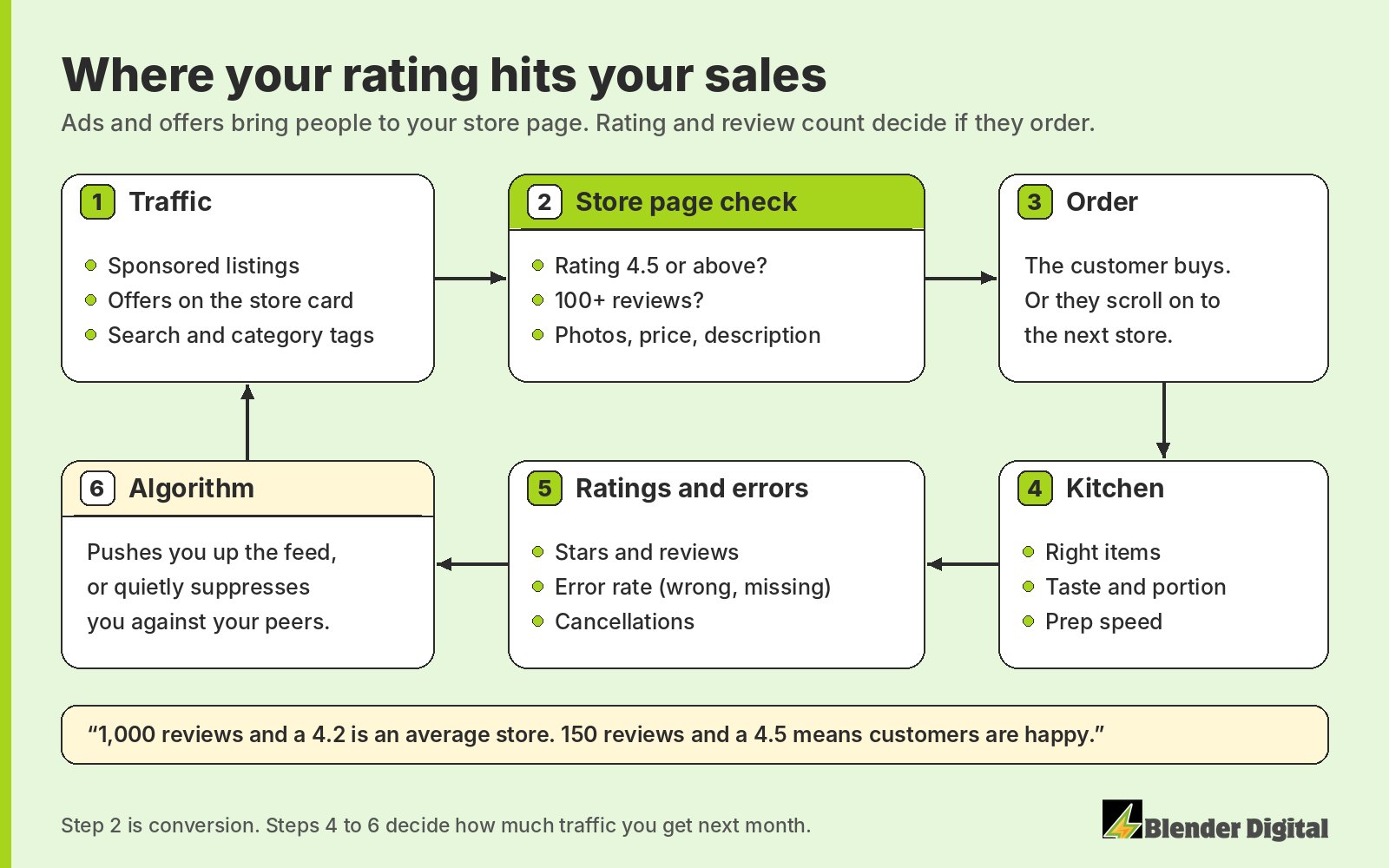
Is it a traffic problem or a conversion problem?
Before blaming the rating, figure out which side is weak. Pull a full month of store views and orders.
- Traffic problem: not enough people see you. Store views are low. The fixes there are sponsored listings, an offer showing on your store card, and clean category tags. I cover that side in why your restaurant is invisible on DoorDash and Uber Eats.
- Conversion problem: people see you and don't buy. That's where your rating and review count live, along with photos, price and descriptions.
For a benchmark, about 10% to 11% of store views turning into orders is healthy for a burger store, and 10% to 12% for coffee. Some simple example math: 2,000 store views at 10% is 200 orders. At 7% it's 140. Same traffic, same ad spend, 60 fewer orders. That gap is what a weak rating can cost you, and you're still paying for the ads that brought those people in.
Do errors and bad reviews hurt your ranking?
Yes. Operations are marketing on these apps. If you have no errors, no inaccurate orders, no taste and quality issues, the algorithm is going to be happy and it's going to keep pushing you forward.
DoorDash is basically measuring you against all your peers. If your kitchen keeps making mistakes, it will suppress you. The DoorDash error-rate benchmarks I've seen range from 2% to 6.5% depending on the store. On Uber Eats, under 2% is just the cost of doing business.
The badges work the same way. Uber's Top Eats badge looks back 90 days and goes to roughly the top 5% to 10% of stores. You need about 80% online availability, a high rating, and fewer than 2 inaccurate orders per 100. DoorDash's Most Loved badge looks at error rate, cancellations (1.1% or less), rating, and now a menu markup of 10% or less. I don't chase Most Loved. The lift is small next to good campaigns and good reviews.
What does a healthy month look like?
Here's September 2026 for a smash-burger ghost kitchen in Houston that we manage, straight from its monthly report:
- Uber Eats: 60 reviews, 49 of them five-star. We replied to 59.
- DoorDash: 47 reviews, 27 "loved" and 6 "didn't like." We replied to 45.
- Errors: 1.4% of orders across the apps, 17 out of 1,230. Five of those charges were disputed and all 5 were won, getting $95.32 back.
Nothing fancy. A kitchen that gets the order right most of the time, and someone answering almost every review. Everything else we do on that account, the offers and the ads, works better because of it.
What causes bad delivery ratings?
When I read through one-star reviews, they mostly land in three buckets: taste, price and slowness. Slowness you can't control. Taste is something you can cautiously look into. Price, you're not going to change for one customer.
Wrong and missing items are the ones you can fix fastest:
- Fix your descriptions. Inaccurate descriptions cause item errors. We had one menu describing fries with jalapeños that weren't on them.
- Use modifiers, not notes. Requests typed into the notes field get missed. Build the common ones as modifiers.
- Out of stock? Call the customer. Offer a swap or a cancel. Never force a substitute.
- Dispute what isn't your fault. Courier batching, food that went cold on the courier's route, orders that left your counter complete. Don't try to solve for issues that aren't yours.
Also check whether one person is dragging the number down. I've seen a single customer leave 19 one-star reviews. Flag that to your rep. I explain how repeat reviews from one customer work in can the same customer review an Uber Eats restaurant more than once.
How do you raise a low rating?
Fix the kitchen issue first, then grow the review count so the newer, better reviews outweigh the old ones. The bag card and reply-offer setup we use for that is in how to get more reviews on DoorDash and Uber Eats.
On Uber Eats, your store rating covers your whole history, but roughly 90% of the weight sits on the last 90 days. So a bad stretch fades if the next 90 days are clean. Judge it month over month. One or two bad days isn't something to immediately solve for.
Frequently asked questions
What rating do you need on DoorDash and Uber Eats?
Aim for 4.5 stars or higher with at least 100 reviews. That's the point where your rating builds trust instead of costing you orders.
How is the Uber Eats store rating calculated?
It covers your whole history, but roughly 90% of the weight is on the last 90 days. Recent orders matter most.
Can I get a bad review removed?
Reviews from genuine buyers generally stay up on Uber Eats. If one customer is a repeated problem, you can ask to have them blocked from ordering at your store.
Does replying to reviews improve my rating?
Not directly. Stars come from food and operations, and replies are more of a concierge service. But a reply with a small offer brings customers back, and that gets you more orders and more reviews.
Want us to look at your ratings?
My team handles reviews, error-dispute prep, offers and ads for the restaurants we manage on DoorDash, Uber Eats and Grubhub. If your rating or conversion feels off, get in touch and I'll tell you which side I'd fix first.