
SERVICES
Error handling for DoorDash, Uber Eats and Grubhub
Error handling is the daily work of catching wrong and missing item reports, finding out why they happened, and fixing the cause so they stop. We review errors every day, prepare disputes for the ones that weren’t your fault, and work with your team on the menu and process fixes behind the rest.
It’s for restaurants growing their delivery volume without someone watching every order. The outcome is fewer charges, a healthier error rate, and a store the apps keep showing. It comes with every Blender Digital plan.
WHY IT MATTERS
Does error rate affect your ranking?
Yes. Error rate is error orders divided by total orders, and the apps watch it. DoorDash measures you against your peers. If the kitchen keeps making mistakes, you get shown less. On Uber Eats, under 2% is the normal range. A few errors are just a way of doing business. A pattern of them is a problem.
I think of operations as marketing. Every wrong or missing item is a charge, a customer who may not come back, and a small mark against you in the ranking. Every clean week does the opposite.
“If you have no errors, no inaccurate orders, no taste and quality issues, the algorithm is going to be happy and it’s going to keep pushing you forward.”
Hassan Shaikh, founder
THE REAL COST
How do unaddressed errors bleed margin?
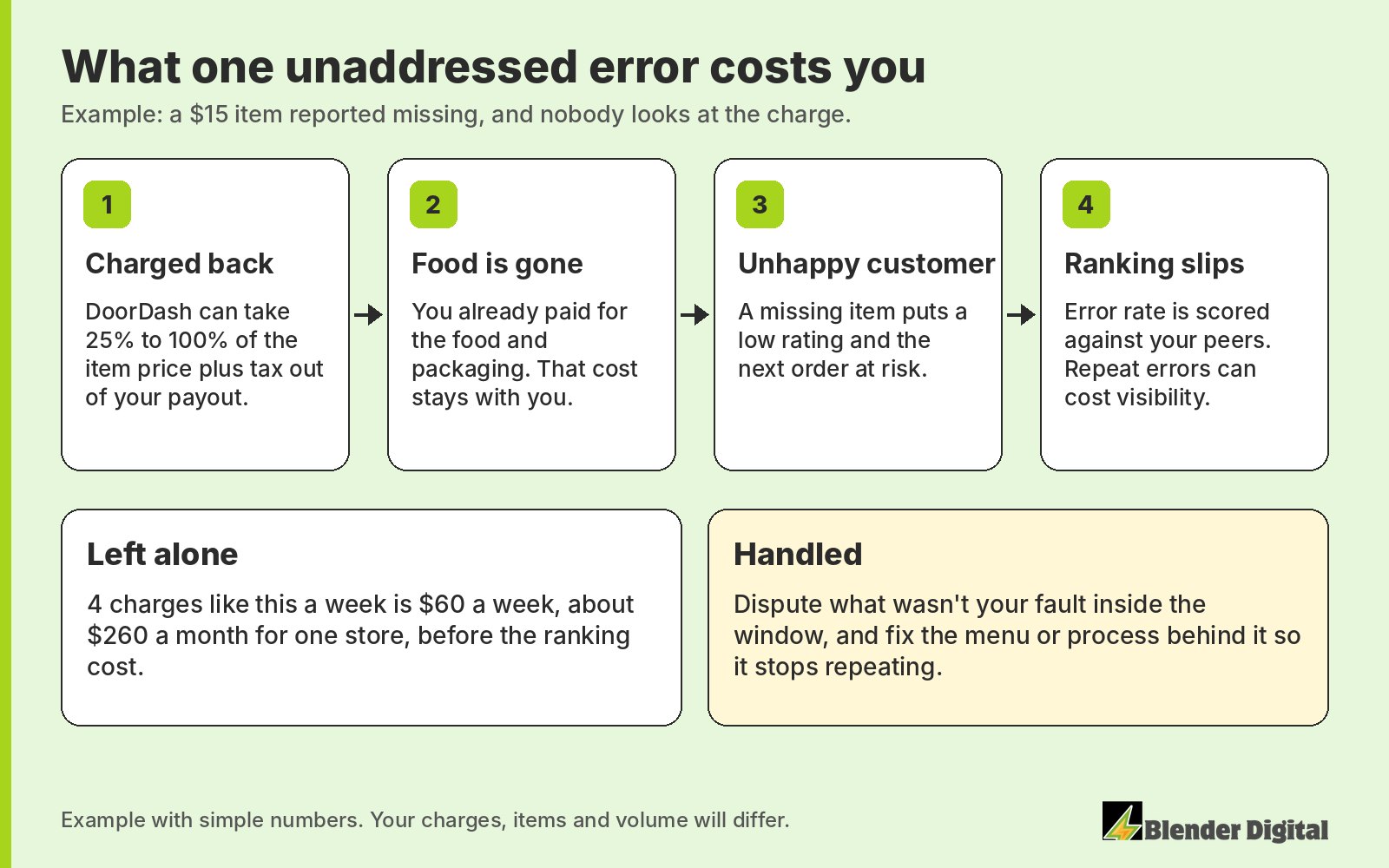
An error costs more than the charge. The app takes back part or all of the item price, you’ve already paid for the food, the customer is less likely to order again, and the error rate that ranks you goes up. Owners tell me their chargebacks are “only $10 a week.” One prospect’s statements showed $1,198 in a single month across 2 stores.
WHAT’S INCLUDED
What does our error handling include?
Some of it we fix ourselves. Some of it we pass along to you, plainly and without blame. Either way, someone is looking every day.
- Daily error reviewEvery wrong, missing and quality report on each app, read the same day with the order details.
- Root causes, shared carefullyWhen the same item keeps coming back, we tell you or your manager what we’re seeing. Something like “might be worth checking with the kitchen on portioning.” The food and the line are yours.
- Menu and description fixesDescriptions that match what’s in the bag, photos that match the portion, and modifiers in place of free-text notes, which get missed.
- Out-of-stock handlingItems marked unavailable on every app, with a check that the change actually synced from your POS.
- Disputes prepared for youCharges that weren’t your fault get reviewed with your location manager and prepared for you to submit. See dispute management.
- Problem couriers and customersOn Uber Eats you can unpair a courier and block a problem customer from ordering at your store. We flag who and why.
- Kitchen capacity before big promosA strong campaign can mean couriers arriving all night, a ticket screen that never clears and stock running out. We plan launches around what the kitchen can handle, because a rushed line makes mistakes.
- Weekly and monthly reportingError rate, charges and recoveries in the Monday errors and disputes summary and in your monthly report.
HOW WE DO IT
How do we handle errors day to day?
Read every error
Each morning we go through the previous day’s error reports on every app: what was reported, which item, how much was charged.
Sort by cause
Kitchen, courier, menu setup, or a claim that looks off. The cause decides the fix. A courier mix-up gets disputed. A confusing description gets rewritten.
Fix what we can, share the rest
Menu, descriptions, modifiers and stock settings we change ourselves, with your approval. Kitchen patterns we pass along to you or your manager, with the orders attached.
Watch the trend
One bad night isn’t a trend. We judge error rate month over month and check that a fix actually held before calling it done.
OUT OF STOCK
What should you do when an item runs out?
Call the customer. Offer a swap, or cancel if they’d rather. Don’t send a substitute they didn’t ask for. That tends to come back as a wrong-item charge and an unhappy customer. If they say cancel, don’t worry about losing that order.
Then mark the item unavailable on every app. If your menu flows from Toast, check that it actually went through, because sold-out items don’t always sync. In our experience, an item switched off in DoorDash’s menu manager can also come back on by itself the next day, so it’s worth a second look.
DISPUTES
How long do you have to dispute an error, and what can you win?
DoorDash: the delivery has to be within the last 14 days to dispute it in the Merchant Portal, under Financials, then Transactions, filtered to error charges (DoorDash help).
Uber Eats: 30 days from the order date, using the dispute button in the Orders tab of Uber Eats Manager (Uber Eats).
Usually winnable: anything that wasn’t the kitchen’s fault. Courier mix-ups, items that were handed over, late deliveries and temperature complaints, which DoorDash calls outside your control. Claims that look off, like a brand-new account saying everything was missing. And charges where you have evidence, such as a camera on the pickup shelf and the courier’s pickup time.
Usually not worth it: clear kitchen misses, very small charges and claims with nothing to show. Those get fixed at the source instead. Disputing everything can get a store temporarily restricted from disputing on DoorDash.
WHAT WE TRACK
What do we track on errors?
Error rate by app
Error orders divided by orders, month over month. Under 2% is the line.
Error reasons
Missing, wrong, or quality. Each points to a different fix.
Repeat items
The handful of items behind most of the charges.
Charges and recoveries
What the apps took back, and what came back through disputes.
Out-of-stock misses
Items that were sold out in the store but still live on an app.
Reviews tied to errors
Low ratings that trace back to the same order, so you see the full cost.
IN PRACTICE
What does good error handling look like?
ONE PLAN
Why handle errors in the same plan as your marketing?
A dispute recovery service, like Dispute Dojo or Voosh, gets money back on charges. That’s useful. But errors also come from the menu, the item setup and how hard promotions push the kitchen, and those sit with whoever runs your storefront. When it’s the same team, an error pattern turns into a fix.
A separate dispute vendor
- Recovers charges after the fact
- Doesn’t run your menu, photos or campaigns
- A separate fee and a separate report
- Focused on the refund, not on sales growth
One Blender Digital plan
- Daily error review and dispute prep
- Menu, description and stock fixes from the same team
- Campaigns planned around what the kitchen can handle
- One monthly report, focused on growing what you keep
FAQ
Error handling questions
What is a good error rate on DoorDash and Uber Eats?
Under 2% of orders, which is the line Uber Eats treats as normal. The DoorDash peer benchmarks we’ve seen in client portals range from about 2% to 6.5%, depending on the store. Error rate is error orders divided by total orders, so check it on each app separately.
Does error rate affect ranking on DoorDash and Uber Eats?
Yes. DoorDash measures your store against similar stores, and a kitchen that keeps making mistakes gets shown less. Fewer errors, fewer inaccurate orders and fewer quality complaints keep the algorithm pushing you forward.
What should I do when an item runs out of stock?
Call the customer and offer a swap, or cancel if they’d rather. Don’t send a substitute they didn’t ask for, because that tends to come back as a wrong-item charge. Then mark the item unavailable on every app and check that the change actually went through.
Will you tell my kitchen what to do?
No. Food, portions, accuracy and prep times are yours. We share what the data shows, like an item that keeps getting reported, and suggest it might be worth a look with your team. The call is always yours.
How long do I have to dispute an error charge?
On DoorDash, the delivery has to be within the last 14 days (DoorDash). On Uber Eats, you have 30 days from the order date (Uber Eats). We review every error charge daily and prepare the disputes for you to submit, so the window isn’t a problem. More on our dispute management.
Not sure what your error rate is?
On a free 30-minute call, we’ll look at your error charges on each app and tell you where they’re coming from and what’s worth fixing first.