
Owners tell me their chargebacks are "only $10 a week." One prospect we looked at had lost $1,198 to them in a single month, across two stores.
That's what most owners miss about the apps. The commission is the fee everyone talks about, and it's usually 15 to 30%. Add promos, the $0.99 fee on every redeemed offer, ads, error charges and a few statement lines nobody explains, and a restaurant in a growth phase keeps about 50 to 58 cents of every dollar. With no promos at all, the best you'll do is about 70 to 85 cents. Below is every cost I see on DoorDash and Uber Eats statements, what it looks like on a $1,000 month, and what I do about each one.
What does a $1,000 month on DoorDash or Uber Eats actually cost?
Here's an example month for a store running a BOGO and some ads to win new customers. The numbers are simplified, but they sit where I see real stores land in a growth phase.
| Example: $1,000 month | Amount | Left |
|---|---|---|
| Menu sales before discounts | $1,000 | $1,000 |
| Promo discounts (BOGO, spend-and-save) | -$120 | $880 |
| Commission, 25% plan, charged on the $880 after discounts | -$220 | $660 |
| $0.99 fee on about 20 redeemed offers | -$20 | $640 |
| Ads and sponsored listings | -$60 | $580 |
| Error charges | -$15 | $565 |
| Disputes won back | +$5 | $570 |
| Paid out to you | $570 | 57% |
Commission is the biggest line, but it's only about half of what came out. And food, labor, packaging and rent haven't been paid yet. They come out of the $570, not the $1,000.
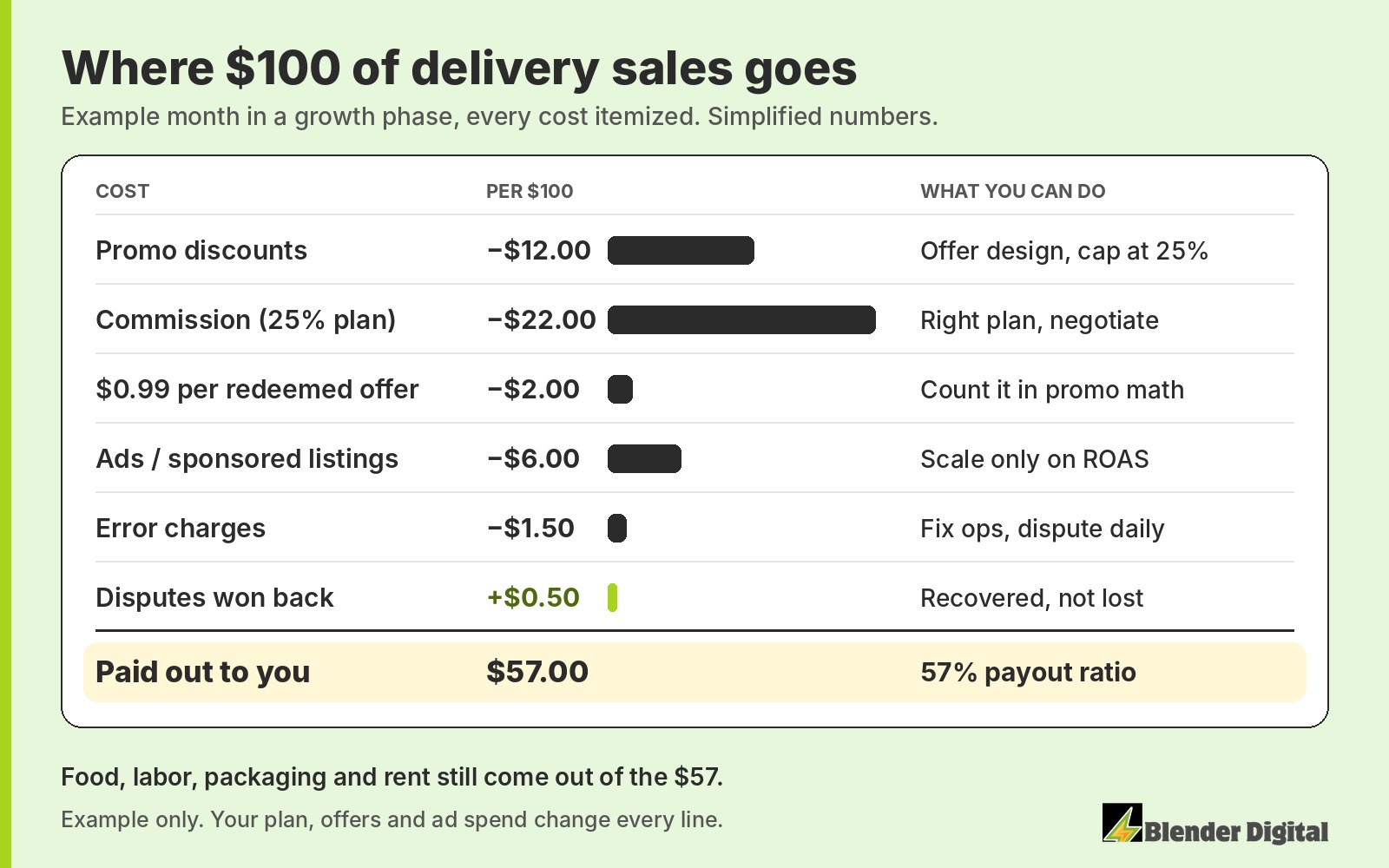
If you want the full walk-through of how to read that 57% and what a good number is for your stage, I wrote a separate post on how much delivery revenue you actually keep. This one is about the line items.
What fees does DoorDash charge restaurants besides commission?
Commission is a percentage of each order, and the plan you pick sets it. I cover the plans and how billing works in how much DoorDash and Uber Eats cost restaurants, so I'll keep that to one line here: on DoorDash it's 15%, 25% or 30% for delivery, and the commission is charged after the discount, not on the full price.
On top of the commission, these are the costs I see:
- $0.99 per redeemed offer. Both DoorDash and Uber Eats charge it every time a customer uses one of your promotions. DoorDash's own promotions page describes your cost per order as the customer discount plus a DoorDash marketing fee. It is a racket, but that's what happens when a duopoly basically exists. Twenty redemptions is about $20 a month that no promo dashboard puts front and center.
- The tablet. If you use DoorDash's tablet, it's $6 a week after the trial. Small, but it's there every week.
- Processing on your own storefront. On marketplace orders DoorDash says the commission covers card processing. Orders through DoorDash's commission-free online ordering carry a payment processing fee.
- Ads. Sponsored listings come out of your payout. More on that below.
- Error charges. The one I'd watch most closely. It gets its own section.
Do you have to run promotions on DoorDash and Uber Eats?
If you want to grow, yes. In practice I treat promos as a cost of selling on the apps, not an extra. The reason people convert in a marketplace is the incentive you put in front of them. When there's no campaign lifting your sales, nobody buys, because your food looks expensive next to the store with a BOGO tag on its card.
So the question is how much the promos cost and whether they're buying you customers or just discounting orders you'd have gotten anyway. Three things decide that:
- What a BOGO really costs. The platform shows you the revenue you gave up. It doesn't show the food cost of the free item. You're giving up revenue and eating the cost at the same time. That's why I only put BOGOs on items with a 75% or better food margin, and make the expensive part, like the protein, a paid add-on. Add-ons are never discounted. The BOGO profit calculator runs this per item, and this post has the full setup.
- Stacking. Promos stack on Uber Eats. They don't on DoorDash. On my cousin's coffee shop I let two offers land on the same customers and payout fell to 35 to 40 cents on the dollar. One audience, one campaign. Here's what a stacked Uber Eats order pays you.
- Who it's for. In steady state, the BOGO is for new customers only. An evergreen BOGO for everyone tells people your food is cheap, and you pay the discount plus the $0.99 on your regulars too.
Sometimes a big promo bill is the plan. In September 2026, a smash-burger ghost kitchen we manage in Houston ran a BOGO on 94% of its Uber Eats and DoorDash orders. It cost $25,496 that month, about $22 an order. The store beat its first-month sales goal by 81% at a 42.7% payout ratio, against a target we'd agreed of 40% or better. Expensive on purpose, for a set period, with a plan to pivot to profit.
How much do DoorDash and Uber Eats ads cost?
Whatever you let them. DoorDash sponsored listings charge per order, not per click, and you can bid as low as $3 an order manually. Uber Eats ads charge per click, with daily budgets starting around $3. Both come straight out of your payout.
The cost that hurts is the recommended budget. Reps and the portal will always tell you to multiply spend. "That's money in Uber Eats' pocket." I start low, raise spend in small steps only when the return is there (8 to 12x on Uber Eats, and anything over 3.5x on DoorDash is what DoorDash itself calls excellent), and refresh DoorDash listings that have gone stale. Run ads alongside an offer, not instead of one. I wrote about running ads and promos at the same time if you want the detail.
What are DoorDash error charges and can you dispute them?
An error charge is what the app takes back from you when a customer reports a missing, wrong or poor-quality item. DoorDash says it can charge 25% to 100% of the item price plus tax, taken from your payouts. Uber Eats does the same and, per its order errors page, keeps its full service fee on the order.
Yes, you can dispute them, and you should. The windows are short:
- DoorDash: Financials, then Transactions, filtered to "Error charge." The delivery has to be within the last 14 days to dispute it in the portal.
- Uber Eats: the Orders tab in Uber Eats Manager, filtered to "Issue charged." You have 30 days from the order date. If a line says "Uber refunded," the courier side paid, not you.
Each charge is small, which is exactly why nobody looks. That's how "only $10 a week" becomes $1,198 in a month across two stores. Miss the window and the money is gone.
What's worth disputing, from what we do every day:
- Anything that wasn't the kitchen's fault. Courier batching, cold food, items that were handed over. DoorDash says late deliveries and temperature issues generally shouldn't produce error charges at all, so if one shows up, dispute it.
- Claims that look off. A brand-new customer, no membership, "everything was missing." A member with a long order history who reports one missing drink is usually telling the truth.
- Anything over about $10 where you have evidence. A screenshot or a photo, not a long video. Point a camera at the pickup shelf and note the courier's pickup time.
Don't dispute everything. DoorDash says stores with a high volume of dispute attempts in a short time can be temporarily restricted from disputing. Pick the ones you can win.
One more DoorDash rule worth knowing: its error charge help article says using third parties to submit error charge disputes goes against its terms. So whoever helps you find and prepare disputes, the restaurant should be the one submitting them.
And it does add up. In September 2026 the Houston smash-burger kitchen had 17 error orders out of 1,230 across the apps (1.4%) with $281.14 charged. Five of those charges were disputed and all 5 were won, $95.32 back. Back in March 2026, an artisan bakery and café in Philadelphia won 5 of 6 disputes and recovered $75.40. Neither number will make headlines. Both are money that would have quietly stayed with the app.
The other half is fixing what causes the errors. Error rate feeds the algorithm. If your kitchen keeps making mistakes, DoorDash will show you less. Under 2% is normal. Fix vague item descriptions and push requests into modifiers, because notes get missed.
What other charges show up on Uber Eats and Grubhub statements?
These are the ones owners ask me about most:
- Uber One orders. On Uber's Plus plan, orders from Uber One members carry an extra 5%. They figured out a way to nickel-and-dime restaurant owners in every single way.
- The "variable marketing fee." Some Uber Eats orders show it. It's a black box. Read your statement under Payments, then Payouts, then Statements, and ask your rep what it is if the number is big.
- Driver cancels after pickup. If a courier picks up the food and then cancels, you should still be paid. If you weren't, ask for the credit.
- 24% held back on Uber. That's tax withholding when your W-9 is missing. It explained one owner's "Uber is scamming me." Get the W-9 on file.
- Grubhub. Grubhub's marketplace plans charge a marketing commission of 5%, 15% or 20%, delivery fees start at 10%, and the listed pricing doesn't include payment processing. On the Plus plan the 15% marketing fee applies to pickup orders too, against roughly 6% pickup on DoorDash. Also check that direct deposit is actually set up. One store we looked at had $996 sitting unpaid.
Can you just mark up your menu to cover the fees?
Partly. The trap is a blanket markup. To fully cover a 30% commission you'd need about a 43% markup, so a $10 item becomes $14.29. You would never mark something up by 43%. And the first thing people look at is price. Picture comes second, description comes third. Mark everything up 30% and you lose orders, which costs you more than the commission did.
I aim for 12 to 15% and set it item by item. The items people compare stay close to in-store, and drinks and add-ons carry more. Watch Toast too: a global percentage markup can stack on top of prices you already raised by hand, so you end up with a markup you never chose. The markup parity calculator shows what any price pays you, and this post has the math.
How do you cut each cost?
- Commission: be on the right plan (I usually recommend DoorDash Plus) and negotiate. Reps trade a lower rate for commitments like running campaigns and a set ad spend.
- Promos: one offer per audience, BOGOs on 75%+ margin items, protein as a paid add-on, new customers only once you're past launch.
- $0.99 fees: count them in your promo math. Fewer, better-targeted offers mean fewer fees on orders you'd have gotten anyway.
- Ads: start at the minimum, scale only on return, ignore recommended budgets.
- Errors: check them daily, dispute inside the window with evidence, and fix the descriptions and modifiers behind them.
- Markup: 12 to 15%, priced item by item on a separate online menu.
- Statements: read one full month per platform. Check the W-9, the Uber One line and Grubhub deposits.
Then watch one number. Payout ratio is net payout divided by gross sales, and it holds every line above. About 70 to 85% is the ceiling with no promos, about 50% is normal while you're growing, and 20 to 30% means you're giving the food away. If it moves, something underneath it moved.
FAQ
What are the hidden fees on DoorDash for restaurants?
Beyond commission: a $0.99 fee on every redeemed offer, the promo discounts themselves, sponsored listing spend, error charges taken from payouts, $6 a week if you use DoorDash's tablet, and a processing fee on DoorDash online ordering orders. Errors are the easiest to miss because each one is small.
How long do you have to dispute a DoorDash error charge?
DoorDash lets you dispute in the Merchant Portal when the delivery was within the last 14 days. After that you have to go through DoorDash Support. Uber Eats gives you 30 days from the order date, through the Orders tab in Uber Eats Manager.
Do DoorDash and Uber Eats charge commission on the discount?
No. Commission is charged after the discount, on what the customer actually paid for the food. You still give up the discount and pay the food cost of anything you gave away.
Does Uber Eats charge more for Uber One orders?
On the Plus plan, yes. Uber's pricing page lists an extra 5% on Uber One orders. On the Premium plan Uber One is included.
How much do restaurants really keep from DoorDash and Uber Eats?
About 70 to 85 cents per dollar with no promos or ads, and about 50 to 58 cents while you're running BOGOs and ads to grow. Food, labor and rent come out of that.
Every Blender plan includes daily error-charge review: we check each charge, confirm with your location manager, and prepare the disputes for you to submit. For the stores we manage, that recovers $200 to $1,200+ per location a month, depending on volume. It sits alongside the campaigns, ads and monthly reporting. How our dispute management works. If you want to know where your money went last month, send me one full month from each app and I'll walk you through it on a free 30-minute call. Get in touch here.