
In September, one restaurant we manage got paid 76 cents for every dollar it sold on the delivery apps. Another got paid 43 cents. Both hit the payout target we set for them.
That number is the payout ratio, and it's the first thing I look at on any account. I tell every owner the same thing on the first call: "The most important number when you're selling on third party is a singular number, which is payout ratio." Sales look nice on the dashboard. The payout is what actually lands in your bank account.
How much do restaurants keep from DoorDash and Uber Eats?
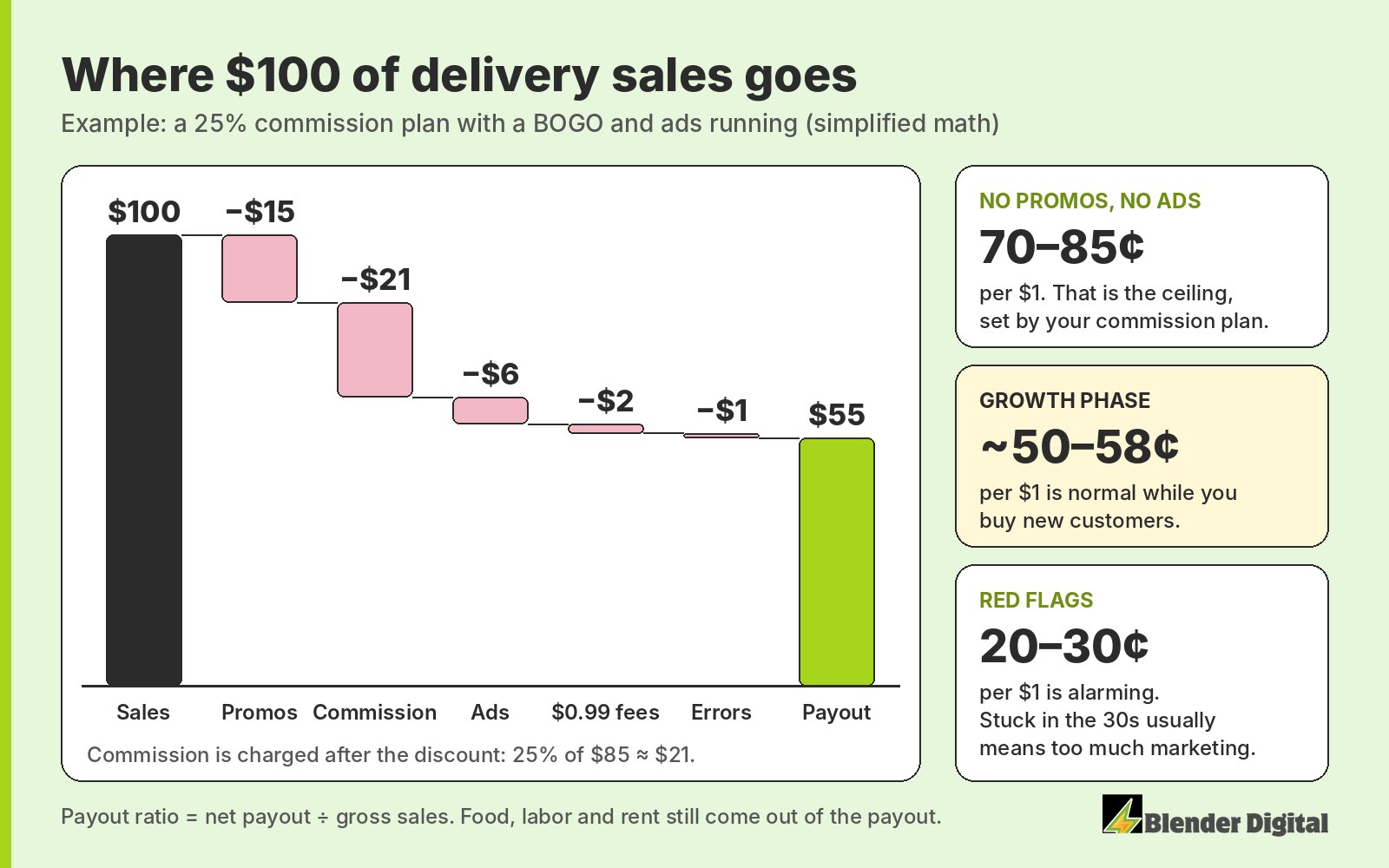
With no promotions and no ads, you keep about 70 to 85 cents of every dollar. That's the ceiling, and your commission plan sets it. In a growth phase, when you're running BOGOs and ads to win new customers, 50 to 58 cents is normal. If you're down at 20 to 30 cents, something is wrong.
So you can't do better than roughly 75 to 80 cents on the dollar on these apps, no matter how well you run them. Third party will always be your least profitable channel. I treat it as a customer acquisition channel. Your own online ordering is where the margin is.
What is payout ratio?
Payout ratio is your net payout divided by your gross sales. If you sold $10,000 on DoorDash last month and DoorDash paid you $5,200, your payout ratio is 52%. You got paid 52 cents on every dollar.
It's one number that holds everything: commission, promos, ads, offer fees, refunds and error charges. The payout ratio is the constant number. It doesn't matter what combination of items you sell. If it moves, something underneath it moved, and you go find out what.
Where does the money go before it reaches you?
Think of it as a waterfall. Starting from gross sales, this is what comes out:
- Commission. DoorDash plans are 15% (Basic), 25% (Plus) and 30% (Premier). On Uber Eats the top plan is around 30%, 25% is common, and I've seen 15% on negotiated deals. Some Uber plans also add 5% on Uber One orders, and Uber raised some of its rates in March 2026. Pickup is much cheaper on both, around 6%. Commission alone takes you down to that 70–85% ceiling.
- Promotions. The discount on a BOGO or a spend-and-save offer comes out of your payout. Commission is charged after the discount, not on the full price, which helps a little.
- $0.99 per redeemed offer. Both apps charge it. It's a racket, but that's what happens when a duopoly basically exists.
- Ads. Sponsored listings on DoorDash and ads on Uber Eats are taken out of your payouts.
- Errors and refunds. Missing items, wrong orders and anything else the app decides was your fault.
What's left is your payout. Food, labor and rent come out of that number, not out of gross sales. When owners ask me where the money went, this is usually the answer.
What's a good payout ratio on DoorDash and Uber Eats?
These are the bands I use with clients. Judge them on a full month, per platform.
| Payout ratio | What it usually means |
|---|---|
| 70–85% | No promos and no ads. The ceiling for your commission plan. |
| About 60% | Good, if you're still running campaigns. |
| About 50% | Respectable. Normal in a BOGO-heavy growth phase. |
| Stuck in the 30s | Too much marketing, often two offers hitting the same customers. |
| 20–30% | Alarming. You gave the food away for basically free. |
The right number depends on what phase you're in. Back to the two stores from September 2026. The one at 76.1% is a historic diner in San Francisco with several virtual brands. Its goal was measured growth while keeping payout at 70% or better, so we kept campaigns light. The one at 42.7% is a smash-burger ghost kitchen in Houston in its first month with us. It beat its sales goal by 81% ($57,375 against a $31,700 goal, across Uber Eats, DoorDash and Grubhub), and the payout target we agreed on was 40% or better. A low payout ratio, on purpose, for a set period.
I learned where the bottom is the hard way. On my cousin's coffee shop I let two offers target the same customers, and payout dropped to 35–40%. Now I never target one audience with two campaigns.
How do I calculate my payout ratio from DoorDash and Uber Eats reports?
- Pick a full calendar month. Not a week, and never a single order.
- DoorDash: in the Merchant Portal, the Monthly Recap shows your net payout directly. Note it next to that month's sales.
- Uber Eats: go to Payments, then Payouts, then Statements. It shows earnings against net.
- Divide payout by sales. Do it for each platform, then for all of them together.
A few traps I see often. Uber's payout week cuts off around 11 PM Sunday, so weekly totals won't line up with Toast. Use the month. On DoorDash, the last few days of a month are often still estimates and settle the following month. And if Uber is holding back 24% of your money, check that your W-9 is on file. That one explained an owner's "Uber is scamming me" complaint.
Also, don't judge it order by order. A single order can pay anywhere from 20% to 80%. Every client I've had has panicked over one at some point, and they all meet in the middle by the end of the month. That's actually why I built a small Chrome extension, Payout Ratio for Delivery Apps, so owners could see the blended number instead.
What does payout ratio look like while a store is growing?
Here's an artisan bakery and café in Philadelphia, Uber Eats and DoorDash combined, from our monthly reports. In January 2026, before campaigns, it did $2,814 in delivery sales at a 64.3% payout ratio. Campaigns started in February and the payout ratio dropped to 49.0%, while sales rose to $4,181. By April, sales were $9,234 at a 52.5% payout ratio. The actual payout that month was $4,847, up from $1,810 in January.
The percentage went down and the money went up. That's the trade you make in a growth phase.
Then you pivot. At an Arab coffee bar in New Jersey, after five months of growth, we moved the focus to profit in June 2026. The payout ratio went from 48.6% in May to 53.0% in June. Sales came down from the peak, which is expected when you pull back on promos. That was the plan from day one: growth first, then profit.
How do I raise my payout ratio?
- Check your plan. On DoorDash I usually recommend Plus over Premier. When owners push back on Premier, reps will often keep the perks and bring commission down from 30% to around 25 or 26%.
- Only BOGO items with a 75% margin or better. Put the BOGO on the base item and make the premium part (protein, an extra patty) a paid add-on, since add-ons are never discounted. You can run your items through the BOGO profit calculator or read how I set up BOGOs that protect margin.
- One offer per audience. No stacking. Keep spend-and-save offers at or under a 25% effective discount.
- Price for the apps. To fully cover a 30% commission you'd need about a 43% markup ($10 becomes $14.30). Nobody should do that. I aim for 12–15%. The markup parity calculator shows what your menu would need, and this post explains why a 30% markup doesn't cover a 30% commission.
- Dispute errors that aren't your fault, with a screenshot as evidence.
- Ignore the "recommended" ad budget. The apps will always tell you to spend more. Scale on results.
Is delivery worth it at a 50% payout ratio?
Compare payout per order with your in-store ticket. Payout per order is the platform's average order value times your payout ratio. At a Yemeni coffee house in Atlanta, April 2026 was the only month Uber Eats paid more per order ($13.02) than the average in-store ticket ($11.76). Most months it paid a bit less.
That doesn't mean the channel was losing money. It's a less profitable channel, so its job is bringing in customers who wouldn't have found you otherwise. For the rest of the numbers, here are the other delivery metrics I check every month.
FAQ
What percentage does DoorDash take from restaurants?
Commission is 15%, 25% or 30% depending on the plan (Basic, Plus or Premier), and around 6% on pickup orders. Promotions, $0.99 per redeemed offer, ads and error charges come on top, so most restaurants running campaigns keep well under the 70–85% that commission alone would leave.
What is a good payout ratio for a restaurant on DoorDash or Uber Eats?
70–85% is the ceiling with no promos. Around 60% is good while running campaigns, and about 50% is normal in a growth phase. 20–30% is alarming.
Why is my DoorDash payout so low?
Usually it's one of four things: two offers stacking on the same customers, BOGOs on low-margin items, ad spend, or error charges. Look at the full month, not single orders, and check each line in the Monthly Recap.
Is the Uber Eats payout ratio calculated differently?
No, it's the same formula: net payout divided by sales. The inputs differ. Uber's plans are priced differently, Uber often co-funds part of a campaign, and promos can stack on Uber, so the two apps rarely land on the same number.
If your payout ratio is stuck in the 30s and you can't tell why, bring your last full month from each app to a free call and I'll walk through where it's going. Get in touch here.