
SERVICES
DoorDash and Uber Eats campaign strategy that starts with the problem
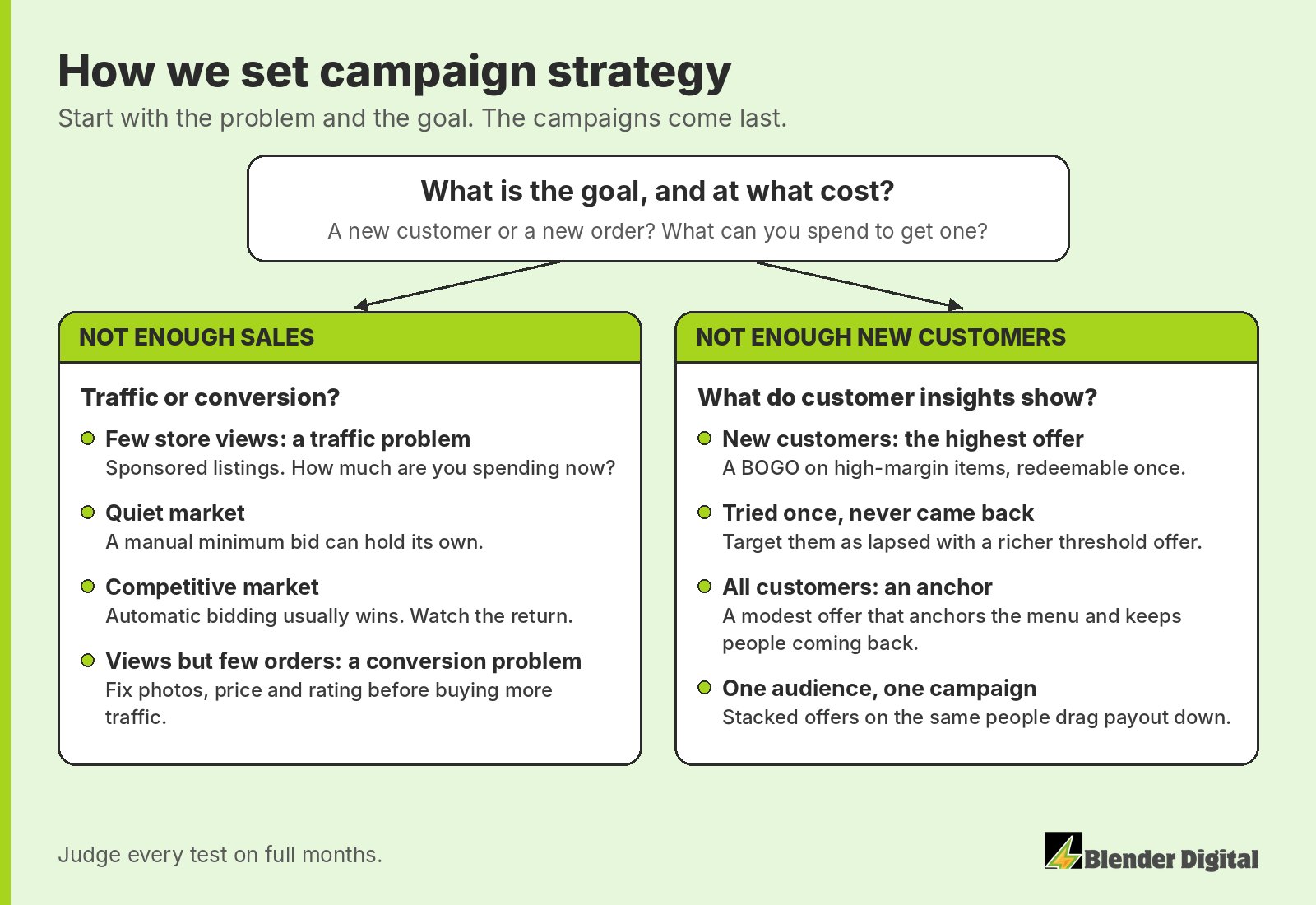
Before we set up a single promo, we work out what is actually holding your store back. Not enough sales and not enough new customers are different problems with different fixes. We set the goal (a new customer or a new order, and what you can pay for one), then choose the audiences, offers and ad bidding that fit your market.
For restaurants that have tried promos and ads on the delivery apps and can't tell what's working, and for new stores that want to start with a plan.
WHAT WE ASK FIRST
What questions decide a delivery campaign strategy?
Most stores we look at are running offers someone switched on months ago, for reasons nobody remembers. These questions come before any campaign.
- Is the issue sales, or new customers?A store with plenty of regulars and flat sales needs something different from a store nobody has tried yet.
- A new customer or a new order?Buying a new customer is worth more than buying one more order from someone who already orders. The goal sets how rich the offer can be.
- At what cost?What you can afford to pay for a new customer, and the payout ratio you need to stay at while you grow.
- What are you spending on sponsored listings?And what is it returning? Plenty of stores pay for ads that underspend, went stale months ago, or compete with a second listing a rep set up.
- Can your market support a minimum bid?In a quieter market a manual minimum bid can work well. In a crowded one, only automatic bidding keeps you visible.
- What do customer insights show?The mix of new, occasional and frequent customers. A mature store runs around 40/40/20. A new store is mostly first-timers.
- What can the menu afford?Item-level margins decide which items can carry a BOGO and which need a paid add-on or a new price first.
- What can the kitchen handle?An offer that triples orders on a Friday night only helps if the line can keep up without errors.
THE DIAGNOSIS
Is it a traffic problem or a conversion problem?
This is the first split. If not enough people see your store, you have a traffic problem. If they see it and don't order, you have a conversion problem. Buying ads for a store with a conversion problem just pays for more people to leave.
Traffic: people aren't seeing you
Store views are flat or falling month over month. The fixes are sponsored listings with the right bidding for your market, a live offer that shows on your store card, the right category tags, and a commission plan that doesn't hold back your visibility.
Conversion: they see you and don't buy
Views are there, but well under about 10% of them turn into orders. Customers read price first, the picture second and the description third. Photos on almost every item, clear prices, and a rating of 4.5 or better with a healthy review count come before more ad spend.
If sales dipped suddenly, we check the boring causes first: a campaign that ended, a review bomb, store hours, a menu sync that broke, weather and holidays. One or two bad days isn't something to solve for.
THE CUSTOMER LADDER
Which customers get which offer?
Each audience gets one offer with one job. Two campaigns aimed at the same people stack discounts and drag your payout down. I learned that the hard way on an early store, where stacked offers pushed payout into the 30s.
New customers: the highest offer
A BOGO on a handful of popular, high-margin items, or free delivery, redeemable once. A first-time customer has twenty other options in front of them. This is the loudest reason you can give them.
Tried once, never came back: lapsed offers
When customer insights show a lot of people ordered once and stopped, we target them as lapsed customers with a threshold offer a bit richer than the one regulars see.
All customers: an offer that anchors the menu
A spend-and-save offer set a little above your average order, or a loyalty reward. It reads as a thank-you, nudges the ticket up and keeps people coming back without marking the menu down.
High spenders: a big threshold
A larger reward behind a high minimum, like $20 off $80. The customer who spends more gets the smaller effective discount.
More detail in New, lapsed or loyal: which delivery customers should get a promo?
On a BOGO you give up the revenue on the free item and you still pay for the food in it. The platform's marketing report shows the first part. It doesn't show the second.
My rule of thumb: items with a 75% margin or better are good BOGO candidates. Here's why, with a simple example at a 50% payout ratio.
- Nachos at $13.20, $2.20 food cost. Payout on the order is $6.60. Two portions cost $4.40. You keep $2.20 and gain a customer.
- Chicken bowl at $15.40, $5.30 food cost. Payout is $7.70. Two portions cost $10.60. You lose $2.90 on every redemption before labor.
When an item fails the math, there are four levers: lower the cost, raise the delivery price, swap the item, or sell the expensive part as a paid add-on. Add-ons are never discounted, so a $12 base bowl with a $4 protein add-on keeps the margin where it belongs.
Example figures for illustration. Your payout ratio and costs will differ.
DIAGNOSIS IN PRACTICE
Three problems, three different fixes
Recent engagements, anonymized, with their time windows and platforms.
STRATEGY OVER TIME
How does the strategy change during the program?
The plan isn't set once. It follows the same arc in almost every engagement.
Baseline and goals
Current sales on each app, a monthly target ramp, and how aggressive you want to be: growth at any cost, balanced, or conservative.
Grow
Early months accept a lower payout to win new customers. Offers that work get more items. Offers that don't get cut.
Pivot to profit
Once the goals are hit, the target moves from growth to payout. Fewer BOGO items, offers aimed at new customers only, and better prices.
See how a full program runs on the services overview and on how we work.
WHAT WE TRACK
Which numbers tell us the strategy is right?
Customer mix
New, occasional and frequent customers, month over month. It shows whether you're growing the base or just discounting regulars.
Cost per new customer
Discount plus ad spend for each first-time customer, set against what that customer is worth over time.
Payout ratio
The number that tells you whether growth is costing too much. It should rise once the program pivots to profit.
Store views and conversion
Traffic versus conversion in one view. Around 10 to 11% of views ordering is healthy for a burger store.
Return per offer
Sales per dollar of discount for each audience, so the ladder gets better every month.
Average order value
Whether threshold offers and add-ons are pushing the ticket up or pulling it down.
ONE PLAN
Strategy, management and the rest of the channel together
A strategy is only as good as the follow-through. In a Blender Digital program the same team that sets the plan runs the campaigns, answers the reviews, reviews error charges and builds the report, so nothing falls between vendors.
Strategy on its own
- A one-off plan or audit
- You or your staff carry it out
- Nobody checks it against next month's numbers
One Blender Digital plan
- Strategy revisited every month with real results
- Campaigns, reviews, error charges and reporting handled
- Disputes prepared for you to submit
- Measured on sales growth and payout
FAQ
Campaign strategy questions
What is the difference between campaign strategy and campaign management?
Strategy decides what to run and why: the goal, the audiences, the offers and how ads should bid. Campaign management is running it week to week, checking it and reporting on it. In a Blender Digital program you get both, and the strategy is revisited every month with new data.
Should a BOGO go to new customers or everyone?
Mostly new customers. That's where the richest offer belongs, because you're paying to win someone once. For everyone else we keep it to a small number of items, or use a spend-and-save offer that pushes the ticket up. An all-customer BOGO that never ends teaches people your food is cheap.
Manual or automatic bidding for sponsored listings?
It depends on the market. In quieter markets a manual minimum bid can return well. In crowded markets automatic bidding usually wins, because a low manual bid can lose most of your impressions. We test, watch the return, and switch if the data says so.
How do you know if a BOGO will lose money?
We run the item math before launch. At a 50% payout, the payout on the order has to cover two portions of food, so items with roughly a 75% margin or better are the safe candidates. Expensive, low-margin items usually lose money on a BOGO even when sales go up. You can run your own items through our BOGO profit calculator.
Can you tell me what's wrong before I sign up?
That's what the free 30-minute discovery call is for. We look at your current setup on DoorDash, Uber Eats and Grubhub, tell you whether it looks like a traffic, conversion or new-customer problem, and what we would try first.
Not sure which problem you have?
Book a free 30-minute call. We'll look at your store on DoorDash, Uber Eats and Grubhub and tell you whether it's traffic, conversion or new customers, and what we'd try first.