
In September, the lapsed-customer offers at a historic diner in San Francisco that we manage brought back 38 orders. Those orders came to $1,962 in sales on $325 of offer cost, about $6 in sales for every $1 (September 2026, the offers' first month, Uber Eats and DoorDash).
That offer was small on purpose. A lapsed customer already knows your food. They need a nudge back, not a giveaway. A first-time customer needs a much bigger reason to try you. If you give both of them the same promo, you either overpay the regular or under-sell the stranger. This is how I split delivery promos by customer type on DoorDash and Uber Eats.
Should new, loyal and lapsed customers get different delivery promos?
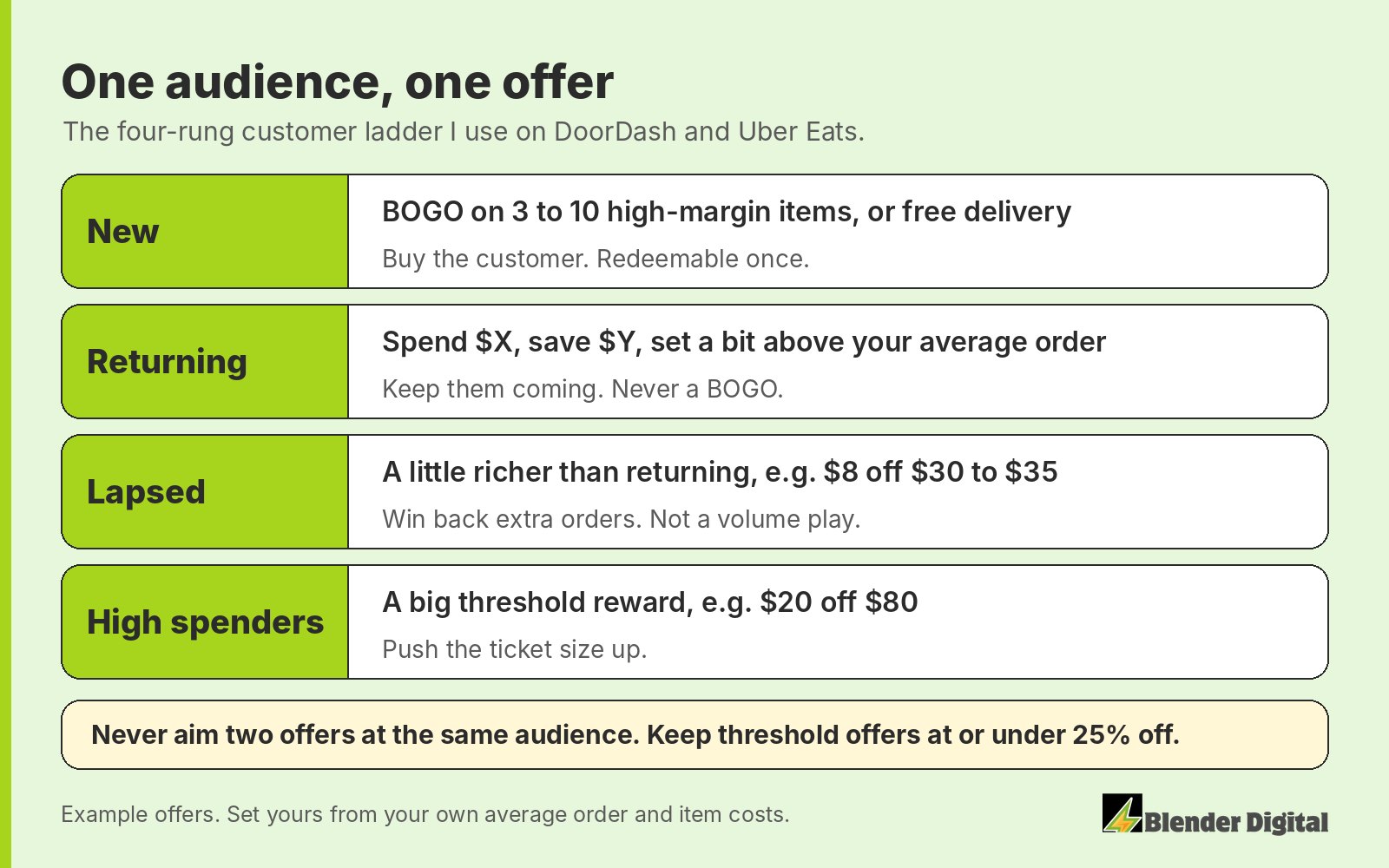
Yes. Every customer group gets one offer built for it, and no group gets two. New customers get the big incentive. Regulars get a small reward that pushes the order size up. Lapsed customers get something a little richer than regulars to come back. Both apps let you pick the audience when you build a campaign, so there's no reason to run one offer for everybody.
I think of it as a ladder:
What promo should new customers get?
The aggressive one. A BOGO on 3 to 10 items, or free delivery, set to new customers only so it can be redeemed once. This is where I spend the most, because it's not about buying the additional order. It's about buying the new customer. A new customer can only be a new customer to your store once.
The catch is margin. My rule of thumb is that an item needs a 75% margin or better to carry a BOGO. A $12 item with $3 of food and packaging is right at 75%. A $15 bowl with $5 of food is not, and you'll lose money on every one you give away. Run your items through the BOGO profit calculator before you pick them.
At a fast-casual franchise in New Jersey, the first-order BOGO on Uber Eats brought in 189 new customers in September 2026, with $8,858 in sales on $3,465 of offer cost. That's what this rung is for. Some of those people only came for the deal, and that's fine. We open the gate, and the people who are driven by promotions filter themselves out. After a new-customer BOGO I usually see about 15% reorder within 30 days.
More on picking BOGO items in how to run BOGO promos without losing margin.
Should you give loyal customers a promo?
A small one, and never a BOGO. Regulars already know the food is good. They need a reason to come back a little sooner, so for them the offer reads as a reward, not a markdown.
My default for returning customers is spend-and-save, set a bit above your average order. If your average order is $41, try spend $45, save $9. People add a drink or a side to hit the number, and the ticket goes up.
I also prefer a flat dollar amount over a percentage here. $8 off is 27% of a $30 order but only 17% of a $48 one. The discount stays flat while the order size grows, so the customer who spends more gets the smaller effective discount. Keep threshold offers at or under about 25% effective. The orders that land between your thresholds are where you make your money.
A few other tools for this group:
- DoorDash loyalty. It only costs you when someone redeems. I set it at spend $120, earn $10 so people aim for the higher number. Uber Eats doesn't have a loyalty program. Grubhub has one built in.
- Review replies with an offer. $2 to $3 for a regular, $5 for a new customer. On Uber Eats the reply acts as a de facto push notification.
- Cheap throw-ins only. If you do give regulars something free, make it a roughly 90% margin item like fries or naan.
- Big spenders get a big threshold. Something like $20 off $80, aimed at the people who already order large.
What I avoid is an evergreen BOGO for everyone. Keep 2 or 3 items on BOGO for all customers at most. Run more than that forever and you're telling people your food is cheap.
What counts as a lapsed customer on DoorDash vs Uber Eats?
They don't use the same definition. On DoorDash, lapsed means no order in 6 months, which I find a clearer segment. On Uber Eats it's shorter, around 45 to 60 days. So a "lapsed" offer reaches different people on each app.
For either one, make the offer slightly richer than your returning-customer offer, something like $8 off $30 to $35. Someone who has drifted away needs the lowest possible friction to come back. Treat it as extra orders, never the volume play. At a taco shop on Long Island, lapsed offers brought $380 from 9 orders on $77 of offer cost in their first 21 days (September 10 to 30, 2026, Uber Eats and DoorDash). Small, but profitable.
One thing I don't do: point sponsored listings at lapsed customers. They already know who you are, so an offer does more than paying for them to see your store again. For how I size ad budgets in general, see how much to spend on DoorDash and Uber Eats ads.
Can you run two promos for the same customer group?
You can, but I don't. I learned this the hard way on my cousin's coffee shop. We had offers overlapping on the same customers, and the payout ratio dropped into the 35 to 40% range. That means 35 to 40 cents of every sales dollar actually reached the bank.
The apps handle overlap differently:
- Uber Eats lets promos stack on one order. Two offers aimed at the same customer can both hit the same basket. I wrote about that in why Uber Eats promotions eat your margin.
- DoorDash doesn't stack promos. When I want two new-customer offers there, like an item BOGO and an order-level discount, I run them in parallel and label one "alternate."
- DoorDash smart campaigns are personalized and pretty opaque. I don't layer smart targeting on top of other promos. It's just an overlap, and it doesn't tell the algorithm who the offer is for.
The same goes for ads. If an offer and an ad both target the same group, check that you aren't paying twice for one order. I cover that in running ads and promos at the same time.
How do you know your segments are working?
Three numbers, read on full months:
- Customer mix. A mature store usually runs around 40% new, 40% occasional and 20% frequent. A new store will be 85 to 90% new, and that's normal.
- 30-day reorder rate. DoorDash's newer campaign view shows it. Around 15% after a new-customer BOGO is what I usually see.
- Payout ratio. Net payout divided by gross sales. Around 50% is normal in a BOGO-heavy growth phase and 60% is good. Stuck in the 30s means too much marketing, and overlapping offers are the first place I look.
If you want help reading these, my guide to what your delivery metrics mean walks through each one.
Quick answers
Should loyal customers get a BOGO on DoorDash or Uber Eats?
No. Give regulars a spend-and-save set a bit above your average order, or a loyalty reward. Save the BOGO for new customers, where it buys a customer and not just an order.
How long until a customer counts as lapsed?
On DoorDash, no order in 6 months. On Uber Eats, around 45 to 60 days. The same word reaches different people on each app.
Is dollars off or percent off better for returning customers?
Dollars off. $8 off is 27% of a $30 order and 17% of a $48 one, so bigger orders get a smaller effective discount. Keep threshold offers at or under about 25%.
Can I target two offers at new customers?
Not on the same customer. On DoorDash promos don't stack, so I run a second new-customer offer in parallel as an alternate. On Uber Eats promos can stack on one order, so keep each audience to one offer.
If your offers overlap and you can't tell which group is getting what, that's one of the first things we sort out for the restaurants we manage. Reach out and I'll take a look at your setup.