
The first time I saw promo stacking hurt a store, it was my cousin's coffee shop. We had a few offers running on Uber Eats. Each one made sense on its own. Two of them were landing on the same customers, and payout dropped to 35 to 40 cents on the dollar.
I learned that one the hard way. Now it's one of the first things I check on any Uber Eats account: is anyone getting two offers on one order?
Can you stack promos on Uber Eats?
Yes. Promos stack on Uber Eats. If a customer qualifies for more than one of your store offers, both can land on the same order. On top of that, Uber's own help page on promo codes says store promos are applied first, "with the highest value account promo added next."
So from the customer's side, the answer to "can you stack Uber Eats promos" is mostly yes. They can only use one promo code per order, but that code goes on top of whatever your store is already offering.
DoorDash works differently. Promos don't stack there. On DoorDash I'll run a new-customer BOGO and an order-level offer side by side, labeled as alternates, because a customer only gets one. Copy that same setup onto Uber Eats and the two offers can pile onto one ticket.
What does a stacked promo cost you?
Two things to know about how Uber charges you. Commission is taken after the discount, so it shrinks a little. But Uber also charges $0.99 for every offer that gets redeemed. Two offers on one order means two fees. I've told more than one owner: it is a racket, but that's what happens when a duopoly basically exists.
Here's a simple example with a $30 order and a 30% commission:
- One offer ($6 off): commission is 30% of $24, so $7.20. Take off one $0.99 fee and you keep $15.81. That's about 53 cents on the dollar.
- Two offers ($6 off plus $5 off): commission is 30% of $19, so $5.70. Take off two fees ($1.98) and you keep $11.32. That's about 38 cents on the dollar.
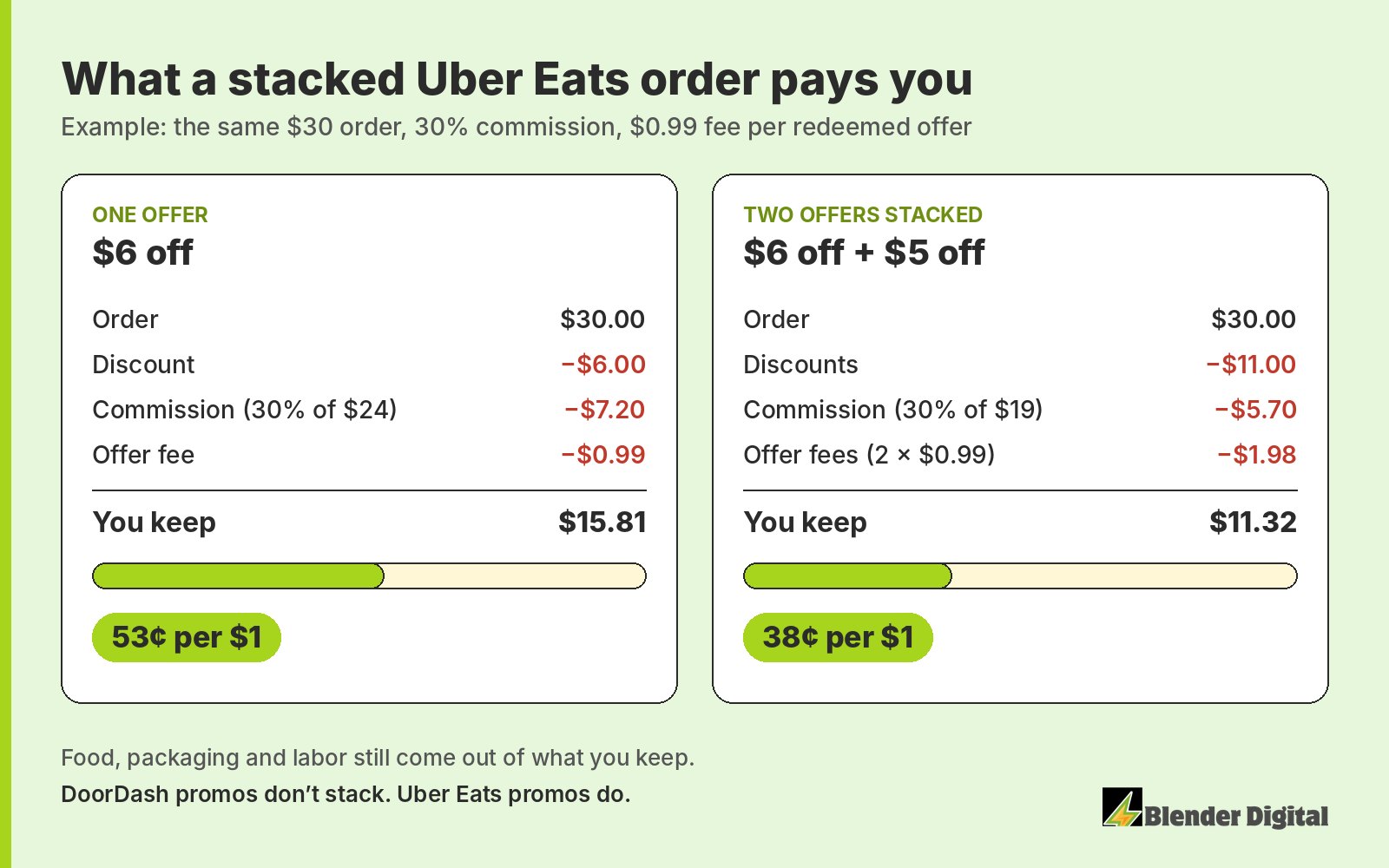
And that's before food, packaging and labor. Those come out of your payout, not your sales.
For reference: with no promos at all, you can't do better than about 70 to 85 cents on the dollar. Around 50 cents is normal when you're pushing growth with BOGOs. If your payout ratio is stuck in the 30s, there's too much marketing on the account, and overlapping offers are usually part of it. If you want to see where your own dollar goes, I broke down the full payout in how much of your delivery revenue you actually keep.
What discounts can merchants run on Uber Eats?
Uber Eats gives merchants a handful of offer types. Here's each one and how I actually use it:
- BOGO. My main offer for new customers. A customer can redeem it up to 3 times per item per order, so they always pay at least half. There's no "buy one get one 50% off" and no buy-2-get-1. Add-ons and modifiers are never discounted, and items built as modifiers in your POS can't go on a BOGO. I only put it on items with a 75% or better margin. You can check yours with the BOGO profit calculator.
- Spend $X, save $Y. For returning customers. Set the threshold a bit above your average order. If your average order is $41, spend $45 save $9 nudges people to add something. I keep these at or under a 25% effective discount.
- Percent off. I mostly stay away from it on Uber. A flat dollar amount stays flat while the order size doesn't, so the customer who spends more gets the smaller effective discount. With percent off, the discount grows with the order, and it can land on top of your other offers.
- Free delivery. New customers only. Uber caps it at $6.99 per order. I like to keep it in my back pocket as something to turn on if sales dip.
- Lapsed-customer offers. On Uber, lapsed means roughly 45 to 60 days without an order. Make it a little richer than your returning offer, something like $8 off $30 to $35. This is for incremental orders, never the volume play.
One more Uber quirk: to get featured in Member Days or national promos, an offer has to save the customer 30% or more. That's why a rep might ask you to turn $8 off $30 into $9 off $30.
How do you keep Uber Eats promos from stacking?
Uber won't stop the overlap for you, so you do it with targeting. My rule of thumb is one audience, one offer.
- New customers get the BOGO (or free delivery).
- Returning customers get spend-and-save, set above your average order.
- Lapsed customers get a slightly richer flat offer.
- High spenders get a big threshold reward, like $20 off $80.
If two campaigns are aimed at the same group, end one. Orders that fall between your thresholds are where you'll make all the money. I go deeper on this in how to use customer segmentation to protect your delivery margin.
Here's what one offer aimed at one group can do. At a fast-casual franchise in New Jersey, a first-order BOGO on Uber Eats brought in 189 new customers in September 2026, with $8,858 in sales on $3,465 of offer cost (Uber Eats only).
Two more habits that save money:
- Check every campaign once it's live, especially ones a rep built. I once had an Uber rep set up "$14 off $15" when we asked for "$14 off $55." The owner saw $700 in discounts after a sales spike. I escalated it and Uber refunded it. Live Uber campaigns can't be edited, only ended, so if something's wrong you end it and rebuild it.
- Judge the month, not the order. Single orders will pay out anywhere from 20 to 80 cents on the dollar. They all meet in the middle. Look at your payout ratio for the full month before you change anything.
What's the difference between Uber Eats promotions and paid ads?
A promotion is a discount on the order. You pay for it only when someone redeems it, plus the $0.99 fee. It helps people who already see your store decide to order.
Paid ads buy placement, so more people see you in the first place. On Uber Eats you bid per click, starting around $3 a day, and Uber reports the return as sales for every $1 you spend. My rule, which came from Uber's own reps: scale up when the return is 8 to 12x or higher, and hold the budget when it's under 8x.
Both come out of your payout. Most stores need some of each, and the tricky part is running them together. I wrote that up separately in should you run delivery ads and promos at the same time.
Quick answers
Can customers use a promo code on top of a store offer on Uber Eats?
Yes. Uber says store promos are applied first, with the highest value account promo added next. Only one promo code can be used per order.
Do promos stack on DoorDash?
No. DoorDash doesn't stack promos the way Uber Eats does, so you can run a new-customer BOGO and an order-level offer side by side as alternates.
Does Uber Eats charge commission on the discounted price?
Yes. Commission is charged after the discount. Uber also charges $0.99 for each redeemed offer, so two offers on one order means two fees.
Will Uber Eats pay for part of my promotion?
Sometimes. Uber co-funds some campaigns, usually 10 to 25% depending on the rep, and most often when the account manager sets the campaign up. Check every rep-built campaign once it's live.
If your Uber Eats payout is sitting in the 30s and you can't tell which offer is doing it, that's exactly what I look at on a free discovery call. Send me a note and I'll take a look at your setup.