
In September, a smash-burger ghost kitchen I manage in Houston ran a BOGO on 94% of its Uber Eats and DoorDash orders (1,157 of 1,227). It beat its first-month sales goal by 81%, with $57,375 against a $31,700 goal across all three apps. The BOGO also cost $25,496 that month. That's about $22 per order.
That was the plan. Month one was about growth, the payout target was 40% and the store hit 42.7%. Now it's moving from growth to profit, and the way we get there is the menu under the BOGO: paid add-ons, so the free item stops costing so much.
Anybody can set up a bunch of campaigns that give away buy one get one free. That doesn't mean they can profitably sell on these platforms.
Is a BOGO on DoorDash or Uber Eats profitable?
It can be. A BOGO pays when the item has a food margin of 75% or more and the expensive part of the dish is a paid add-on. If neither is true, you're giving up revenue and eating the cost of the free item at the same time.
That second part is easy to miss. The platform's marketing line shows you the revenue you gave up. It doesn't show you the food cost of the item you handed out for free.
A few rules apply on both apps:
- A customer can redeem up to 3 per item per order, so they always pay for at least half. There's no "buy one get one 50% off."
- Commission is charged after the discount, not on the full menu price.
- You pay $0.99 for every redeemed offer. It is a racket, but that's what happens when a duopoly basically exists.
- Add-ons and modifiers are never discounted. Keep this one in mind, because it's where the money is.
Which items pass the 75% margin rule?
My rule of thumb: anything with a 75% or higher margin is a good BOGO candidate. That builds in a payout floor of roughly 50%, minus your cost. Some examples from menus I've worked on:
| Item | Price | Food cost | Margin | BOGO? |
|---|---|---|---|---|
| Nachos | $13.20 | $2.20 | 83% | Yes |
| Guac & chips | $10.45 | $1.10 | 89% | Yes |
| Chicken bowl | $15.40 | $5.30 | 66% | No |
| Chips & salsa | Packaging adds to the cost | About 66% | No | |
A BOGO on guac and chips does gangbusters. Put that chicken bowl on a BOGO and you're going to lose your money right out the door. Bowls with the protein baked in are where most restaurants get burned. They're also where the best fix is.
How do chains make a BOGO work on a $12 bowl?
Base plus a paid add-on. You put the BOGO on the base item and make the premium part, the protein or the extra patty, a paid add-on. Add-ons are never discounted, so the customer pays full price for the protein on both bowls.
When I explain it to owners I say: $12 bowl, you click on it, at a minimum you have to add a $4 add-on. Everybody who's figured it out is doing it the same way. That's how you make money in this business.
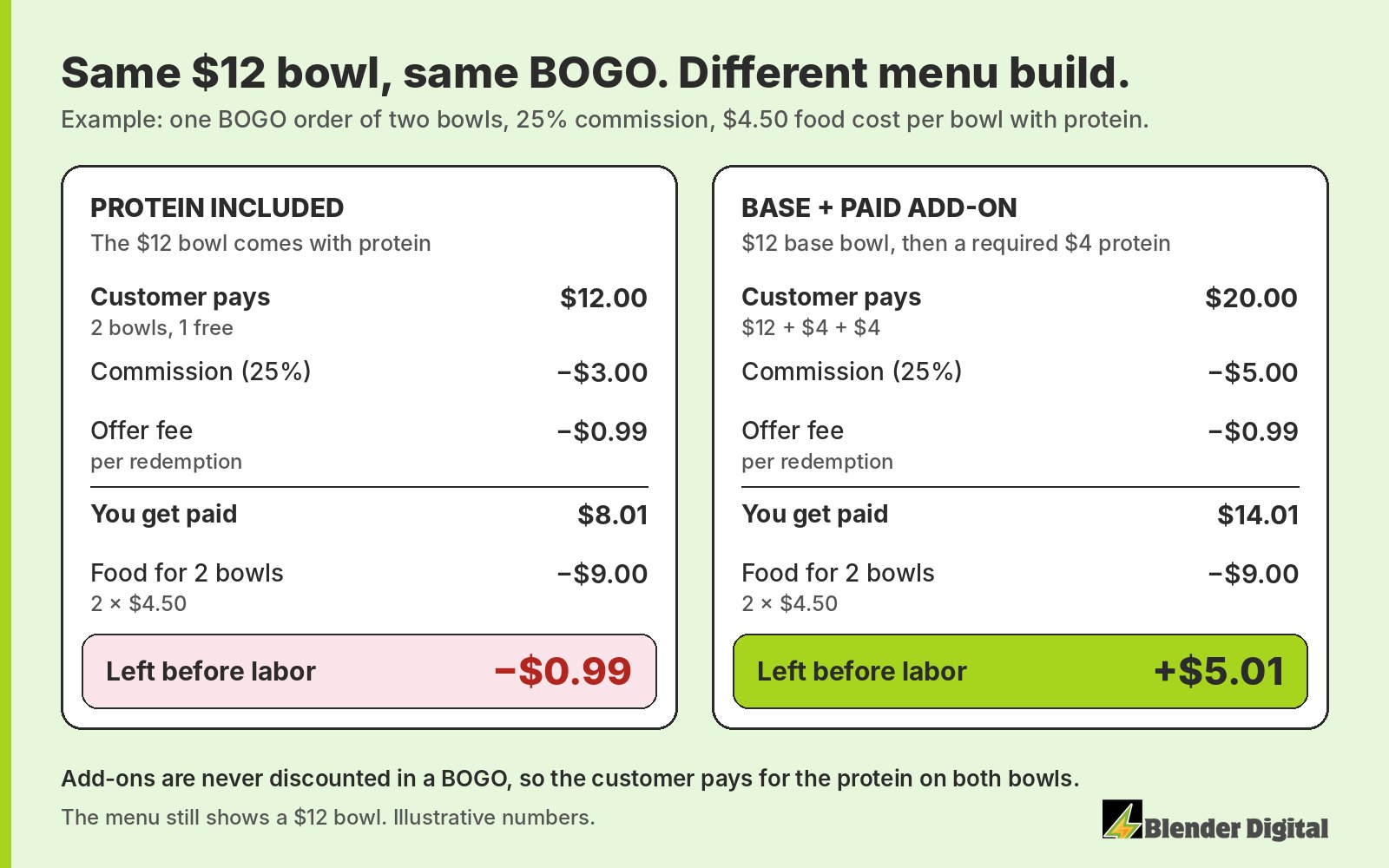
Here's the math with simple numbers. Say a bowl with protein costs you $4.50 in food, and you're on a 25% commission plan, which is DoorDash Plus, the plan I put most stores on.
With the protein included in a $12 bowl, a BOGO order of two bowls brings in $12. Take off $3.00 in commission and the $0.99 offer fee and you get paid $8.01. The food for two bowls is $9.00. You're down 99 cents before anyone gets paid to cook it.
Now make the bowl a $12 base with a required $4 protein. The same order brings in $20: $12 for the bowls plus $4 of protein on each. After $5.00 in commission and the $0.99 fee you get paid $14.01, and you keep $5.01 after food. With a $5 protein the customer pays $22. Either way, the menu still shows a $12 bowl, so you still look competitive in the app.
Before launching, I also like raising the base price by about $1. A BOGO gives you cover for it, because people won't bat an eye when they're getting two for one.
How do you make the add-on required?
Use a required modifier. The customer can't add the item to the cart without making a choice, and you list the paid option first. On loaded fries for a burger client, the required choice is the protein: none, 1 patty or 2 patties, with the paid options at the top. Some burger competitors do the same thing with a required "meal style" choice.
Same idea on burgers: BOGO the single, not the double. Customers add patties at full price, you get rid of the "two doubles for $14.95" comparison, and as that client pointed out, it takes pressure off the grill.
Two things to watch. On Uber Eats, items built as modifiers in your POS can't be put on a BOGO, so the base has to be a real menu item. And if you're on Toast, editing items changes their IDs and can silently break item-level campaigns. Recreate your campaigns right after you publish menu changes.
Can you run a BOGO on an item without a photo?
Not on DoorDash. Items without a photo are ineligible for a BOGO there. Uber Eats doesn't have that rule. Check every item on your BOGO list has a photo before you plan the campaign, and while you're at it, aim for photos on 90 to 95% of the menu. Our free image resizer exports the sizes each app wants. Don't use AI food photos. The platforms ban them and detect them.
Which items should get the BOGO, and who should see it?
Pick items that are popular, high margin, and easy and fast to make. In the first month, keep BOGO items under about $15. Multi-unit items are ideal. Nobody has ever walked into a Mexican restaurant and ordered one taco.
Don't put a BOGO on cheap sides by themselves. Fries are a great free item, but a BOGO on fries alone barely moves anything. On drinks, go for the cheap ones. At an artisan bakery and café in Philadelphia we moved the BOGO from lattes to refreshers for margin.
Then decide who sees it. My steady state is a BOGO for new customers only, with at most 2 or 3 items on BOGO for everyone. It's not about buying the additional order. It's about buying the new customer. An always-on BOGO for everyone tells people your food is cheap. I also keep it off during busy lunch and dinner peaks, when people order anyway, and lean on it on slow days.
At a fast-casual franchise in New Jersey, a first-order BOGO on Uber Eats brought in 189 new customers in September 2026, with $8,858 in sales on $3,465 of offer cost.
Promos don't stack on DoorDash, but they do on Uber Eats, so check what else is running before you add a BOGO on Uber. More on that in why your Uber Eats promotions are hurting your margins.
What if my BOGO is already losing money?
Run each BOGO item through this: payout per BOGO = (price × payout ratio) minus (2 × food cost). If it comes out negative, you have four levers:
- Lower the cost of the item.
- Raise the price on the delivery menu.
- Take the item off the BOGO.
- Raise your payout ratio, which is the hardest one.
Price and cost are much easier to control than payout. For reference, about 50% payout is normal in a BOGO-heavy growth phase, 60% is good, and 20 to 30% means you gave the food away for basically free. If you'd rather not do it by hand, our BOGO profit calculator does the math per item.
Want me to check your BOGO math?
Pulling item costs and building the BOGO item table is part of the first two weeks of every engagement we run. If you want a second set of eyes on yours, reach out here and send me your menu.
Common questions
Do DoorDash or Uber Eats pay for part of a BOGO?
Uber Eats often co-funds campaigns by 10 to 25% depending on the rep, especially when your account manager sets them up. DoorDash rarely co-funds. Assume you're paying for the whole discount unless a rep confirms otherwise, and check the campaign once it's live.
Can customers abuse a BOGO?
There's a cap of 3 redemptions per item per order, so nobody gets more than half off. You can expect one or two customers who only ever order the deal, and at the end of the day your payout ratio still lands around 50% in a growth phase.
Can I run buy one get one 50% off on DoorDash or Uber Eats?
No. Both apps only offer a straight buy one get one free, and Uber Eats has no buy-two-get-one either.
Are add-ons discounted in a BOGO?
No. Add-ons and modifiers are always charged at full price, which is why putting the BOGO on a base item with a paid add-on protects your margin.