
In September, at a taco shop on Long Island that we manage, ads were the cheapest way we won an order. Uber Eats ads cost $4.84 per order. The DoorDash sponsored listing cost $6.64 per order. The BOGOs cost $10.59 to $15.55 per order. Same store, same month, all running at the same time.
So when payout drops and an owner wants to shut the ads off, I usually look at the offers first. Here's how I think about running ads and promos together on DoorDash and Uber Eats.
Should you run ads and promos at the same time?
In most cases, yes. Ads work best when there's an offer running alongside them. Your store card in the app shows your best live campaign, so a BOGO tag on that card is a big part of what gets someone to tap the ad. On DoorDash especially, ad spend is way better used when you have campaigns running.
At that same taco shop, we started new-customer BOGOs on September 10. That month the Uber Eats ad return went from 5.92x to 8.92x, and the DoorDash sponsored listing went from $4.29 to $5.63 in sales per $1 (August vs September 2026). I won't claim the BOGOs did all of that. It's the pattern I keep seeing, though.
Where running both goes wrong is overlap:
- Two offers aimed at the same customer. On Uber Eats your offers can stack on one order. I covered that in can you stack promos on Uber Eats.
- Two ad campaigns on one store. You're paying twice to reach the same people and competing against yourself. When I see two sponsored listings on a store, a rep usually pushed it.
- Ads aimed at lapsed customers. A lapsed customer already knows you. Send them an offer instead.
- Scaling because the platform said so. Don't go by the recommended budget. They'll always tell you to multiply spend.
What's the difference between promotions and paid ads on Uber Eats and DoorDash?
A promotion lowers the price the customer pays. A paid ad (Uber calls them ads, DoorDash calls them sponsored listings) gets you a better spot so more people see your store. Promos help with conversion. Ads help with traffic. Here's how each one charges you:
- Promotions, both apps: you pay the discount when someone redeems it, plus $0.99 per redeemed offer. Commission is charged on the price after the discount.
- Uber Eats ads: you bid per click. The minimum is around $3 a day. Uber shows impressions, click-through rate, cost per click and return on ad spend (sales for every $1).
- DoorDash sponsored listings: you pay per order. The manual minimum bid is $3 per order (DoorDash will suggest $5), and auto-bidding usually lands around $5 to $6.
All of it comes out of your payout. That's why the number I watch is payout ratio: net payout divided by gross sales.
Where does the money go when both are running?
A smash-burger ghost kitchen we run in the Houston area is a good example of a store in full growth mode. In September 2026, its first month with us, the BOGO ran on 94% of Uber Eats and DoorDash orders. It cost $25,496, which was 44.5% of app sales, or about $22 per order. Ads were far cheaper per order: $1.57 on Uber Eats and $6.20 on the DoorDash sponsored listing.
The payout ratio for the month was 42.7%, above the 40% target we set for month one. That was the plan. Month one was about buying customers. Now we're pivoting from growth to profit, and the first lever is the offer: putting the BOGO on base items and making the extras paid add-ons, since add-ons are never discounted.
For reference, here's how I read payout ratio:
- 70 to 85%: the ceiling with no promos at all.
- Around 50%: normal in a BOGO-heavy growth phase. 60% is good.
- Stuck in the 30s: too much marketing. Look at the offers before you touch the ads.
How do you know if ads on top of promos are paying off?
First, read the ad return on each app's own scale. They don't calculate it the same way.
- Uber Eats: 8 to 10x is healthy. At 8 to 12x or higher, scale up. Under 8x, hold. Around 6x, stop adding money.
- DoorDash: DoorDash calls anything over 3.5x excellent and under 2.5x fair. 7x on DoorDash is very high.
Second, don't add your ad sales and your promo sales together. Uber counts any order from a customer who saw an ad, so its ad sales overlap with your BOGO sales. At the Houston kitchen, Uber reported a 32.26x return on ads in September, and the BOGO was on 94% of orders. A lot of those are the same orders, counted in two reports.
Third, let payout ratio settle it, month over month. If your payout grows faster than your sales, that's a good sign the extra sales are profitable ones.
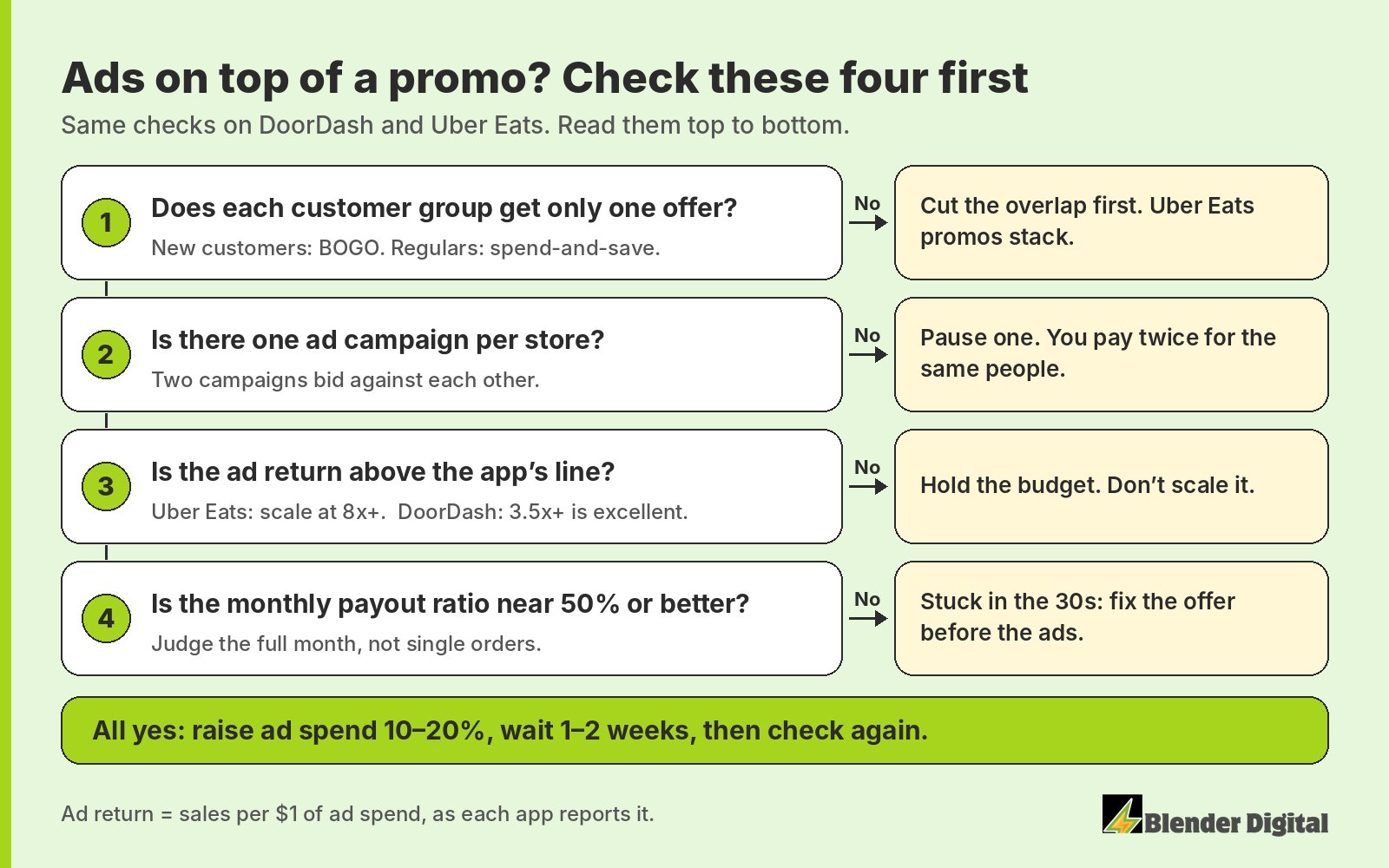
How I run ads and promos together
- One offer per audience. New customers get the BOGO. Regulars get spend-and-save. Never two campaigns on one group. My customer segmentation guide has the full ladder.
- Start ads low. $3 a day on Uber Eats. A $3 manual bid on DoorDash. Then step up 10 to 20% at a time and wait 1 to 2 weeks between moves. Sometimes the algorithm takes a second to adjust.
- Keep the BOGO off your busy hours. If you sell well at lunch and dinner without an offer, you don't need to pay for those orders. Use the BOGO on slow days.
- Refresh stale DoorDash listings. If a sponsored listing sits at the same level for a long time, it goes stale. A DoorDash rep's rule I follow: replace any listing that has run more than 6 weeks with a fresh one.
- Don't layer DoorDash smart targeting on your other promos. It overlaps, and it doesn't give the algorithm a clear signal about who the offer is for.
- Check the BOGO math before you buy traffic for it. Ads multiply whatever is already there. Run your items through the BOGO profit calculator first.
Quick answers
Should I turn off my ads while a BOGO is running?
Usually not. Ads work best with an offer running, because your store card shows your best live campaign. Turn off overlap instead: two offers on one customer, or two ad campaigns on one store.
What's a good ad return on Uber Eats vs DoorDash?
On Uber Eats, 8 to 10x is healthy and 8 to 12x or more is a signal to scale. DoorDash calculates it differently: over 3.5x is excellent and under 2.5x is fair.
How are DoorDash sponsored listings charged?
Per order. The manual minimum bid is $3 per order, DoorDash suggests $5, and auto-bidding usually lands around $5 to $6.
Do Uber Eats ad sales include orders that used a promo?
Yes. Uber counts any order from a customer who saw an ad, so ad sales overlap with BOGO and offer sales. Count each order once.
If you're running both and can't tell which one is eating your payout, that's what we sort out for the restaurants we manage. Get in touch and I'll take a look.