
DoorDash will always be your least profitable channel. I tell every owner that on the first call. Whether it's worth it comes down to two things: does each order still make you money, and is DoorDash finding you customers you wouldn't get otherwise.
This post is for owners already on DoorDash who are wondering if it's paying off. If you haven't signed up yet, start with should a new restaurant join DoorDash, Uber Eats or Grubhub. Here I'll walk through the test I run with a client's own statement, what it looked like at stores we've managed, and what to fix if it fails.
Quick answer: the 5-minute test
- Pull one full month from DoorDash: net payout and number of orders.
- Divide payout by orders. That's what each order actually pays you.
- Subtract the food and packaging for an average order. Positive means every order is contributing.
- Compare it with your in-store ticket. A bit below is normal.
- Check your new customers. If step 3 is positive and new customers keep coming, DoorDash is worth it.
How much does DoorDash actually pay restaurants?
The ceiling is about 70 to 85 cents on the dollar, with zero promos and zero ads. Commission alone takes you there, and your plan decides where in that range you land. "You cannot do better than getting paid out 75 to 80 cents on the dollar."
Once you're running BOGOs and sponsored listings to win customers, about 50 cents is normal. If you're down in the 20s or 30s, something is wrong. That number, net payout divided by sales, is your payout ratio. I explain the bands and how to pull it in DoorDash payout percentage: how much restaurants keep.
One thing to keep in mind before you run the test: food, labor and rent come out of the payout, not out of gross sales. A $30 order doesn't give you $30 to work with.
How do I tell if DoorDash is paying off for my restaurant?
Use one full calendar month. Not a week, and never a single order. One order can pay anywhere from 20% to 80%, and they all meet in the middle by the end of the month. DoorDash's Monthly Recap in the Merchant Portal shows your net payout directly. If the statement itself is confusing, read how to read your DoorDash and Uber Eats statements first.
Here's the test with example numbers:
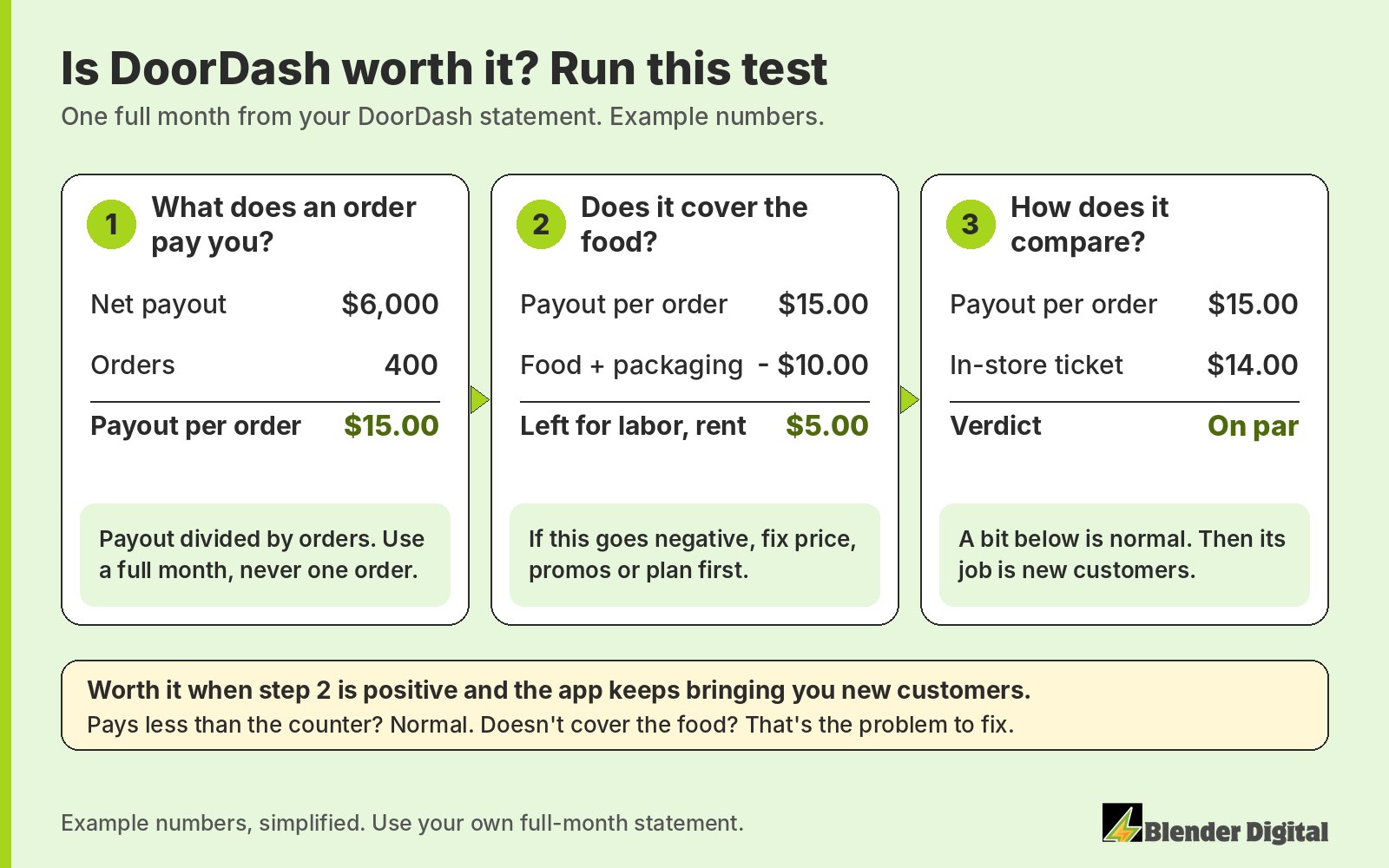
- Find net payout and orders. Say DoorDash paid you $6,000 on $12,000 of sales, from 400 orders.
- Divide payout by orders. $6,000 ÷ 400 = $15 per order. That's the same as your $30 average order times your 50% payout ratio.
- Work out food and packaging for an average order. Use your real food cost against the app prices. Say $9 of food and $1 of packaging, so $10.
- Subtract. $15 minus $10 leaves $5 per order toward labor, rent and profit. Positive means each order is pulling its weight. Negative means you're paying to send food out the door.
- Compare with your in-store ticket. If the counter averages $14, DoorDash at $15 is on par. If it's a little below, that's normal for this channel, and its job is bringing in new customers.
- Check new customers. Look at how many first-time customers DoorDash brought you that month. I show where to find it in how to see new customers on DoorDash and Uber Eats.
What does this test look like at real stores?
At a Yemeni coffee house in Atlanta we worked with, delivery paid $10.43 per order against an $11.97 in-store ticket. Less per order than the counter, and still money in the bank. How I put it to owners: "Unless the platform AOV net of fees is on par with in-store as a channel, these platforms are less profitable." Less profitable is a long way from losing money.
It can go the other way. At an Arab coffee bar in New Jersey on a negotiated rate, Uber Eats paid $15.86 per order in June 2026 against a $12.56 in-store ticket. At those same coffee stores, DoorDash almost always paid less per order than the counter, which is why I pushed plan changes there. If DoorDash pays you noticeably less per order than Uber Eats, look at your plan first. I compare the three in DoorDash Basic vs Plus vs Premier.
If DoorDash pays less than my counter, why stay on it?
Because the counter only sees people who already walk past. DoorDash is where people who've never heard of you decide what to eat tonight. "Always remember third party is going to be the least profitable… But it's a user acquisition channel."
So I judge it on customers, not just orders. It's not about buying the additional order. It's about buying the new customer. For a halal South Asian restaurant a partner agency ran while I advised, a new-customer BOGO on DoorDash brought in 232 new customers from July to August 2026, and 15% of them reordered within 30 days. Those are people who didn't know the restaurant a month earlier.
And walk-ins aren't free either. Restaurant owners for some reason magically think a person walking in has no cost associated with it.
Can I move my DoorDash customers to my own online ordering?
Some of them. Put a card in every bag asking people to order direct next time, because it saves you the commission. Expect about 10% to 20% to switch. The rest ordered on DoorDash because it was easy, and you can't convert convenience factor.
When owners talk about leaving the apps for their own ordering, my question back is always the same: what about the more casual eater? Nobody downloads an app for every restaurant they like. Run both. DoorDash finds them, your own ordering keeps the ones who come back. I go deeper on that split in third-party vs first-party delivery.
What if DoorDash isn't covering my food cost?
Fix the inputs before you quit. When payout per order minus food and packaging comes out negative, it's almost always one of these:
- Prices too close to in-store. Fully covering a 30% commission would take about a 43% markup, which nobody should do. Aim for 12% to 15%. The markup parity calculator shows where your menu lands.
- Promos that are too rich or overlap. A payout stuck in the 30s usually means too much marketing, often two offers hitting the same customers. Only put a BOGO on items with a 75% margin or better. The BOGO profit calculator checks an item in a minute.
- The wrong plan. Paying 30% for Premier perks you don't use, or sitting on Basic with flat sales.
- Error charges. Refunds come out of your payout. Dispute the ones that aren't your fault, as I explain in keeping up with error charges.
If the fees are the problem, renegotiate the commission before you pause anything. I watched one owner switch off Uber Eats in what turned out to be his most profitable month on it. If you've fixed all four and a full month still doesn't cover the food, that's when I'd seriously question the channel.
FAQ
Is DoorDash worth it for restaurants?
For most, yes, as a way to find new customers. DoorDash pays about 70 to 85 cents per dollar with no promos and about 50 cents while you run offers. It's worth it if your payout per order covers food and packaging and it keeps bringing in new customers.
How much does a restaurant make on a DoorDash order?
Divide your monthly net payout by your number of orders. For example, $6,000 from 400 orders is $15 per order. Food, packaging, labor and rent come out of that $15, not out of the menu price.
Is DoorDash less profitable than in-store orders?
Usually. At a coffee house in Atlanta we worked with, delivery paid $10.43 per order against an $11.97 in-store ticket. It still made money, so treat DoorDash as a customer acquisition channel rather than your profit channel.
Should I leave DoorDash for my own online ordering?
Run both. A card in the bag moves about 10% to 20% of app customers to direct ordering. The rest order on DoorDash for convenience, and casual eaters won't download your restaurant's app.
What should I do if DoorDash isn't profitable for my restaurant?
Check four things before quitting: menu prices (aim 12% to 15% above in-store), promos that overlap or sit on low-margin items, your commission plan, and error charges. Renegotiate commission rather than pausing the store.
Want a second pair of eyes on your numbers? Send me your last full month from DoorDash and I'll run this test with you. Payout per order against the in-store ticket is a standing slide in the monthly report we send every client. Get in touch here.