
With no promotions and no ads, you keep about 70 to 85 cents of every dollar you sell on DoorDash or Uber Eats. That's the best case, and your commission plan decides where in that range you land. Once you start running offers to win customers, 50 cents on the dollar is normal.
So delivery apps will always be your least profitable channel. I still put almost every restaurant on them, because that's where the customers are. "Always remember third party is going to be the least profitable… But it's a user acquisition channel." Here's how I'd decide whether to join, which app to start with and which plan to pick, before you sign anything.
Should a new restaurant join DoorDash and Uber Eats?
For most restaurants, yes. The apps have the customers, and the casual eater isn't going to download your restaurant's own app. Treat them as the place you find new customers, then move the regulars to your own online ordering where you keep more of the sale.
Owners sometimes ask me about skipping the apps and building their own ordering instead. You can do both, and you should. But your own site only reaches people who already know you. My question back is always the same: what about the more casual eater?
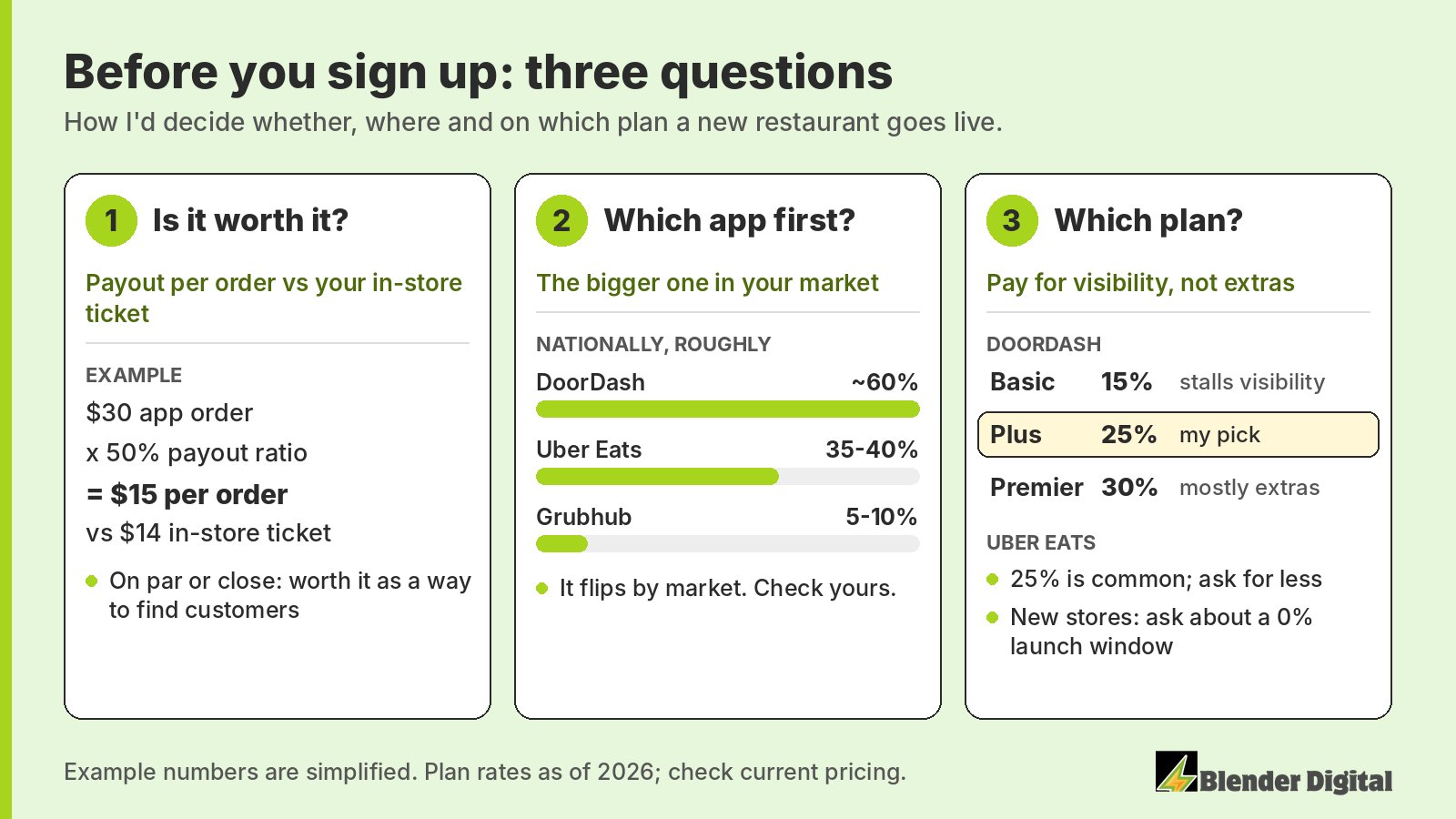
Is delivery worth it for my restaurant?
Run one test. Take the app's average order and multiply it by your payout ratio (net payout divided by sales). That's what you actually get paid per delivery order. Compare it with your average in-store ticket.
Example: a $30 app order at a 50% payout ratio pays you $15. If your in-store ticket is $14, the app order is on par, and the channel is clearly worth having.
Most stores land a little below. At a Yemeni coffee house in Atlanta, delivery paid $10.43 per order against an $11.97 in-store ticket. Delivery still made money there, just less per order than the counter. So its job is bringing in customers who wouldn't have walked in. With negotiated rates it can go the other way: at an Arab coffee bar in New Jersey, Uber Eats paid $15.86 per order in June 2026 against a $12.56 in-store ticket.
Keep in mind that food, labor and rent come out of the payout, not out of gross sales. I break that down in how much delivery revenue you actually keep.
Already live on DoorDash and wondering if it's paying off? Run the test in Is DoorDash worth it for restaurants?
Should I start with DoorDash or Uber Eats?
Start with whichever is bigger in your area. Nationally it's roughly 60% DoorDash to 35 to 40% Uber Eats, but it flips by market. At a smash-burger ghost kitchen we manage in Houston, Uber Eats did $31,272 in September 2026 and DoorDash did $25,995.
Most of the stores we manage run on both, with Grubhub on as a smaller third. If your kitchen and staff can handle both from day one, go live on both. If you'd rather learn one first, start with the bigger one and add the other once the first is running cleanly. I wrote a checklist for that in when to add a second delivery app.
Two differences worth knowing before you choose:
- Uber Eats co-funds. Uber often pays part of your campaigns, usually 10 to 25% depending on the rep, and new stores may get a 0% commission window. DoorDash rarely co-funds. It gives small launch credits at most.
- DoorDash has more tools. It has a loyalty program (Uber Eats doesn't), clearer customer segments and pay-per-order sponsored listings.
Don't go exclusive with one app as a single location. The platforms come asking once you're doing about $12,000 to $15,000 a month on one of them. Keep your bargaining power.
Which DoorDash plan should a new restaurant choose?
Plus, at 25%. Here's how I see the three plans:
| DoorDash plan | Commission | My take |
|---|---|---|
| Basic | 15% | Cheapest, but it stalls visibility. Our Atlanta coffee house's DoorDash sales went flat on Basic until we upgraded it. |
| Plus | 25% | My pick. You can target DashPass customers, which Basic can't. |
| Premier | 30% | Mostly a marketing trick. "Customers pay the lowest fees" means those fees get passed on to you. The one useful perk is a boost on sponsored listings. |
If a rep pushes Premier, push back. They'll often keep some of the benefits and drop the commission to 25 or 26%. "They do this all the time." Pickup orders run around 6% on both apps. Check DoorDash's pricing page for current rates, since they change.
On Uber Eats, the top plan is around 30% and 25% is common. I've seen 15% when it's negotiated. Watch for plans that add 5% on Uber One orders, and check the pickup rate on your statement (one client was charged 10%). Uber's current plans are on its pricing page.
If Uber also pitches Uber Direct and you already take online orders through Toast, you don't need it. Just tell them no. Marketplaces bring you customers. Uber Direct only delivers orders you already have, and I explain that difference in Toast delivery vs DoorDash vs Uber Eats.
For the full breakdown of each plan and how to talk Premier down, read DoorDash Basic vs Plus vs Premier.
Is Grubhub worth it for a new restaurant?
Turn it on, but don't spend much time on it. Grubhub has about 5 to 10% of the market. "There's no point over-optimizing for Grubhub." I keep it on as a market play.
What works there is simple: $3 to $4 off a $20 order and Grubhub's built-in loyalty. Watch the fees. On the Plus plan Grubhub charges a 15% marketing fee even on pickup orders. And once you're live, check that direct deposit is actually set up. One store had $996 sitting there unpaid.
What to have ready before you go live
- App prices. A 30% commission would need about a 43% markup to cover fully ($10 becomes $14.30). Don't do that. Aim for 12 to 15%. The markup parity calculator shows what your menu needs, and this post explains why a 30% markup doesn't cover a 30% commission.
- A delivery menu with photos on 90%+ of items. Each app wants different image sizes, so use the image resizer.
- A monthly sales goal for each app, so you have something to measure against.
- Someone who owns it. Errors, disputes and reviews need checking every day.
Once you're live, the week-by-week plan is in your first 30 days on DoorDash and Uber Eats.
FAQ
Is it worth putting a new restaurant on DoorDash and Uber Eats?
For most restaurants, yes, as a way to find new customers. Compare payout per order (average app order times payout ratio) with your in-store ticket. If it's close, the channel earns its place. It will rarely be your most profitable channel.
Should I start with DoorDash or Uber Eats?
Start with whichever is bigger in your area. Nationally that's usually DoorDash, at roughly 60% of the market, but some markets lean Uber. Most of the stores we manage end up on both.
Which DoorDash plan is best for a new restaurant?
Plus at 25%. Basic (15%) tends to stall visibility and can't target DashPass customers. Premier (30%) costs 5 more points for extras that are mostly marketing.
Is Grubhub worth it?
Yes as a small add-on. It's about 5 to 10% of the market, so keep the setup simple: a $3 to $4 off $20 offer, the built-in loyalty, and a check that payouts are reaching your bank.
If you're about to sign up and want a second opinion on the plan or the menu first, book a free call. I'll look at your market and tell you where I'd start. Get in touch here.