
Yes. Your DoorDash and Uber Eats menu should be its own menu, with fewer items, its own prices and paid add-ons. If you're on Toast, that means a separate online-only menu, so you can change the apps without touching what the cashier rings up.
I got into this through the coffee shop my cousin and I started, and delivery was the hard part from day one. A coffee doesn't carry that well, and neither do baked items. The in-store menu was built for someone standing at the counter. The delivery menu has to hold up in a bag, after commission, on a phone screen.
Why shouldn't you copy your in-store menu onto the apps?
Because the economics are different. At 30% commission, a $10 item pays you about $7 before any promos or ads. To take home the same money as in-store you'd need about a 43% markup, so that $10 item would sell for $14.30. You would never mark something up by 43%, so the delivery price has to land somewhere in the middle. Your counter menu can't carry those prices, which is why the apps need their own.
The other two reasons are travel and mistakes. Some items don't survive the trip. Others need someone at the counter to explain them, and on an app they get misordered. Both turn into refunds, low ratings and error charges, and error rate feeds into where you rank.
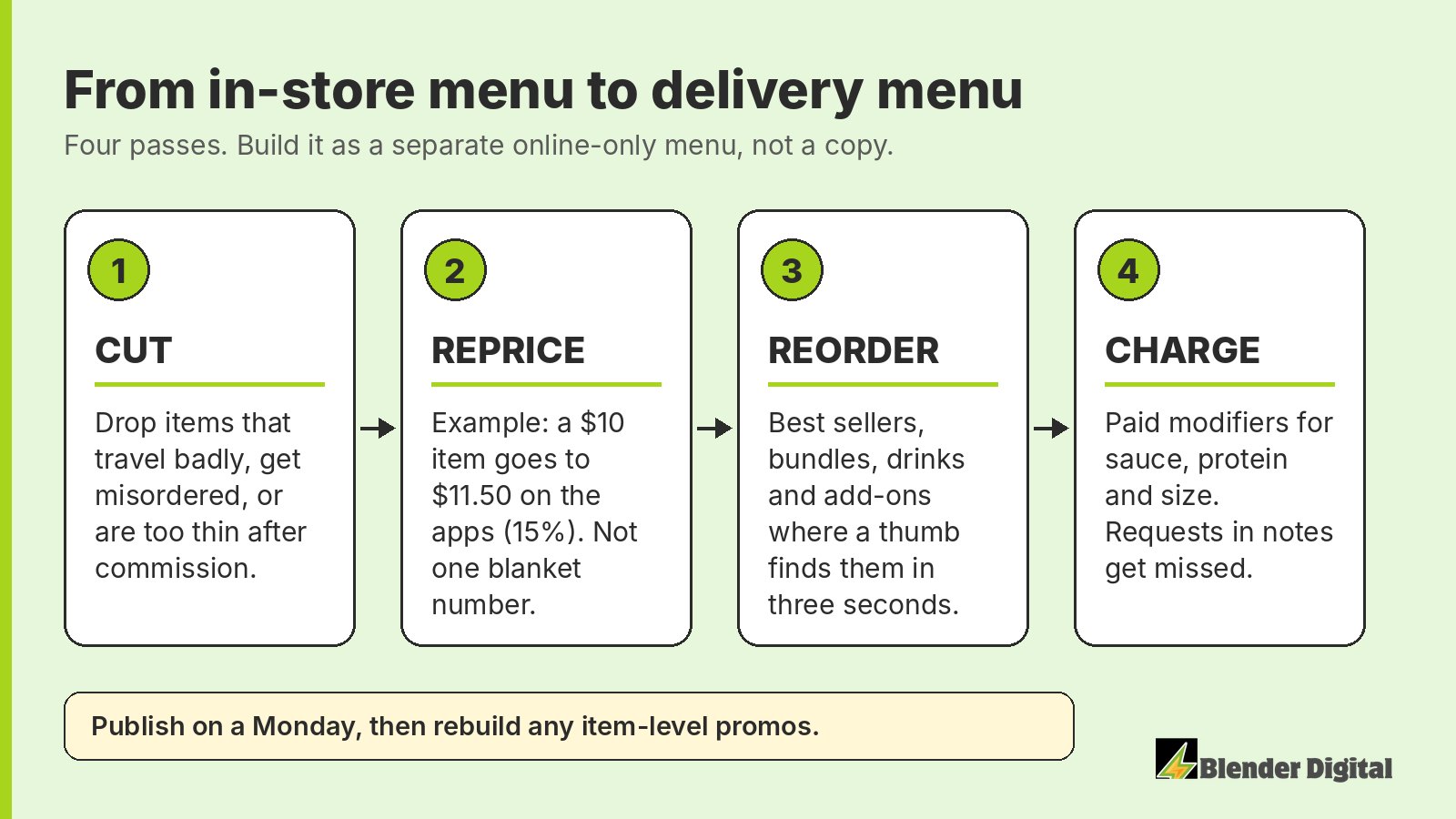
Which items should you take off the delivery menu?
Go through the menu and pull anything that does one of three things:
- Travels badly. It's soggy, cold or a mess by the time it reaches the door.
- Gets misordered. It needs explaining, or it keeps showing up in your error charges.
- Is too thin for commission. After 15 to 30% commission and packaging, there's nothing left.
Chips and salsa is a good example of the last one. It looks cheap to make, but once you count the packaging the margin drops to about 66%. That's too thin to put on a BOGO.
Most menus also have a long tail. On one menu I went through, 49 of the 117 items made 90% of the sales. The other 68 were mostly standing between the customer and the food they came for.
How should you price a separate delivery menu?
Price item by item rather than putting one blanket percentage on everything. I aim for a 12 to 15% markup. A 10% markup is technically hurting you once commission comes out. As a simple example, a $10 item at 15% goes to $11.50.
In Toast, watch for a global percentage markup stacking on top of prices you've set by hand. It's easy to miss, so check a few items on the live store after you publish.
You'll also see DoorDash nudging you to keep markup at 10% or less, since it now counts toward the Most Loved badge. I don't chase it. That badge is close to impossible to chase anyway, and it's a game DoorDash is playing because they take so much in commission. For the full math, read why a 30% markup doesn't offset a 30% commission or run your prices through the markup parity calculator.
How should the delivery menu be laid out?
Put best sellers, bundles, drinks and add-ons where a thumb finds them in three seconds. Don't make people dig through the order your printed menu happens to be in.
Bundles earn their spot. A drink almost always goes with a cake or a sandwich, so package them. It lifts the average order, and the customer has one less decision to make.
Should you charge for modifiers on DoorDash and Uber Eats?
Yes. Sauces, extra protein and size upgrades should be paid modifiers. Requests typed into the notes get missed, and a missed request comes back as an error charge.
Modifiers also protect your promos. Add-ons are never discounted on a BOGO, so a $12 base bowl with a required protein choice puts the BOGO on the base and keeps the protein at full price. One Uber Eats quirk to know: items built as modifiers in the POS can't be put on a BOGO there. The BOGO profit calculator is handy for checking which items can carry one.
And don't flatten your modifiers to make a sync problem go away. Customers like modifying their orders.
How do you set up a separate delivery menu in Toast?
Build an online-only menu in Toast. It gives you exact third-party prices, a shorter item list, and control over which brand shows what if you run more than one concept from the kitchen. The menu group settings for online ordering partners decide what actually shows up on the apps.
Toast is one of the most convoluted pieces of software I've ever seen, and it has no menu change log. So be deliberate about three things:
- Publishing pushes everything. Hitting publish sends every pending change live at once. We save changes and leave them unpublished until the owner has looked them over.
- Item IDs can change. Editing items can change their IDs on DoorDash and quietly break item-level promos. Publish on a Monday, never right before a busy weekend, and rebuild those campaigns straight after.
- Photos can get overwritten. Toast compresses images, so for anything important we upload straight to each platform. The integration only runs one way from Toast, though, so check that a later publish hasn't replaced them.
Last rule: change one thing at a time. If I change the menu and the pricing at the same time, we won't be able to tell which change moved the numbers.
If your current menu is already losing orders and you're not sure where, start with the delivery menu mistakes I check first. And if you'd rather hand the rebuild off, it's part of what we do when we take on a store. You can request a menu audit here.
FAQ
Should my delivery menu be different from my in-store menu?
Yes. It should have fewer items, its own prices and paid modifiers. If you use Toast, build it as a separate online-only menu so app changes never touch your in-store menu.
How much should delivery app prices be marked up?
I aim for 12 to 15%. Full parity at 30% commission would take about a 43% markup, which customers will not pay, and 10% is usually too thin.
Which items should I take off DoorDash and Uber Eats?
Items that travel badly, items that keep getting misordered, and items whose margin is too thin once commission and packaging come out.
Does editing my Toast menu affect my DoorDash promotions?
It can. Editing an item can change its ID on DoorDash and quietly break item-level campaigns. Publish on a Monday and recreate those campaigns right after.