
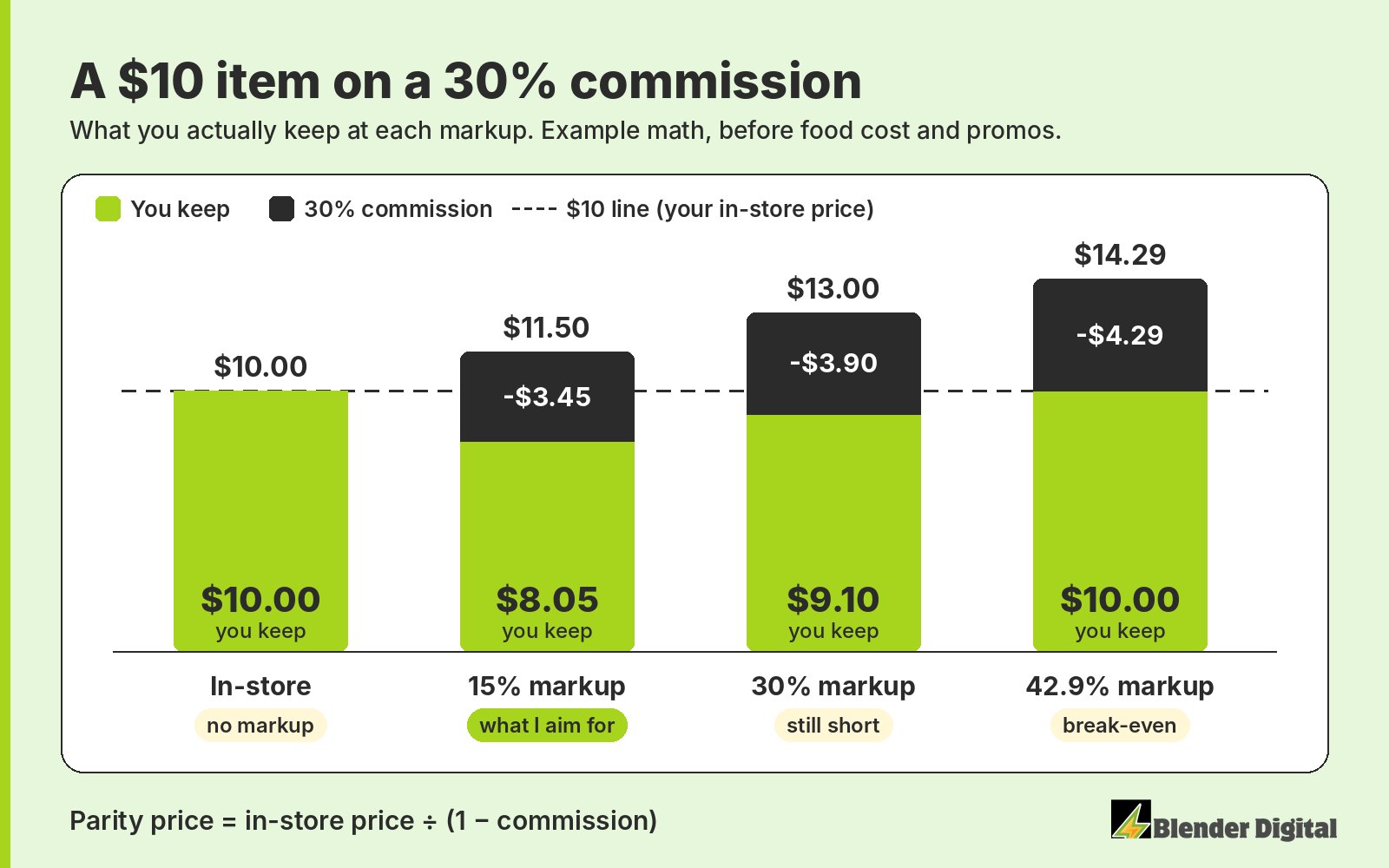
To get paid $10 on a $10 item at a 30% commission, the app price has to be $14.29. That's a 42.9% markup. I've never told a client to do that, and I don't think anyone should. The way I said it to one owner: "You would never mark up something by 43%. So it's got to be somewhere in the middle."
Where in the middle is the pricing question I get asked most. Below is the math, the markup I actually use, and what I do about the part of the gap that pricing can't close.
How much should you mark up menu prices on DoorDash and Uber Eats?
For most restaurants I aim for a 12–15% markup over in-store prices. That won't fully cover the commission, and it isn't meant to. It narrows the gap without making your store look expensive next to the place down the street.
I also don't apply it as one flat number across the whole menu. The items people search for and compare stay closer to in-store. Drinks, add-ons and anything with a strong margin can carry more. Then the menu structure and the offers do the rest, which I'll get to below.
Does a 30% markup cover a 30% commission?
No. The commission is taken from the marked-up price, not from your in-store price. Mark a $10 item up 30% and it sells for $13.00 on the app. A 30% commission on $13.00 is $3.90, so you keep $9.10.
| Step | Amount |
|---|---|
| In-store price | $10.00 |
| App price after a 30% markup | $13.00 |
| 30% commission on $13.00 | -$3.90 |
| What you keep | $9.10 |
So you raised prices 30% and the app still pays you less than a walk-in customer does. And that's before food cost, packaging, promos or ads.
What markup breaks even with the commission?
Divide your in-store price by the share you keep. At a 30% commission you keep 70%, so $10 ÷ 0.70 = $14.29. That's your parity price, and the markup is 42.9%. The rule of thumb: parity markup = 1 ÷ (share you keep) − 1.
| Commission | You keep | Parity price for a $10 item | Markup needed |
|---|---|---|---|
| 15% | 85% | $11.76 | 17.6% |
| 25% | 75% | $13.33 | 33.3% |
| 30% | 70% | $14.29 | 42.9% |
Your commission plan matters more than most owners think. DoorDash's plans are Basic at 15%, Plus at 25% and Premier at 30% (current details are on DoorDash's pricing page). I usually recommend Plus. When owners push back on Premier, reps will often keep the perks and bring the commission down to around 25 or 26%. That alone takes the break-even markup from 42.9% to about 33%.
Run your own prices
The free markup parity calculator shows the app price you'd need for any in-store price, at any commission rate or payout ratio. Put in your top five sellers and see where you land.
Why can't you just price your way out of delivery fees?
Because commission isn't the only thing that comes out. Promos, ads, the $0.99 fee on every redeemed offer and error charges all come out of your payout too. That's why I look at payout ratio (net payout divided by gross sales) and not just the commission rate.
With no promos, restaurants keep about 70 to 85 cents on the dollar. While you're growing with BOGOs and ads, about 50 cents is normal. At a 50% payout ratio, the break-even price for a $10 item is $20. That's a 100% markup. You can't price your way out of delivery fees.
Price is also the first thing a customer reads. "The first thing people look at is price. Picture comes second, description comes third." Push prices too far and fewer people order, and the app has less reason to show your store.
So I treat the apps as a customer acquisition channel. You cannot do better than getting paid out 75 to 80 cents on the dollar there, no matter how well you run it. The markup closes part of the gap, and the rest has to come from how the menu and the offers are built. If you want the full breakdown of where the money goes, I wrote about how much restaurants actually keep from DoorDash and Uber Eats.
Why is a 10% markup too thin?
At 10%, a $10 item sells for $11.00 and a 30% commission leaves you $7.70. At 15%, it sells for $11.50 and you keep $8.05. Neither gets you back to $10, but at 10% the commission is eating more than most owners realize. I've told clients a 10% markup is technically hurting them. 12–15% is where I start.
There's one catch on DoorDash. The Most Loved badge now looks at menu markup as well, and the bar is 10% or less, on top of error rate, cancellations and rating. I don't chase it. The lift is marginal next to good campaigns and reviews, and I see the 10% rule as a game DoorDash is playing because it takes so much commission.
If markup can't cover it, how do you protect your margin?
These are the moves I make on almost every menu we take over:
- Base item plus a paid add-on. This is my favorite. Keep the base item close to normal and make the premium part, the protein or the extra patty, a paid add-on. A $12 bowl, you click on it, and at a minimum you have to add a $4 add-on. Add-ons are never discounted on a BOGO, so the customer pays full price for the part that costs you the most.
- Charge for modifiers. Extra sauce, extra protein and bigger sizes should all cost something on the apps.
- Let the BOGO carry the price. An item on a BOGO can hold a slightly higher price because people don't bat an eye when they're getting two for one. One client suggested raising the price about $1 before launching a BOGO, and I agreed with it.
- Negotiate the commission. A lower rate cuts the break-even markup directly. Reps trade rate for commitments like running campaigns and a set daily sponsored-listing spend.
- Give the apps their own menu. If your app prices come from Toast, build a separate online-only menu so you control exact prices. Watch for a global percentage markup stacking on top of prices you already set by hand.
For the BOGO side of this, here's how I set up BOGOs that protect margin, and for the menu itself, why your delivery menu shouldn't be a copy of your in-store menu.
FAQ
How much should I mark up my menu on DoorDash?
I aim for 12–15% over in-store prices. Fully covering a 30% commission takes a 42.9% markup ($10 becomes $14.29), which is too high for most menus. Keep the items people compare close to in-store and put more of the markup on drinks, add-ons and high-margin items.
Does a 30% markup cover a 30% commission?
No. The commission comes out of the marked-up price. A $10 item marked up 30% sells for $13.00, the 30% commission takes $3.90, and you keep $9.10.
Can I charge more on DoorDash and Uber Eats than in my store?
Yes. Both apps let you set your own app prices, and DoorDash notes that many restaurants set different delivery prices. Some features look at your markup, like DoorDash's Most Loved badge, so check the current rules before you raise prices.
Is the markup math different on Uber Eats?
The formula is the same: in-store price divided by (1 minus commission). The rate is what changes. The top Uber Eats plan is around 30%, 25% is common, and some plans add 5% on Uber One orders, so plug in the rate you actually pay.
If you want a second opinion on your app prices, send me your menu and your last full month from each app, and I'll tell you where I'd start. Get in touch here.