
A fast-casual franchise in New Jersey went live on Uber Eats, DoorDash and Grubhub on August 12, 2026. We started managing it in September. That month it did $19,592 in delivery sales against a $15,000 goal, and got paid 63 cents on every dollar.
We set the store up properly, launched one offer for new customers, kept ads small, and then mostly left it alone. That's how I run every new store's first 30 days.
What should a new restaurant do in its first 30 days on DoorDash and Uber Eats?
Get the menu, photos, prices and commission plan right before you go live. In week 1, launch one new-customer offer and small ads. Then leave the campaigns alone for the rest of the month while you fix operations and collect reviews. At the end of the month, read the full month's numbers before you change anything.
The algorithm swings day to day. One week can look great and the next can look dead, and neither tells you much. "Week to week it may not tell the full story, but by the end of the month it will."
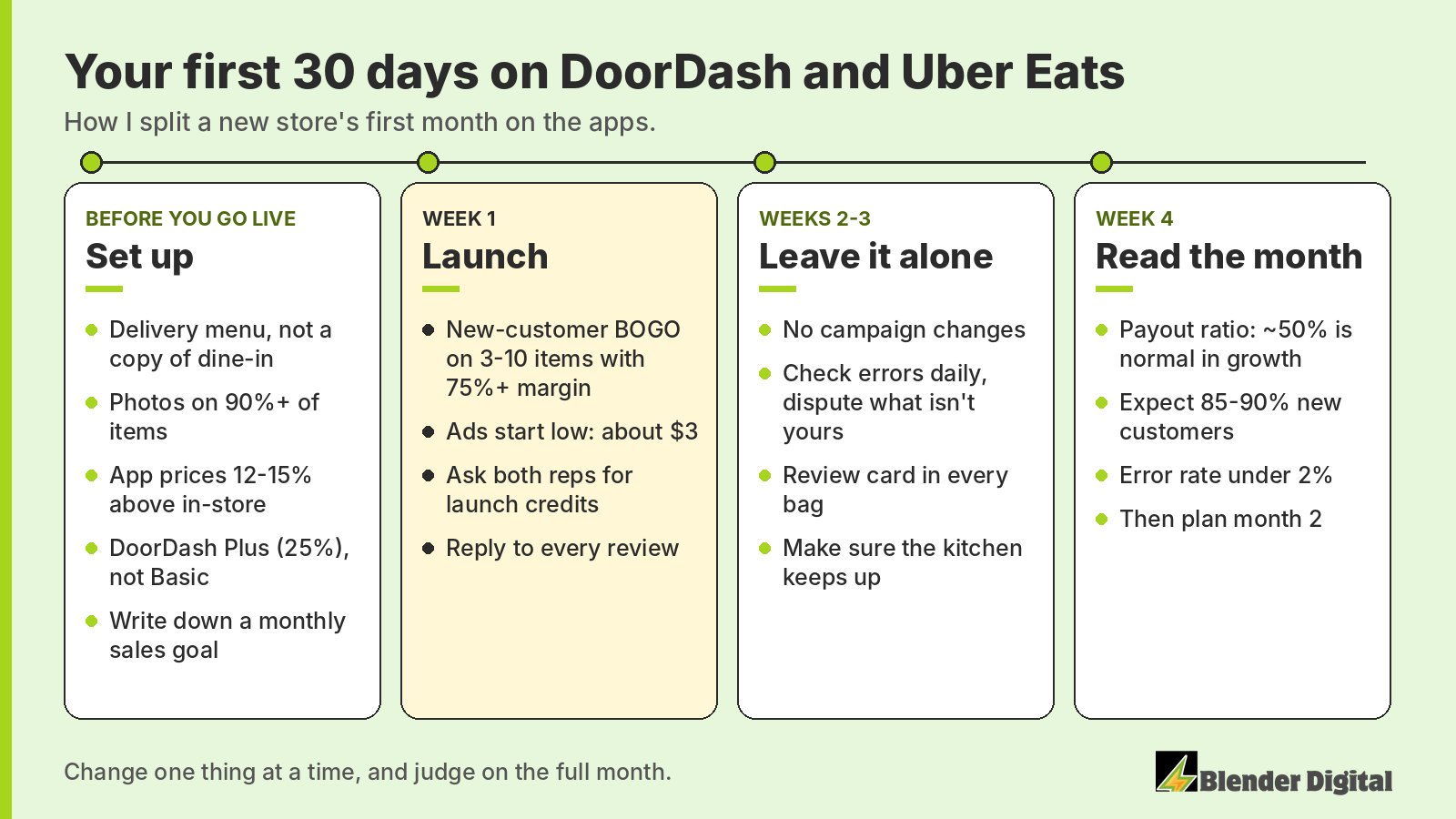
Before you go live: menu, photos, prices and plan
I fix things in this order: the hero image, then the menu, then pricing, then operations. Ads come last, because ads only multiply what's already there.
- Build a delivery menu. Take out what travels badly, what gets misordered and anything too cheap to survive the commission. Put best sellers, bundles, drinks and add-ons where a thumb finds them in three seconds. Charge for modifiers like extra protein, sauces and size. More on this in why your delivery menu shouldn't copy your in-store menu.
- Get photos on 90 to 95% of items. "It's an online medium, you have to have pictures in order to sell items." DoorDash won't even let you run a BOGO on an item without a photo. Skip AI food photos. The platforms ban them, and a plain real photo does more. Each app wants different sizes, so use the image resizer to export them.
- Price for the apps. To fully cover a 30% commission you'd need about a 43% markup, so a $10 item becomes $14.30. Nobody should do that. I aim for 12 to 15% above in-store. The markup parity calculator does the math for your menu. If you're on Toast, build a separate online-only menu so app prices don't leak into the store.
- Pick the plan. On DoorDash I put new stores on Plus (25%). Basic is cheaper, but I've watched a store go flat on it. I explain the plan choice in should a new restaurant join DoorDash, Uber Eats or Grubhub.
- Write down a goal. A monthly sales number per app, ramping over a few months. "If we're not measuring against something tangible, we're setting ourselves up for failure."
Week 1: launch a new-customer offer and start ads small
A new store's customers are 85 to 90% new. Nobody knows you yet, so the first offer has one job: get the first order. "It's not about buying the additional order. It's about buying the new customer." A new customer can only be new to your store once.
My default is a BOGO for new customers only, on 3 to 10 items with a margin of 75% or more. Keep those items under about $15 in the first month, and pick things that are popular and quick to make. Multi-unit items work best. Nobody has ever walked into a Mexican restaurant and ordered one taco.
The margin rule matters because you give up revenue and you pay for the second item's food. Nachos at $13.20 that cost $2.20 to make are a great BOGO item. A chicken bowl at $15.40 that costs $5.30 loses money on every redemption. Run your own items through the BOGO profit calculator before you switch anything on.
A few more things for week 1:
- Ads start small. About $3 a day on Uber Eats, or a $3 manual bid per order on DoorDash. Ignore the "recommended" budget. Ads also work better when there's an offer running beside them.
- Ask for launch money. New stores can sometimes get 0% commission on Uber Eats for a while. If you get that window, go aggressive during it. Two stores we work with paid no Uber Eats fees in their launch month in 2026. DoorDash rarely co-funds, but new stores can get a small Smart Campaign credit (around $150) and credits on a first sponsored listing. Ask both reps.
- One offer per audience. Uber Eats lets promos stack. DoorDash doesn't. I learned this the hard way on my cousin's coffee shop, where two offers hitting the same customers pushed the payout down to 35 to 40 cents on the dollar.
Weeks 2 and 3: leave the campaigns alone and fix operations
This is the hard part for owners. A slow Tuesday makes everyone want to change something. Don't. If you change the offer in week 2, you'll never know what the original one did. I tell clients to leave the whole first month untouched so we get a clean baseline. "One or two bad days isn't something to immediately solve for."
Spend these two weeks on the things that feed the algorithm instead:
- Errors. Check them every day. DoorDash measures your error rate against your peers and pushes you down if your kitchen keeps making mistakes. Dispute anything that wasn't your fault with a screenshot. DoorDash's dispute window is short, about a week or two. Uber Eats gives you 30 days.
- Reviews. Reply to every one, with a small offer where the order was big enough. Put a card in the bag: "Leave us a review and get $5 off your next order." At an Arab coffee bar in New Jersey, a printed bag card took Uber Eats reviews from 2 to 24 in one month (Feb to Mar 2026), a 16.1% review rate against 4.5 to 6.4% at three sister stores. The full playbook is in how to get your first 100 reviews.
- The kitchen. A strong new-customer offer means a steady line of couriers, an order screen going off the hook and items running out. Plan labor and stock before the weekend, and pause the store if you're buried. Just remember to turn it back on.
- Menu edits. If you're on Toast or another POS, editing an item can change its ID and quietly break the BOGO on it. That was a very expensive lesson for me. If you must edit, rebuild the campaign right after.
Week 4: how do you know if your first month went well?
Pull the full month from each app and look at these, in this order:
- Payout ratio. Net payout divided by sales. In a growth month with a BOGO running, about 50% is respectable and 60% is good. If you're at 20 to 30%, something is wrong. Here's how I read payout ratio.
- Sales against your goal, split into orders and average ticket.
- Customer mix. Expect most of your customers to be new. That's the point of month 1.
- Error rate. Under 2% is normal. Above that, fix it before you spend more.
- Rating and review count. The milestone is 4.5 stars with 100 or more reviews. It takes longer than a month, but you should see it moving.
Do your own month-over-month math. The "vs 7 days prior" comparisons in the dashboards can be badly off. I've seen one claim 11,000% growth.
For reference, the New Jersey franchise from the top of this post brought in 189 new customers on Uber Eats in September 2026 from its first-order BOGO, with $8,858 in sales on $3,465 of offer cost.
Month 2 is where you scale what worked. Add BOGO items a few at a time (5, then 7, then 9). Add a spend-and-save offer for returning customers set a little above your average order. Step ad budgets up 10 to 20% where the return holds. And once the first app runs cleanly, look at when to add a second delivery app.
FAQ
Should a new restaurant run promotions in its first month on DoorDash or Uber Eats?
Yes, one offer aimed at new customers, usually a BOGO on 3 to 10 high-margin items. Almost all of your customers are new in month 1, and the offer is what gets them to try you over the other options on the screen.
Does Uber Eats charge commission in your first month?
Sometimes not. New stores can get a 0% commission window on Uber Eats, and two stores we work with paid no Uber Eats fees in their launch month in 2026. Ask your rep. Your payout ratio will drop once fees start, so don't treat that month as your baseline.
Which DoorDash plan should a new restaurant pick?
I recommend Plus (25%). Basic (15%) tends to stall visibility, and most of Premier's (30%) extras aren't worth the extra 5 points. Only the 25% and 30% plans can target DashPass customers.
How many reviews does a new restaurant need?
The trust milestone I aim for is 4.5 stars with 100 or more reviews. A card in the bag and a reply with a small offer on every review are the fastest ways I know to get there.
If you're about to go live and want a second set of eyes on your menu, prices and plan before you do, book a free call and I'll go through it with you. Get in touch here.