
In September 2026, a smash-burger ghost kitchen we manage in Houston did $31,272 on Uber Eats and $25,995 on DoorDash. Grubhub went live the same month and did $108 from 3 orders.
That one report answers most of what owners ask me about adding another app. The app that's smaller nationally can be the bigger one in your market. And the third app is usually small. Here's how I decide when a store is ready for its second app, and which one it should be.
When should a restaurant add a second delivery app?
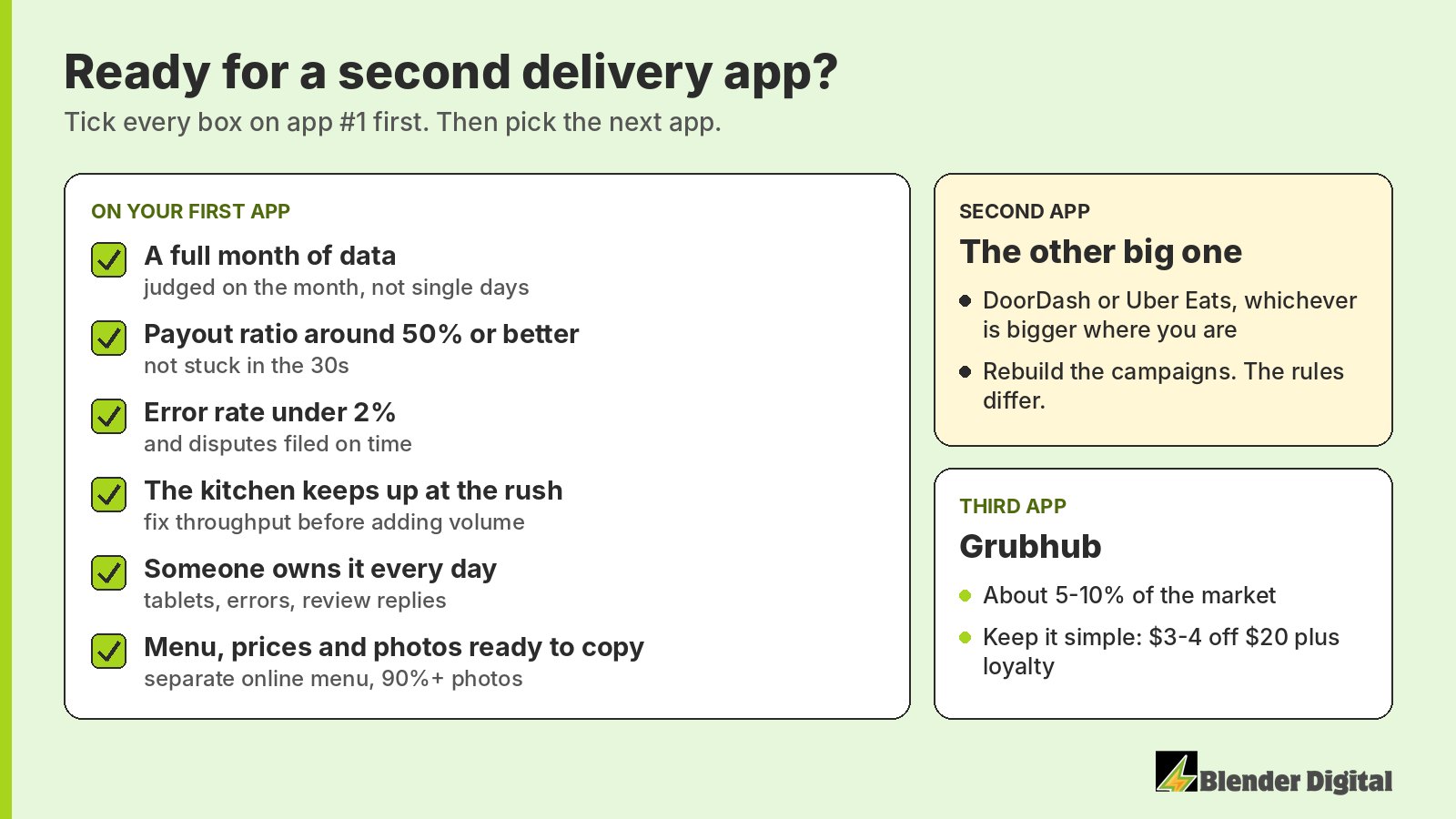
Add it once your first app is running cleanly: a full month of data you've actually read, a payout ratio around 50% or better, errors under 2%, a kitchen that keeps up at the rush, and someone who checks the account every day. If any of those is shaky, fix it on the first app before you add a second one. A second app doubles the tablets, the error checks and the review replies, and it adds a second set of rules.
How do I know my first app is running cleanly?
- You've read a full month. Per-order payouts can range from 20% to 80%, and the algorithm favors you one day and ignores you the next. Over a month they all meet in the middle. Judge the app on full calendar months, not on one great week.
- Your payout ratio is healthy. That's net payout divided by sales. While you're running offers to win customers, about 50% is respectable and 60% is good. If you're stuck in the 30s, you're spending too much on marketing, and a second app will only copy the problem. More on that in how much delivery revenue you actually keep.
- Errors are under 2%. That's the line Uber Eats uses, and under it errors are just a cost of doing business. DoorDash measures your error rate against your peers and pushes you down if the kitchen keeps making mistakes. You should also be disputing the charges that weren't your fault, on time.
- The kitchen keeps up. If the kitchen struggled in month 1, we don't expand. We fix throughput first. If orders back up at the rush, a second app pays for promotions and then loses ranking because orders run late or go out wrong.
- Someone owns it every day. Each app has its own error charges and dispute window (about a week or two on DoorDash, 30 days on Uber Eats) and its own review-reply window (7 days on DoorDash, 14 on Uber Eats). Somebody has to be in both portals.
- Your menu is ready to copy. If you're on Toast, a separate online-only menu with your app prices makes adding the second app a lot easier. Photos should be on 90%+ of items, because DoorDash won't let you run a BOGO on an item without one. The image resizer exports the sizes each app wants.
If you're still in your first month, the plan for that is in your first 30 days on DoorDash and Uber Eats.
Should my second app be DoorDash or Uber Eats?
The other big one. If you started on DoorDash, add Uber Eats. If you started on Uber Eats, add DoorDash. Grubhub comes third.
Nationally DoorDash has roughly 60% of the market and Uber Eats 35 to 40%, but that flips by market, as the Houston numbers above show. So don't assume the second app will be the small one. If you're still deciding which app to start with, I cover that in should a new restaurant join DoorDash, Uber Eats or Grubhub.
Copy the menu across. Rebuild the campaigns, though, because the two apps work differently:
- Promos stack on Uber Eats. They don't on DoorDash. A setup that's safe on DoorDash can double-discount the same customer on Uber.
- Uber Eats often co-funds campaigns, usually 10 to 25% depending on the rep. DoorDash rarely does.
- DoorDash has a loyalty program. Uber Eats doesn't.
- They measure ad return differently. On Uber Eats I want 8x or more before adding spend. DoorDash calls anything over 3.5x "excellent." Don't compare the two numbers.
Can I negotiate when I add the second app?
Yes, and your first app gives you something to negotiate with. Commission is a trade: "We'll run these campaigns and we'll run this much sponsored listing daily spend, but you need to give us a better deal on our commission rate." I've seen 0% commission for the first 2 months, and the 30%-plan benefits at a 25% rate. You can also use one app's volume with the other. Telling a rep "we want to stick with you guys" carries weight.
New stores get the most. Uber Eats sometimes gives new stores a 0% commission window, and if you get one, run your campaigns harder while it lasts. DoorDash gives new stores small credits, like a store-level Smart Campaign credit (around $150) and credits on a first sponsored listing. Ask for them early.
What I wouldn't do is go exclusive. Platforms start asking once you're doing about $12,000 to $15,000 a month on one app, and the offer can look generous. As a single location, keep both apps and keep your bargaining power.
When is Grubhub worth adding?
Add it after the two big apps, and don't spend much time on it. Grubhub has about 5 to 10% of the market. "There's no point over-optimizing for Grubhub." I keep it on as a market play.
It can still bring in real money. At a taco shop on Long Island, Grubhub did $1,275 of the store's $9,463 in delivery sales in September 2026.
Keep the setup simple: $3 to $4 off a $20 order plus Grubhub's built-in loyalty. Be careful with heavier campaigns. At one client, running campaigns on Grubhub actually cut organic traffic, because the app started ranking the store against other stores running campaigns. Two more checks: the Plus plan charges a 15% marketing fee even on pickup orders, and make sure direct deposit is set up. One store had $996 sitting there unpaid.
FAQ
Should a restaurant be on both DoorDash and Uber Eats?
Most of the stores we manage are on both, with Grubhub as a smaller third. The right time to add the second one is when the first is running cleanly: a full month of data, a healthy payout ratio, errors under 2% and a kitchen that keeps up.
Is it better to add DoorDash or Uber Eats second?
Add whichever big app you're not on yet. DoorDash is bigger nationally, but some markets lean Uber Eats, so don't expect the second app to be the small one.
Is Grubhub worth it for restaurants?
As a third app, yes. It's about 5 to 10% of the market, so keep it simple with a small spend-and-save offer and the built-in loyalty, and check that payouts are reaching your bank.
Can I get a lower commission when I join a second delivery app?
Often, yes. Offer campaigns and ad spend in exchange for a better rate, ask about launch windows and credits for new stores, and point to your volume on the other app. Avoid exclusivity as a single location.
If you're on one app and wondering whether you're ready for the next, send me your last full month and I'll tell you what I'd fix first. Get in touch here.