
Even with zero promos running, the best a DoorDash or Uber Eats order will ever pay you is about 70 to 85 cents on the dollar. That's after commission and before food, labor and rent.
I say this to every owner I work with: third party is going to be your least profitable channel. But it's a customer acquisition channel. Your own ordering page is where the profit is, once people know to use it. Almost everything I think about first-party vs third-party delivery comes back to that.
What is first-party delivery?
First-party delivery means the customer orders from you directly: your website, your app, or an online ordering page like Toast Online Ordering or Owner.com. You set the menu and prices, the order lands in your system, and the customer's details stay with you.
The delivery itself can be your own driver or a courier network. Toast Delivery Services, for example, runs on DoorDash Drive and Uber Direct drivers, per Toast's support page. A DoorDash driver carrying the bag doesn't make it a DoorDash order. I break that down in Toast Delivery Services vs DoorDash vs Uber Eats.
Third-party delivery means the customer found you and ordered inside a marketplace app. DoorDash, Uber Eats or Grubhub owns that ordering experience and charges you commission for bringing the customer.
What are the benefits of first-party ordering?
The main one is margin. Take a $30 order. On a 25% marketplace plan, commission alone is $7.50. Add a promo, a sponsored listing and the $0.99 fee the apps charge on every redeemed offer, and in a growth month that order often pays out $15 to $17. The same $30 order on your own page skips the commission. You pay your ordering platform's fees and whatever part of the delivery fee you don't pass to the customer, and the rest is yours.
The other benefits:
- You keep the customer. Their name, contact info and order history sit in your system, so you can reach them again.
- No competitors on the page. On your own page nobody is running a BOGO two tiles down from you.
- Your offers, your rules. No redemption fee, and no platform deciding who sees which offer.
So why not move everyone to first party?
Because the people you most need, new customers, aren't looking at your website. They're scrolling DoorDash or Uber Eats deciding what to eat tonight. The apps are a demand channel. Your ordering page only works for people who already know you exist.
I hear "let's get off the apps and build our own" from owners a lot. My answer is always the same question: what about the more casual eater? Nobody downloads an app for every restaurant they like. The marketplace has those customers, and you give them up when you leave.
I've seen what quitting costs. One owner I advised through a partner agency switched Uber Eats off over fees in his best month on the platform, right after the relaunch hit a 63% payout. If the fees are the problem, renegotiate the commission. Don't walk away from the demand.
When you work the marketplace properly, it moves the whole store. At an Arab coffee bar in New Jersey that we manage, delivery went from 9.83% of the whole store's sales to 20.9% between February and May 2026.
How do you move delivery customers to first-party ordering?
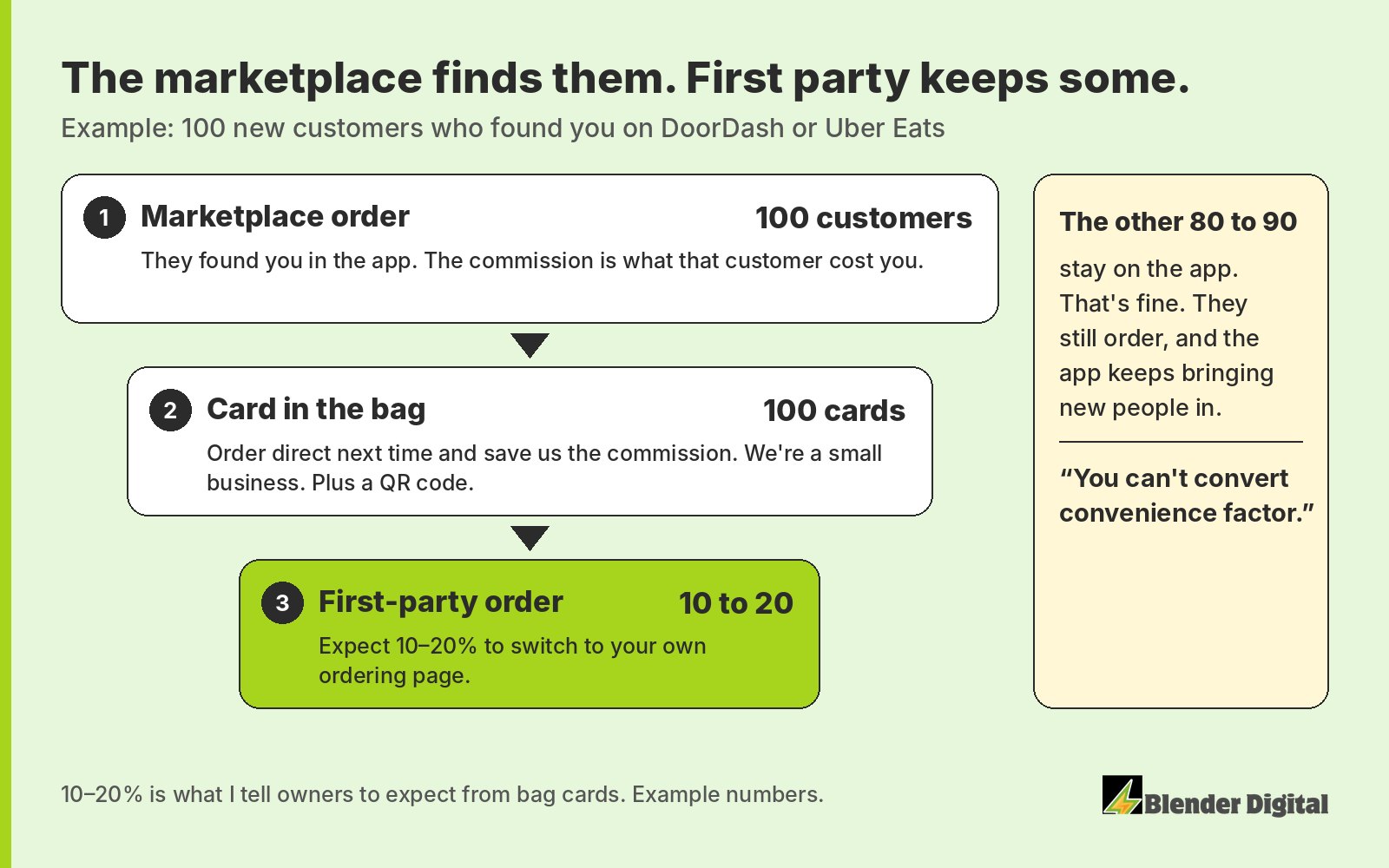
Use the bag. Anytime you send out a delivery package, that's your marketing vessel. Put a card inside every marketplace order with a QR code to your ordering page and a plain ask: order direct next time, it saves us the commission, we're a small business.
Then keep your expectations honest. I tell owners to expect 10 to 20% of those customers to switch. The rest ordered through the app because it was easy, and they'll keep doing that. You can't convert convenience factor.
A few things that help:
- Keep it to one card per ask. We also use bag cards to ask for reviews on the app, and those work. At the same New Jersey coffee bar, a card in the bag took Uber Eats reviews from 2 to 24 in one month (February to March 2026). A review card shouldn't carry a QR code, though, because a QR can't open that order's review screen. Save the QR for the order-direct card. More on that in how to get your first 100 reviews.
- Make your ordering page easy to find. Link it from your Google Business Profile, your website and your Instagram.
- Give regulars a reason. A small direct-only perk gives people who already like your food one more reason to skip the app.
Which first-party ordering system should you use?
If you're already on Toast POS, Toast Online Ordering is the easy starting point because the menu and orders live in one place. Owner.com is the other one I hear about most. It's a first-party platform, not a service, and its strength is SEO, so your ordering page actually shows up when people search for you. It charges a small per-order fee plus a monthly subscription; get a current quote from them.
My one test for any of these: will it help people find my page, or will it only process orders once they get there? Toast is a technology company first. If a tool you already have is bringing in search traffic, don't switch just to get loyalty in one place and lose the traffic.
How I split the two channels
- Third party finds new customers. Run your strongest offers for new customers only. It's not about buying the additional order. It's about buying the new customer. I go deeper on this in customer segmentation for delivery.
- First party keeps the ones who come back. Bag cards, your own page, your own perks.
- Judge the apps on payout, not on how much they cost per order. Read how much of your delivery revenue you're keeping to see where the money goes.
Manage the apps. Don't quit them. If you'd like help making the marketplace side pay while you build up direct ordering, that's what my team does every day. Get in touch and we'll take a look at your setup.
FAQ
What is the difference between first-party and third-party delivery?
With first-party delivery, the customer orders from your own website or ordering page and you keep the customer relationship. With third-party delivery, they order inside an app like DoorDash or Uber Eats, which charges commission for bringing you the order.
What are the benefits of first-party ordering?
You skip marketplace commission, so more of each order stays with you. You also keep the customer's contact info and order history, and there are no competitors on the page.
How many delivery customers will switch to ordering direct?
I tell owners to expect 10 to 20% from a bag card with a QR code. Most people order through the apps for convenience, and that doesn't change.
Should I get off DoorDash and Uber Eats and only use first-party ordering?
No. The apps are where new customers find you. Use them to acquire customers, use your own ordering page to keep some of them, and renegotiate commission if fees are the problem.