
On a DoorDash or Uber Eats order, the most you will ever get paid is about 70 to 85 cents on the dollar. That's with zero promos running. Once you add a BOGO, ads and the $0.99 fee on every redeemed offer, a store in a growth phase usually lands somewhere around 50 to 58 cents.
So when Toast offers to handle delivery for orders on your own website, the obvious question is whether you still need the apps. I manage DoorDash, Uber Eats, Grubhub and Toast for restaurants every day, and my answer is yes. They do different jobs. Below is how I explain the difference to owners, what each one costs, and how I'd set them up together.
Is Toast Delivery Services the same as DoorDash or Uber Eats?
No. Toast Delivery Services (TDS) delivers orders that customers place on your Toast Online Ordering page. It does not list you anywhere new. DoorDash and Uber Eats are marketplaces: the customer opens their app, scrolls, and finds you there.
The confusing part is that the same drivers can show up for both. Toast's own support page for Toast Delivery Services says TDS uses on-demand drivers powered by Uber Direct or DoorDash Drive, and that it is separate from the DoorDash and Uber Eats marketplaces, which you set up on their own.
So a DoorDash driver might pick up two bags from your counter tonight. One came from the DoorDash app. The other came from your website and DoorDash is only driving it. Same car, very different order.
Demand channel or fulfillment channel?
This is the simplest way I've found to keep it straight. DoorDash and Uber Eats marketplaces are demand. They find you customers, and what you pay them is a customer acquisition cost. Toast Delivery Services, DoorDash Drive and Uber Direct are fulfillment. They move food you already sold, and what you pay them is a shipping cost.
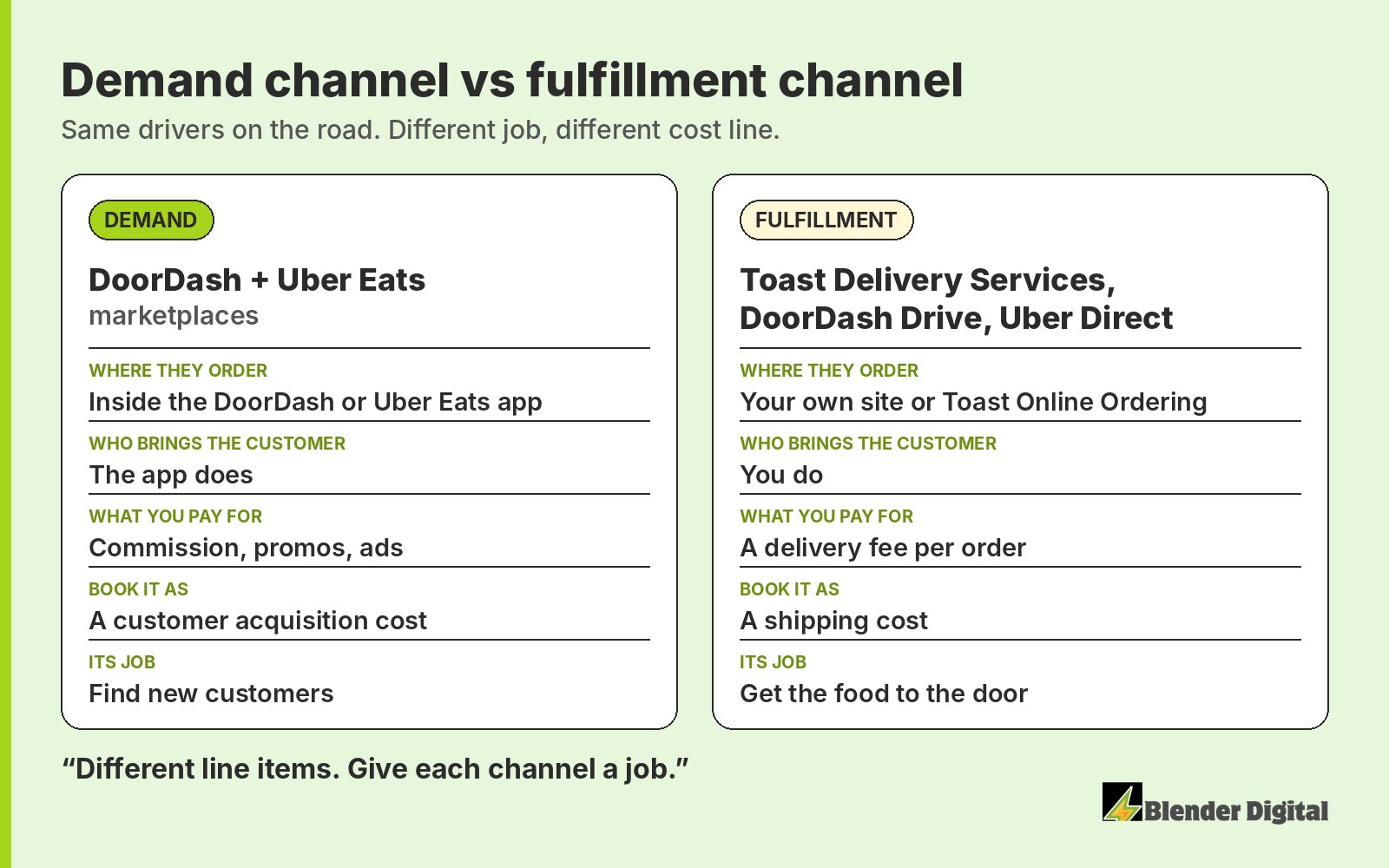
Different line items. Give each channel a job. Once you book them that way, a lot of the "DoorDash is too expensive, let's just use Toast" conversations get simpler, because you stop comparing a marketing cost with a delivery cost.
| Channel | Where the customer orders | Type | Its job |
|---|---|---|---|
| DoorDash Marketplace | DoorDash app or website | Demand | Put you in front of people already browsing DoorDash |
| Uber Eats Marketplace | Uber Eats app or website | Demand | Same, for the Uber Eats crowd |
| Toast Delivery Services | Your Toast Online Ordering page | Fulfillment | Deliver orders from people who already know you |
| DoorDash Drive | Your own ordering channel | Fulfillment | DoorDash's drivers, your order |
| Uber Direct | Your own ordering channel | Fulfillment | Uber's drivers, your order |
What does each one cost?
Marketplaces charge commission. DoorDash publishes its U.S. tiers on its merchant pricing page: Basic at 15%, Plus at 25% and Premier at 30% as of 2026. Uber Eats lists its plans on its merchant pricing page, and the rates I see in practice run from about 15% when negotiated up to around 30% on the top plan. Pickup orders cost much less on both.
Here's a simple example. A $30 order on a 25% plan:
- Commission: $7.50. You're left with $22.50, which is 75 cents on the dollar.
- Run a promo, a sponsored listing and a $0.99 redemption fee on top, and in a growth month that $30 order often pays out closer to $15 to $17.
Food, labor and rent come out of that payout, not the $30. That's why I treat the marketplace as the least profitable channel you have. It's also the one that brings in people who have never heard of you.
Toast Delivery Services charges a delivery fee. Toast's support documentation says TDS charges a flat fee per delivery on Toast Online Ordering orders, and you choose how much of it to pass on to the guest. The fee tables differ between the Uber Direct and DoorDash Drive options and by delivery radius. I'm not going to quote a number here. Check your Toast contract and the Toast support page for what applies to your store.
Don't compare the two order by order
A TDS order will almost always cost you less to fulfill than a marketplace order. But that cheaper order only happens if the customer already knew to go to your website. The marketplace order includes the cost of finding that person in the first place.
Which one should my restaurant use?
Most restaurants should run both and give each one a job. A quick way to think about it:
| Your situation | What fits |
|---|---|
| You need new customers and most of your area orders through the apps | DoorDash and Uber Eats marketplaces. This is where the casual eater is scrolling. |
| You have regulars, website traffic or a strong Google Business Profile | Toast Online Ordering with TDS, so those people can order direct. |
| You want direct delivery but don't want to hire drivers | TDS. It already runs on DoorDash Drive and Uber Direct drivers. |
| You want more third-party revenue | Work the marketplace itself: menu, photos, reviews, promos and sponsored listings. Fulfillment won't move that number. |
Operators in a ToastPOS thread on running TDS alongside DoorDash and Uber Eats landed in the same place. Some liked TDS for cost control and owning the order. Others pointed out that the apps are still where a lot of customers browse.
Do I need Uber Direct or DoorDash Drive on top of Toast?
Usually not. Platform reps sometimes pitch Uber Direct or a similar low-commission "first-party" product. If you already have Toast Online Ordering with TDS turned on, you're already using those driver networks. When owners ask me about it, I tell them you actually don't need this, and it's fine to say no.
How I set these up together
- Marketplaces for new customers. Run new-customer offers, keep photos on 90% or more of the menu, reply to reviews and keep errors down. Third party is an acquisition channel, so judge it on new customers and payout ratio, not on how cheap each order is.
- Toast Online Ordering plus TDS for people who already know you. Put a card in every marketplace bag that asks them to order direct next time. Expect only 10 to 20% to switch. You can't convert convenience factor.
- A separate online-only menu in Toast. This lets you set exact third-party prices and a shorter menu without touching in-store pricing. If you mark up for the apps, run the numbers with the markup parity calculator first.
- Careful menu edits. Editing an item in the POS can change its ID and quietly break item-level campaigns on DoorDash. I learned this one the expensive way when a BOGO just went flat. Recreate campaigns right after you publish menu changes.
If you want the bigger picture on owned ordering, read third-party vs first-party delivery. For where the marketplace money actually goes, see how much of your delivery revenue you're keeping.
FAQ
Does Toast Delivery Services use DoorDash or Uber drivers?
Yes. Toast says TDS uses on-demand drivers powered by Uber Direct or DoorDash Drive. The customer still orders from your Toast Online Ordering page.
Does Toast Delivery Services put my restaurant on DoorDash or Uber Eats?
No. TDS only delivers orders placed through your Toast Online Ordering channels. Listing on the DoorDash or Uber Eats marketplace is a separate setup with its own commission.
Is Toast Delivery Services cheaper than DoorDash or Uber Eats?
Per order, usually yes, because you pay a delivery fee instead of marketplace commission. But TDS doesn't bring you new customers. Check your Toast contract for the exact fee at your store.
Should I drop DoorDash and Uber Eats if I have Toast online ordering?
I wouldn't. The marketplaces are where new customers find you, and most people won't download or bookmark an ordering page for every restaurant. Use the apps to find customers and your own page to keep some of them.
Want a second opinion on your setup?
Sorting out which channel does what, and making the marketplace side pay, is most of what my team does day to day. If you'd like us to look at how your Toast, DoorDash and Uber Eats accounts are set up, request a platform strategy audit or get in touch.