
Are you struggling to tell whether your promos bring in new people or just discount your regulars? Can't find a "new customers" number anywhere in the portal? Not sure if 60% new customers is good or bad? Or have no idea what you're paying to win one?
I ask about this on almost every first call, and almost nobody knows. That matters, because the apps are where new customers find you. My rule is simple: "It's not about buying the additional order. It's about buying the new customer." A new customer can only be a new customer to your store once, so that's where I'm willing to spend the most.
Below is where to find new, returning and lapsed customers on DoorDash and Uber Eats, what a healthy mix looks like, and the one calculation that tells you if your offers are worth it.
Quick answers and quick fixes
- Can't find it on Uber Eats? Uber Eats Manager, then the Analytics tab, then the Customers section. It shows how many new and returning customers you have.
- Can't find it on DoorDash? Reports, then Create report, then a Sales report broken down by new and returning customers. Campaign results show new and existing customers reached.
- Only seeing a month of DoorDash history? Build a report for a longer range, or ask your account manager for 6 to 12 months.
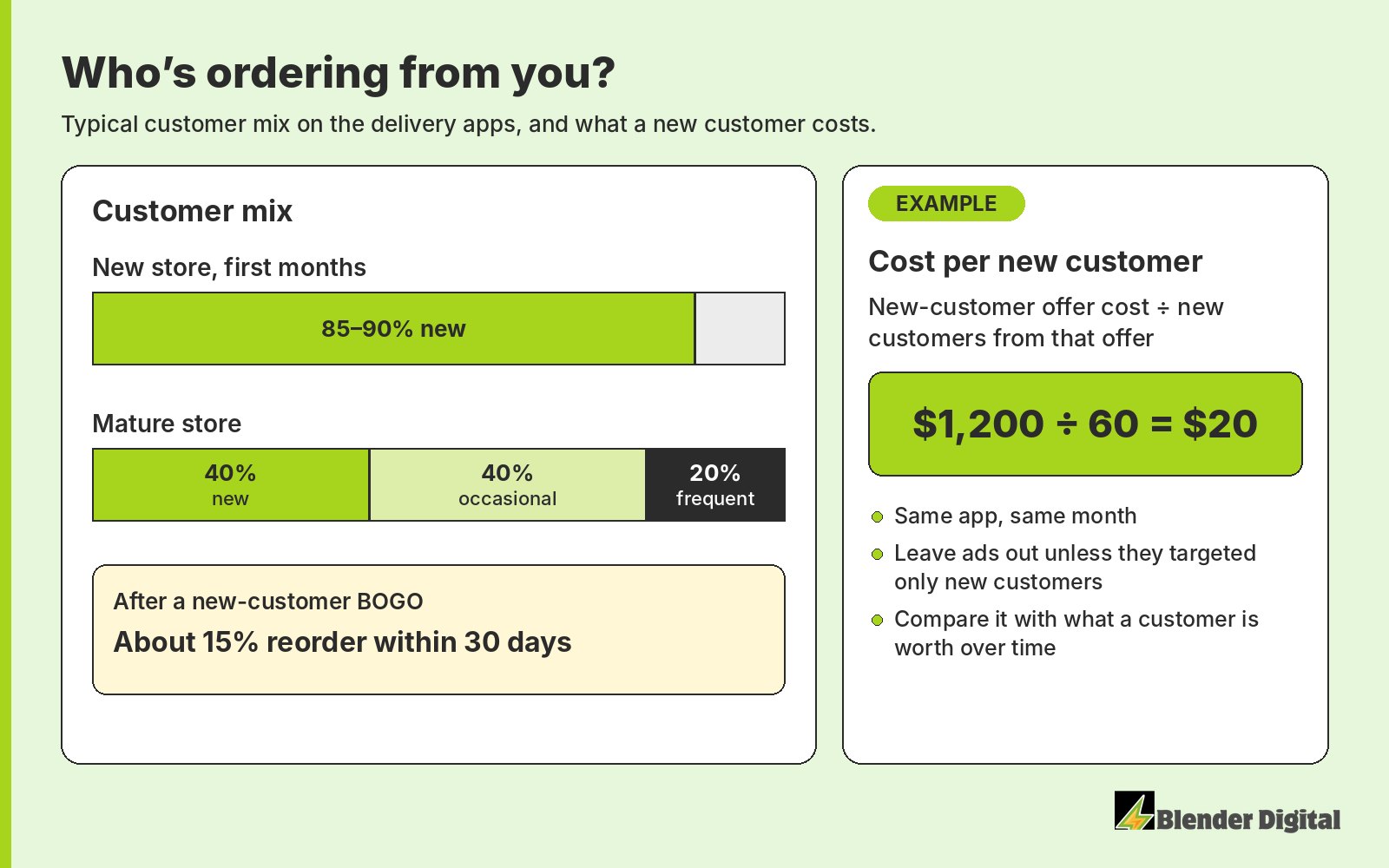
- Mostly new customers? Normal for a new store, often 85% to 90%. A mature store tends to settle around 40% new, 40% occasional and 20% frequent.
- Want to know what a new customer costs? Offer cost ÷ new customers from that offer. Same app, same month.
- BOGO running for everyone? Switch it to new customers only, so you're paying to win customers instead of discounting regulars.
Why is it so hard to see how many new customers I'm getting?
Because the dashboards lead with sales and orders. Customer numbers sit a few clicks deeper, and each app slices them differently. A few things make it harder than it should be:
- Short history on DoorDash. In my experience the customer view only goes back about a month. For longer trends you need a report or your account manager.
- Different definitions. On DoorDash, lapsed means no order in 6 months. On Uber Eats it's much shorter, around 45 to 60 days. Same word, different people.
- Generous attribution. Uber's ad reporting counts new customers from anyone who saw an ad, so it overlaps with whatever offer they used. If you add ad new customers to offer new customers, you'll count some people twice.
- Grubhub. It's a small slice of most stores' sales, so I don't spend time chasing this number there.
Where does DoorDash show new vs returning customers?
Two places, according to DoorDash's reporting guide:
- Sales report. In the Merchant Portal, open Reports, then Create report, and choose Sales. DoorDash says it can break sales down between new and returning customers, over any range within the last two years. Set it to full calendar months.
- Marketing report. For promotions and sponsored listings, it shows customers reached, split into total, new, existing and DashPass. This is how you see whether a "new customer" offer actually reached new people.
The newer campaign view also shows a 30-day reorder rate for each campaign. After a new-customer BOGO, I usually see about 15% of those customers order again within 30 days. If you want a longer look at your customer base and the portal won't give it to you, ask your account manager for 6 to 12 months of customer data.
Where does Uber Eats show new vs returning customers?
In Uber Eats Manager, open the Analytics tab and go to the Customers section. Uber says it shows how many new and returning customers you have. Scroll past the conversion funnel to see how each group orders (Uber Eats).
Two other spots are worth checking. The Insights tab compares you with similar stores nearby, and Uber says it may suggest a promotion if you have fewer repeat customers than your competitors. And when you build an offer, you can aim it at "only new customers who have never ordered from your merchant location before" (Uber Eats offers). That setting is the difference between buying a customer and discounting one you already have. More on choosing the audience in which customers to target with promos.
What's a healthy customer mix?
For a mature store, I expect roughly 40% new, 40% occasional and 20% frequent customers. A brand new store will run 85% to 90% new, and that's fine. Everybody is new to you in month one.
| What you see | What it usually means | What I'd look at |
|---|---|---|
| 85% to 90% new, first months | Normal for a new store. | Reviews and errors. You want those first orders to come back. |
| Still mostly new after several months | People try you once and don't return. | 30-day reorder rate, low reviews and food that travels badly, before adding more offers. |
| Mostly occasional and frequent, few new | Regulars are carrying the store and new people aren't finding you. | A new-customer-only offer and your visibility in the app. |
| Around 40 / 40 / 20 | A healthy, mature mix. | Keep new-customer spending steady and don't give regulars a BOGO. |
Read it on full months. One week of numbers is too small to mean anything.
How do I work out what a new customer costs?
Take what the new-customer offer cost you that month and divide it by the new customers it brought in. Same app, same month. On DoorDash use the Marketing report for that campaign. On Uber Eats use the offer's own results.
A real one: at a fast-casual franchise in New Jersey, the first-order BOGO on Uber Eats brought in 189 new customers in September 2026, on $3,465 of offer cost. That's a little over $18 per new customer, and those orders came to $8,858 in sales.
Is $18 good? Compare it with what a customer is worth to you over time. At a halal South Asian restaurant I advised (a partner agency ran the account), a new-customer BOGO brought in 232 new customers between July and August 2026, at about $20 each against roughly $60 in lifetime value. When the customer is worth a few times what you paid, keep going.
Two cautions. Keep ad spend out of this number unless the ad was aimed only at new customers, or you'll double count. And the cost only makes sense if the offer is set to new customers. If your BOGO runs for everyone, you're paying your regulars too, and the cost per new customer looks much worse than it should.
To pick items that can carry a BOGO without losing money, run them through the BOGO profit calculator. For which offer each customer group should get, I lay out the full ladder in delivery promos for new, lapsed and loyal customers.
Example: reading your mix and your cost
What a new store and a mature store usually look like, and the math behind cost per new customer.
How does Blender track new customers for clients?
Before we set up any offer, we decide what the store is buying: a new customer or one more order, and how much it can afford to pay for each. That decides how rich the offer can be and who sees it. That's the campaign strategy step. Then every monthly report counts new customers by platform and campaign, the cost of each, and how many come back.
At a taco shop on Long Island, the new-customer BOGOs we launched on September 10, 2026 brought in 75 new customers by the end of the month: 33 on Uber Eats and 42 on DoorDash. The same report showed ads winning orders for less than the BOGOs did ($4.84 per order on Uber Eats ads and $6.64 on the DoorDash sponsored listing, against $10.59 to $15.55 for the BOGOs). So we keep both. The BOGO wins the first order, and the ads keep the store in front of people for less.
We run the offers, the ads and the monthly read-out as part of campaign management. If you don't know how many new customers you got last month, Blender's here to help. Book a free 30-minute call and we'll pull the numbers with you.
FAQ
How do I see new customers on Uber Eats?
In Uber Eats Manager, open the Analytics tab and go to the Customers section. It shows how many new and returning customers you have, and how each group orders.
How do I see new vs returning customers on DoorDash?
In the Merchant Portal, go to Reports, then Create report, and run a Sales report broken down by new and returning customers. For campaigns, the Marketing report shows customers reached, split into new and existing.
What is a good new vs returning customer mix on delivery apps?
A mature store usually runs around 40% new, 40% occasional and 20% frequent customers. A new store will be 85% to 90% new, which is normal in the first months.
How much should I pay to get a new customer on DoorDash or Uber Eats?
There's no fixed number. Divide your new-customer offer cost by the new customers it brought in, then compare that with what a customer is worth to you over time. One store I advised paid about $20 per new customer against roughly $60 in lifetime value.
What counts as a lapsed customer on DoorDash and Uber Eats?
On DoorDash, a customer who hasn't ordered in 6 months. On Uber Eats the window is shorter, around 45 to 60 days, so a lapsed offer reaches different people on each app.