
Are you struggling to decide whether your promo should go to everyone or only to new customers? Not sure how many regulars you even have? Running three offers and can't tell which one is doing the work? Worried you're handing a discount to people who would have ordered anyway?
A rep once suggested to me that we take a new-customer campaign that was working and open it up to all customers. That makes zero sense. The campaign was working because it only reached people who had never ordered. Open it to everyone and your regulars get the same discount for food they were already buying.
I've already written about which offer fits each type of customer. This post is the decision part: how to size each group in the portals, which group to fund first, how much to spend on each, and how to check that two offers aren't landing on the same person.
Quick answers and quick fixes
- Don't know your customer mix? On DoorDash, open Customers, then Customer Insights. On Uber Eats, open Analytics, then Customers.
- Almost everyone is new? Normal for a new store, where 85 to 90% new is typical. Put the money into a new-customer offer and leave regulars alone for now.
- Plenty of first orders, few come back? After a new-customer BOGO I usually see about 15% reorder within 30 days. Well under that, look at reviews and the food before you add a returning offer.
- BOGO open to everyone? Switch it to new customers only, or keep 2 or 3 items on it for everyone at most.
- Two offers on the same group? End one. Each audience gets one offer per app.
- No spending limit? Set an average weekly budget on DoorDash or a maximum budget on Uber Eats while you test.
How do I find out how many new, returning and lapsed customers I have?
DoorDash. In the Merchant Portal, go to Customers, then Customer Insights. It shows the share of new, occasional and frequent customers (DoorDash Help). In my experience the insights only go back about a month. If you want 6 to 12 months, ask your account manager for it.
Uber Eats. In Uber Eats Manager, open the Analytics tab and go to the Customers section. Uber says it shows how many new or returning customers you have, and if you keep scrolling, how each group orders (Uber Eats Academy).
Write the split down for the last full calendar month on each app. For a mature store I expect roughly 40% new, 40% occasional and 20% frequent. A store in its first months runs 85 to 90% new, and that's fine.
One thing trips people up. The two apps don't define the groups the same way, so the same word reaches different people:
| Audience | DoorDash | Uber Eats |
|---|---|---|
| New | Never ordered from you | Never ordered from your location |
| Existing / returning | Ordered within the last six months | Targeted by past order activity, such as customers who recently came back |
| Lapsed | No order in six months or longer | A much shorter window. I've seen about 45 to 60 days in US accounts, and some of Uber's guides say 30 |
| All customers | Everyone in your delivery radius | Everyone in your delivery radius |
Sources: DoorDash promotions guide, Uber Eats offers, Uber's February 2026 update. Read the definition next to the audience when you build the offer.
Which group should I spend on first?
New customers, almost always. It's not about buying the additional order. It's about buying the new customer, and a new customer can only be new to your store once. After that, it depends on what your numbers show. This is the order I work through:
- The store is new, or most customers are new. New customers only. A returning offer here just discounts the few regulars you have.
- Store views are falling, or few new customers show up. That's a traffic problem. A new-customer offer plus a small ad budget is the fix. I go through the signs in why your restaurant isn't showing up.
- New customers come in but don't come back. Check the 30-day reorder rate on your campaigns (here's where to find it). If it's well under 15%, read your reviews before you spend more. Then add a small returning offer, like spend-and-save set a bit above your average order.
- You have a big list of past customers who went quiet. Add a lapsed offer, and keep it small. Lapsed offers bring extra orders. They're never the volume play.
- Orders are fine but the ticket is small. Use a threshold offer for returning customers or big spenders to pull the order size up.
Before you add any group, check your payout ratio (net payout divided by sales). If it's stuck in the 30s, you're already spending too much on marketing. Cut first, then add.
Which offer goes with which group?
One line each here, since the reasoning is in delivery promos for new, lapsed and loyal customers.
| Group | Offer I start with | What it buys you |
|---|---|---|
| New | BOGO on 3 to 10 items with a 75%+ margin, or free delivery | A first order from someone who has never tried you |
| Returning | Spend-and-save a bit above your average order, loyalty on DoorDash | A slightly bigger ticket, a little sooner |
| Lapsed | A bit richer than returning, like $8 off $30 to $35 | Extra orders from people who already know you |
| Big spenders | A big threshold, like $20 off $80 | Larger orders |
How much should I spend on each group?
The biggest share goes to new customers. You should be spending the most to acquire a customer, not to acquire an order. The other groups get small, steady offers.
New customers: watch the cost per customer. Divide what the offer cost you by the number of new customers it brought in. For a halal South Asian restaurant I advised (a partner agency ran the account), a new customer cost about $20 against roughly $60 of lifetime value. That's a trade worth repeating. If you can't tell what a customer is worth yet, at least make sure each BOGO item clears a 75% margin. The BOGO profit calculator does that check for you.
Returning customers: cap the effective discount. Keep threshold offers at or under about 25% of the order. Use a flat dollar amount so bigger orders get a smaller discount. DoorDash loyalty is a good fit here because it only costs you when someone redeems.
Lapsed customers: small and measured. Judge it by sales per $1 of offer cost on a full month. If a lapsed offer can't return several dollars per $1, stop it.
Set limits while you test. DoorDash lets you choose no cap or set an average weekly budget for a promotion. Uber Eats ends an offer when it reaches the maximum budget you set at launch (DoorDash, Uber Eats). Start capped, then lift the cap on the offer that's working. And ignore the recommended budgets. The apps will always tell you to multiply spend.
Then leave it alone for the month. Week to week it may not tell the full story, but by the end of the month it will.
How do I stop two promos hitting the same customer?
Do this audit once a month, on each app:
- List every live campaign. Audience, offer, schedule, and who built it. Include campaigns a rep set up for you. On DoorDash only the user who created a campaign can edit it, so note that too.
- Keep one row per audience. If two campaigns share an audience, end one. On Uber Eats a live campaign can't be edited, only ended, so rebuild it if you need a change.
- Look hard at "All customers" offers. They overlap every other group. Keep an all-customer BOGO to 2 or 3 items at most. An evergreen BOGO for everyone tells people your food is cheap.
- Watch stacking on Uber Eats. Promos can stack on one Uber order, so split offers by audience and avoid percent-off. DoorDash doesn't stack. When I want two new-customer offers there, I run them in parallel and label one "alternate."
- Don't layer DoorDash smart targeting on top. It's an overlap, and it doesn't tell the algorithm who the offer is for.
- Keep ads off lapsed customers. They already know you, so an offer does more than paying for them to see your store again. More on that in running ads and promos at the same time.
Example: what does a one-offer-per-audience plan look like?
Here's the kind of plan I'd write for a store in its growth months. The offers and dollar amounts are examples. Set yours from your own average order and item margins.
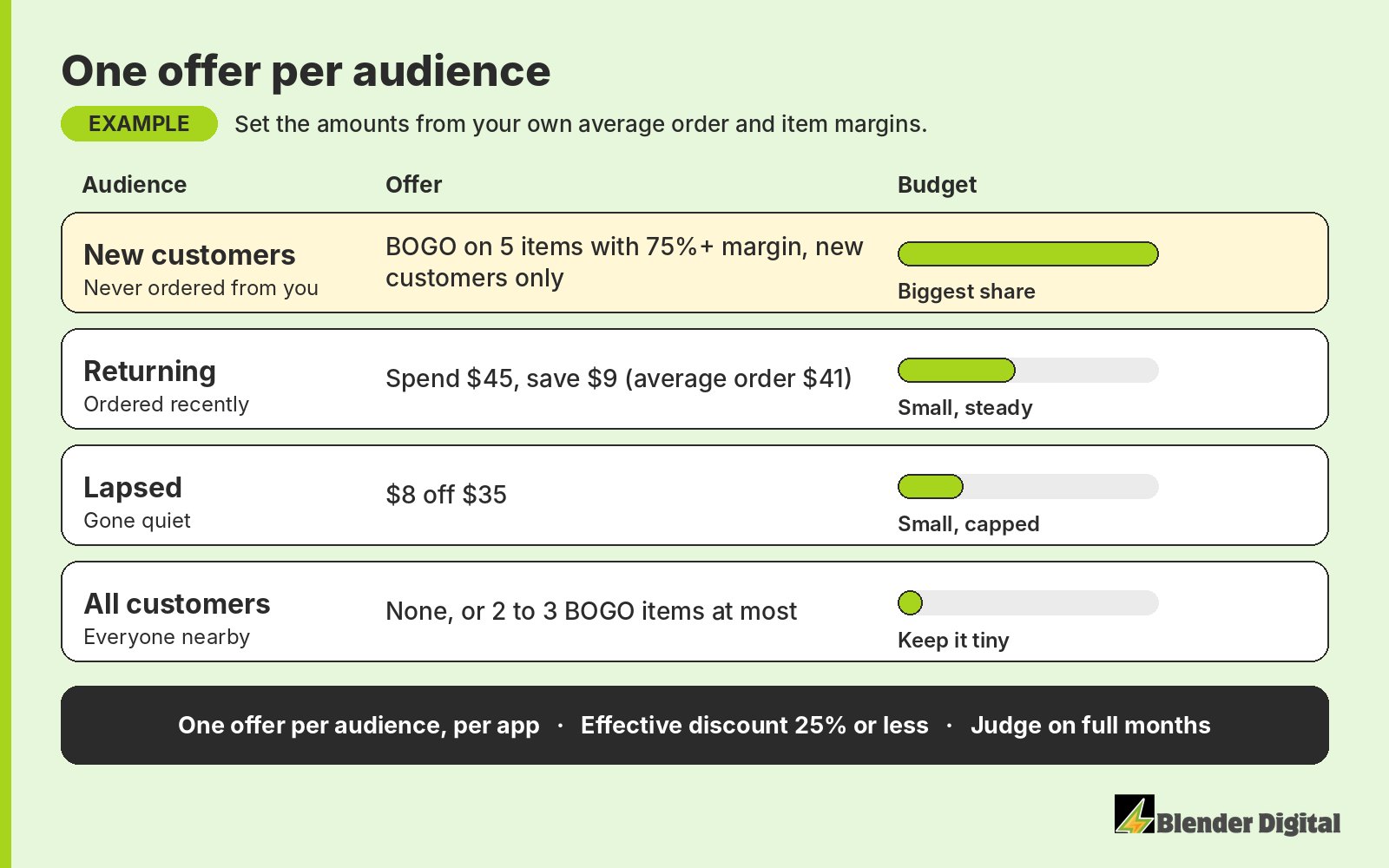
Each row has one job. The new-customer BOGO gets most of the money. The returning offer pushes the ticket up. The lapsed offer is small and capped. Nothing is aimed at everyone except, at most, a couple of BOGO items. On Uber Eats, check that no customer could qualify for two of these on one order.
How does Blender decide who gets which promo?
The first two weeks of every engagement are an audit. We pull the customer mix, the live campaigns and who they target, item margins, reviews and errors. Then I send a campaign plan in writing, one email per platform. Each recommendation names the audience, the offer, the evidence from the store's own history and why, with an approval line under it. Anything that would muddy the first month's read waits for month 2. That's the core of our campaign strategy work, and our campaign management team runs and checks the campaigns after that.
Here's how that played out at a taco shop on Long Island. New-customer BOGOs went live on September 10, 2026 and brought in 75 new customers by the end of the month (33 on Uber Eats, 42 on DoorDash). A separate, small lapsed-customer offer started the same day and returned $380 from 9 orders on $77 of offer cost. Two groups, two offers, no overlap.
If you're not sure who your promos are reaching, send me screenshots of your live campaigns on each app. Blender's here to help. Book a free 30-minute call and I'll tell you what I'd keep, cut and add.
FAQ
Should I target new or existing customers with DoorDash promotions?
Start with new customers. A BOGO or free delivery for new customers only buys a first order from someone who has never tried you. Give existing customers a smaller offer, like spend-and-save set a bit above your average order, or DoorDash loyalty.
What counts as a lapsed customer on DoorDash and Uber Eats?
On DoorDash, lapsed means no order from your store in six months or longer. Uber Eats uses a much shorter window, about 45 to 60 days in the US accounts I manage, so check the definition when you build the offer.
Can a customer use two promos on one Uber Eats order?
Yes, promos can stack on Uber Eats. Give each audience one offer and avoid percent-off. DoorDash does not stack promos on one order.
How much should I spend to get a new delivery customer?
Divide the offer cost by the number of new customers it brought in, and compare that with what a customer is worth to you. For one restaurant I advised, a new customer cost about $20 against roughly $60 of lifetime value.
Should I run a delivery promo for all customers?
Rarely. An all-customer offer overlaps every other group and discounts regulars who would have ordered anyway. If you run one, keep it to 2 or 3 BOGO items at most.