
The short answer
A restaurant group needs a delivery management agency when nobody owns DoorDash, Uber Eats and Grubhub as their main job. Without one owner, each location runs its own promos, prices and menus, error charges go undisputed, and nobody can say which campaign made money. An agency gives you one operator across every location and platform, judged on how much of each sale you actually keep.
Owners tell me chargebacks are "only $10 a week." Then we look. One prospect with two stores had lost $1,198 to them in a single month.
Another prospect put it better than I could: "The money look like it should be here but I don't see it." That's payout leakage. In a restaurant group it's spread across every location and every app, so nobody sees the whole thing. If you own two locations or twenty and you're deciding whether to get outside help, this is how I'd think about it.
Who is actually running delivery at your restaurants?
For most groups, it's one of these:
| Who runs it | Where it breaks |
|---|---|
| Each store manager runs their own storefront | Every location ends up with different prices, promos, photos and menus. There's no clean way to compare stores. |
| A dedicated in-house delivery manager | Works if you find the right person. It's a full salary for a role that needs deep platform knowledge, and when they leave, most of it leaves with them. |
| Nobody, really. The owner logs in when sales dip. | Promos run for months unchecked, error charges get written off, and problems get found weeks late. |
| An outside management agency | You pay a fee, so the extra profit has to cover it. If it doesn't, you shouldn't keep paying. |
The store-manager setup is the one I see most. Your GMs are good at running a kitchen, and reading campaign reports isn't what you hired them for. So one location runs a BOGO on its most expensive item while another hasn't touched its promos in a year.
There are also problems that only show up across locations. Edit an item in your POS and its ID changes, which can silently break an item-level campaign on DoorDash. I learned that one early, and it was a very expensive lesson: the BOGO campaign just went flat. In a group, one menu update can do that to every store at once.
Do the platform reps look out for multi-location restaurants?
They pay more attention to you. On Uber Eats, around $10K to $15K a month, or multiple units, is usually what gets an account manager to notice. Single-location stores often don't get a dedicated one at all, and on DoorDash the account managers rotate quarterly.
But keep in mind who they work for. They don't work for you. They work for the company. Uber Eats makes the most money when you make the most money, and they don't care about whether you're selling profitably. Reps will suggest bigger budgets, second sponsored listings, and retargeting a winning campaign to everyone. I turn most of that down.
They also make mistakes. At a coffee shop in Philadelphia, an Uber Eats rep set an offer to "$14 off $15" when it was supposed to be "$14 off $55." I escalated it, and Uber refunded $380.80. After that I put controls in place to check every campaign once it goes live, whoever built it.
Where size really helps is commission. It's a trade: we'll run these campaigns and this much daily sponsored-listing spend, and in return we want a better rate. Deals I've seen include 18 to 20% for groups of 15 to 30 locations, 15% for a franchise that put every location on the top plan, and 30%-plan benefits at a 25% rate. A single store rarely gets those conversations.
Are DoorDash and Uber Eats worth it for a restaurant group?
For most groups, yes, if you run them on purpose. Third party will always be your least profitable channel. Even with zero promos, you can't beat 70 to 85 cents on the dollar. But it's a customer acquisition channel, and few channels find and close a customer in the same place:
| Channel | Discovery and purchase |
|---|---|
| Social media | Good for discovery. The purchase happens later, somewhere else, if the customer remembers you. |
| Google search and Maps | Good for intent. The customer still has to call, visit or find a way to order. |
| DoorDash, Uber Eats, Grubhub | Both at once. A customer finds you and pays you in the same couple of minutes. |
Some owners want to get off the apps entirely. But nobody downloads an app for every restaurant, so what about the more casual eater? I'd rather manage the apps and use your own ordering as the profit channel for regulars. I wrote about how the two fit in third-party vs first-party delivery.
What decides whether delivery makes you money?
The most important number when you're selling on third party is a single number: payout ratio. It's net payout divided by gross sales. If a location did $10,000 in sales and the apps deposited $5,000, the payout ratio is 50%, so you got 50 cents on the dollar before food and labor.
Six things feed it, and in a group they sit in different screens and often with different people:
- Menu markup. To fully cover a 30% commission you'd need about a 43% markup, and nobody does that. I aim for 12 to 15%.
- Commission plan. On DoorDash I usually recommend Plus at 25% over Premier at 30%.
- Ads and sponsored listings. Scaled only when the return earns it. Here's how I set ad budgets.
- Promos. One offer per customer group, never two on the same people. More in promos for new, lapsed and loyal customers.
- Food cost of promoted items. I want a 75% margin or better on anything that goes on a BOGO.
- Errors and disputes. Every undisputed error charge comes straight out of payout.
How I read it: 70 to 85% is the ceiling with no promos. Around 50% is normal in a growth phase, and 60% is good. Stuck in the 30s means too much marketing. More on the math in why a 30% markup doesn't cancel a 30% commission and running ads and promos at the same time.
What does a delivery management agency do?
Here's what we handle for the restaurants we manage, across DoorDash, Uber Eats, Grubhub and Toast:
- Campaigns and sponsored listings. Who gets which offer, what we bid, and when we scale.
- Menu, pricing and photos. Including a separate online menu in Toast so third-party prices are exact.
- Reviews and loyalty. Replies with offers, and loyalty programs where the app has one.
- Errors and disputes. Daily checks, with evidence attached to anything that isn't your fault.
- The platform reps. Commission and credit negotiations, and checking any campaign a rep builds.
- One monthly report. Every location, every app, same definitions, walked through live.
Every change goes to you in writing first, with an approval line under each recommendation. You keep ownership of your accounts and your data. And we split the work clearly, because both sides show up in the numbers:
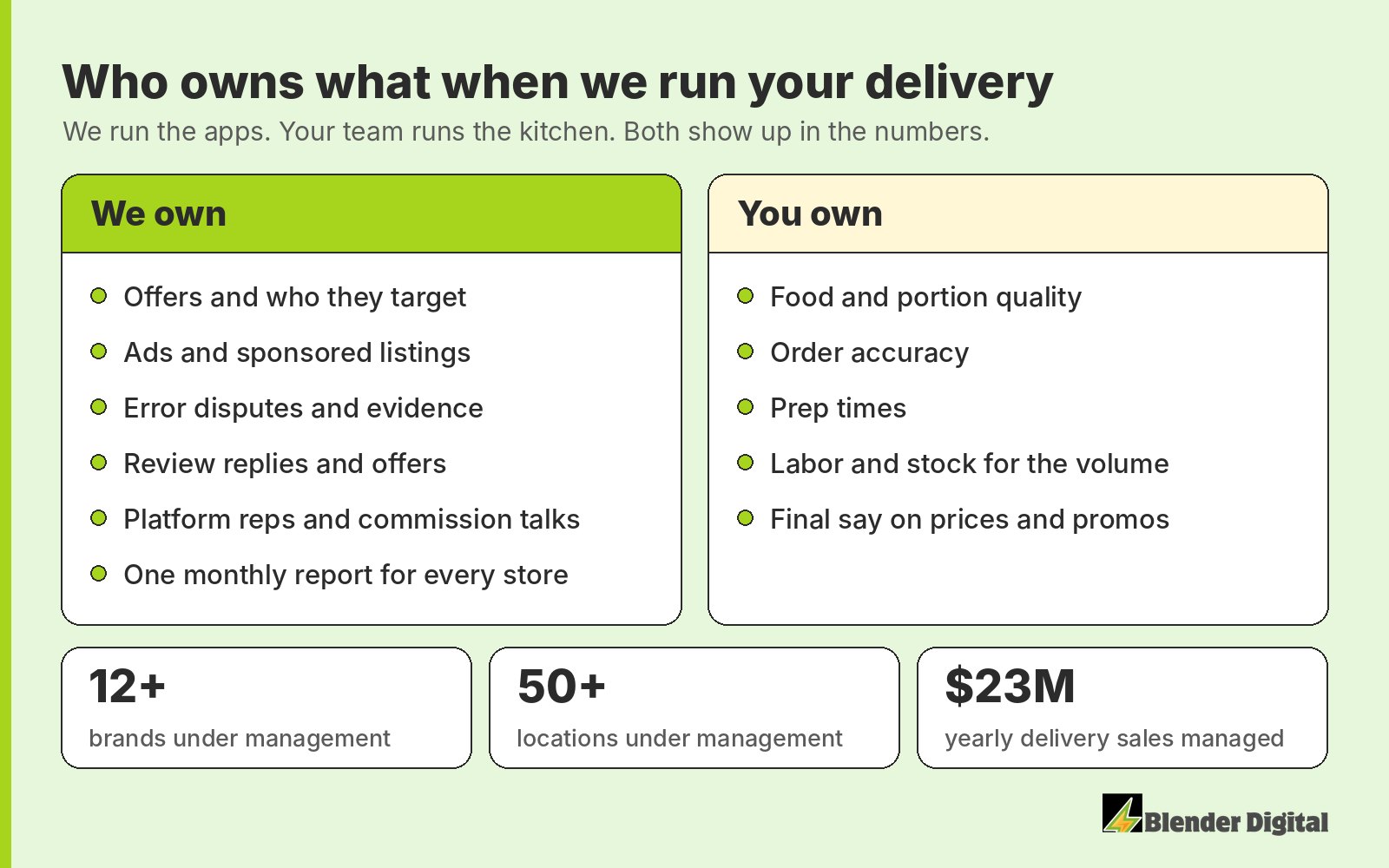
That split matters. Stores with hands-on owners have far fewer errors, and if you have no errors, no inaccurate orders and no taste and quality issues, the algorithm keeps pushing you forward.
What results can a restaurant group expect?
I won't promise a number. No serious agency would promise an outcome. If I had the magic bullet, I'd be licensing my solution, not offering it as a managed service. What I can show you is what's happened at stores we've worked with:
- An Arab coffee bar in New Jersey: delivery sales up 91% in one month, from $5,629 to $10,764, with orders going from 236 to 429 (February to March 2026, Uber Eats and DoorDash).
- A two-location Mexican QSR in New York City: Uber Eats sales grew 1.25x in two months at stores already doing $66K to $92K a month each (December to February and April to June 2026, Uber Eats only, advisory work).
The same playbook has worked at a store starting from a few hundred dollars a month and at stores doing tens of thousands. You can see more before-and-after numbers on our results page.
When don't you need an agency?
I'd rather say this upfront. You probably don't need us if:
- You run one location, have the time, and enjoy digging into the dashboards yourself.
- You already have a strong in-house person who owns delivery across the group and reports on it clearly.
- You don't have a real growth goal, or you want the channel to stay small.
- Your kitchen can't handle more volume right now. Going from 5 orders a day to 48 means a courier every half hour and a KDS going off the hook. If the kitchen struggles, we fix throughput before we push for more orders.
How we work with restaurant groups
Today Blender Digital manages 12+ brands and 50+ locations, with $23M in yearly delivery sales under management, on DoorDash, Uber Eats, Grubhub and Toast. My own background is more than eight years in web product and experimentation, and it shows in how we run things: we set a baseline and a monthly goal before changing anything, we change one thing at a time, and we judge on full months, not single days.
Our programs run four or six months. The goal is a stronger channel and a team that understands how it's run by the end. Groups of three or more locations get one playbook across every store, with centralized promo rules and help with menu launches. You can read more about how we work.
Frequently asked questions
Does a multi-location restaurant need a delivery management agency?
Usually, if nobody in the group owns DoorDash, Uber Eats and Grubhub as their main job. Without one owner, locations drift apart on pricing, promos and menus, error charges go undisputed, and reporting stops lining up.
Should store managers run DoorDash and Uber Eats for their own locations?
Store managers should own the in-store side: accepting orders, prep times, accuracy and flagging outages. Pricing, promos, ads, menus and reporting work better set centrally, so every location follows the same rules.
Can a restaurant group negotiate a lower commission?
Often, yes. Commission is a trade for the campaigns and ad spend you commit to. I've seen 18 to 20% for groups of 15 to 30 locations and 15% for a franchise that put every location on the top plan.
How much does Blender Digital cost?
Single-location programs start from $1,030 per month on a six-month program. Groups with three or more locations get custom pricing. See pricing for details.
Running delivery across several locations?
In a free 30-minute call, I'll look at your storefronts, promos and payouts across locations and tell you honestly whether we're a good fit. Book a free discovery call.