
Almost every week, we watch a restaurant owner set up a promotion on DoorDash or Uber Eats, check it two days later and change it. A few days after that, they change it again. A month later they’ve run four different offers, none of them long enough to tell what worked, and they decide promos “don’t work for us.”
Promos do work. Changing them before they’ve had time to show you anything doesn’t. Here’s what we see go wrong, a real example of a campaign that looked great and did almost nothing, and the rules we follow before touching a campaign.
Quick answer
- Leave a campaign alone for at least two to four weeks before you judge it. DoorDash doesn’t even show reorder rate or long-term value until a campaign has run for 30 days.
- Change one thing at a time, and write down what you changed and when.
- Judge a campaign on orders and total sales, not return on ad spend alone. A high ROAS on a handful of orders usually means the offer is too hard to reach.
- Decide how much discount you can afford before you launch, then let the campaign bring in volume inside that limit.
- Your goal is to sell food. A great-looking ratio on $200 of sales doesn’t pay the rent.
Why does changing campaigns every few days backfire?
Because a few days of data can’t tell you anything, and every change wipes out the comparison you were trying to make.
- Too few orders to read. A new campaign might bring in a handful of orders in its first few days. One slow rainy Tuesday or one busy Friday can swing the numbers either way.
- Customers need time to see it. Most people don’t open DoorDash or Uber Eats every day. An offer you launched on Monday hasn’t reached your weekend regulars yet.
- You never learn what worked. If you change the discount, the minimum and the items in the same week, there’s no way to know which change moved the numbers, or whether anything did.
- The best data comes later. DoorDash shows reorder rate and long-term value only after 30 days of campaign activity (DoorDash). Those two numbers tell you whether a promo is building repeat customers, which is the whole point.
A real example: $8 off $40 vs. $6 off $30
A diner we started working with had a “spend $40, save $8” promotion running. Their average order was around $28, so most customers never got close to $40 and the offer barely got used.
We moved it to “spend $30, save $6.” It’s the same 20% off a qualifying order, but now the minimum sits just above what a normal order already costs. A customer adds a drink or a side and gets the deal. The owner agreed.
A week later, they wanted to change it back because the discount felt too high.
Look at what actually changed. Each customer who used the offer got $2 less than before. The discount rate didn’t move. What went up was the number of people using it, so total promo spend rose, and so did orders and sales. That’s the trade you’re making with any promotion: you give up a set share of each order in exchange for more orders. Changing it back after one week would have thrown that away before there was enough data to judge it.
Why a high return on ad spend can still be a bad campaign
ROAS tells you how much you sold for every dollar of promo spend. It doesn’t tell you how much you sold. A campaign can post a strong ratio on almost no orders.
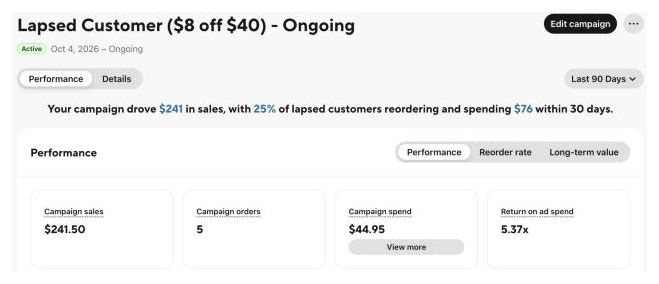
On paper, 5.37x looks healthy. In practice, five orders in seven weeks means the offer is too hard to reach or aimed at too small a group, so it isn’t doing much for the business. The few customers who used it were happy. Everyone else never saw a reason to order.
Compare two campaigns:
- Campaign A: $45 in promo spend, $240 in sales. A 5.3x return.
- Campaign B: $400 in promo spend, $1,600 in sales. A 4x return.
Campaign A has the better ratio. Campaign B sold more than six times as much food. If you can afford Campaign B’s discount, it’s the better campaign, because restaurants are in the business of selling food. Decide how much effective discount you’re comfortable with, then push for as much volume as you can inside that limit.
How should you read a campaign before you change it?
Look at orders, sales and ROAS together. Each combination points to a different fix, and sometimes the right fix is to leave it alone.
| What you see after 2–4 weeks | What it usually means | What to change |
|---|---|---|
| High ROAS, very few orders | The minimum is too high or the audience is too narrow | Lower the minimum closer to your average order, or open it to more customers |
| Lots of orders, low ROAS | The discount is too rich, or it’s on low-margin items | Trim the discount or move it to items with more margin |
| Lots of orders, healthy ROAS | It’s working | Leave it alone. Consider a bigger budget |
| Few orders, low ROAS | The offer doesn’t interest your customers | Replace it with a different offer or different items |
Notice that only one of these is “turn it off.” Most campaigns need one adjustment, then more time.
The rules we follow before touching a campaign
Set it up carefully, give it time, change one thing, and judge it on sales.
- Decide your discount limit before launch. Know what share of a promo order you’re willing to give up, so you aren’t second-guessing it every time you see the spend.
- Set minimums near your average order. Slightly above your average nudges people to add an item. Far above it means hardly anyone qualifies.
- Run it for two to four weeks. On DoorDash, wait 30 days if you want to see reorder rate and long-term value.
- Change one thing at a time. The minimum, the discount, the items or the audience, not all four.
- Keep a simple log. Date, what changed, why. In a month you’ll know exactly what moved your numbers.
- Don’t react to one day. A slow weekend isn’t a trend.
- Don’t change prices and promos in the same week. You won’t be able to tell which one did what.
Instincts to resist
- Turning a promo off after a slow weekend. Give it the full test window.
- Raising the minimum because “people are getting too good a deal.” That usually cuts volume more than it saves.
- Running a new offer every week. Regular customers can’t learn your offer if it keeps changing.
- Copying a competitor’s offer. Their menu, prices and margins aren’t yours.
- Judging by ROAS alone. Always check how many orders and how much food it sold.
How does Blender Digital handle campaigns?
We set campaigns up around a discount limit the owner agrees to, review them every week and change them only when the numbers say so.
That steady approach is a big part of what we do for clients: picking the right offer and minimum, watching orders and sales alongside ROAS, and making one deliberate change at a time instead of reacting to a slow day. If you’d rather learn it yourself, our live webinar on January 15 covers promos and ads in detail, with live teardowns of attendee restaurants.
FAQ
How long should I run a DoorDash or Uber Eats promotion before changing it?
At least two to four weeks. DoorDash only shows reorder rate and long-term value after 30 days of campaign activity, so a month gives you the full picture.
Is a high return on ad spend always good?
No. A high ROAS on a handful of orders usually means the offer is hard to reach or aimed at too few customers. Check orders and total sales alongside it.
Should a spend-X-save-Y minimum be above or below my average order?
Close to it, or a little above. A little above encourages customers to add an item. Far above it means very few orders qualify.
Is $6 off $30 better than $8 off $40?
Both are 20% off a qualifying order. If your average order is under $40, $6 off $30 usually gets used far more often, so it brings in more orders and sales.
What should I change first if a campaign isn’t working?
Change one thing based on what you see: lower the minimum if few people qualify, trim the discount if margins are thin, or swap the offer if customers aren’t interested. Then give it another two to four weeks.