
DoorDash's Most Loved badge is judged monthly on four signals: missing and incorrect items, cancellations, photo coverage and menu markup, and DoorDash's pricing guide says markup must be 10% or less. Uber Eats' Top Eats needs 100+ orders in 12 weeks, a 4.6+ rating, 98%+ order accuracy, under 1% cancellations and 90%+ courier satisfaction, per Uber's help FAQ.
Quick answer
- Most Loved (DoorDash): four signals, scored per store each month on the previous month. Cutoffs live in your Merchant Portal. Markup has to be 10% or less.
- Top Eats (Uber Eats): rating, orders, accuracy, cancellations and courier satisfaction over roughly the last 90 days. No price rule.
- What you get: a badge on your store and more homepage visibility on both apps.
- My take: the badges are hard to chase directly. Work on ratings, errors, reviews and photos, and decide separately if a 10% DoorDash markup is worth it.
Here's what each platform publishes, what I've seen inside the portals, and where I spend effort instead.
How does DoorDash decide who gets the Most Loved badge?
DoorDash now runs Most Loved as a ladder. Every store gets a status each month: Poor, Needs Work, Almost There or Most Loved. Only Most Loved shows to customers (DoorDash, Road to Most Loved).
The status comes from four signals:
- Missing and incorrect items, as a share of orders.
- Cancellations, including ones caused by your POS, outdated hours or items listed that are out of stock.
- Photo coverage, the share of menu items with a photo.
- Menu markup, how far your DoorDash prices sit above in-store.
DoorDash doesn't publish the cutoffs. Its FAQ says "Exact benchmarks are available in the Merchant Portal," under Insights, then Most Loved. Status is per store, it updates monthly based on the previous month, and only marketplace and self-delivery orders count, not Drive, Storefront, in-store or kiosk (DoorDash, Road to Most Loved FAQs).
From what I've seen in portals, cancellations had to be at 1.1% or lower. That's a tight number for a busy kitchen, and it's one of the reasons I call this badge something you can't really chase.
The benefits DoorDash lists: a spot in a homepage carousel of top restaurants, more frequent homepage recommendations, a banner and icon on your store page, and possibly better conversion.
Does Most Loved really require a markup of 10% or less?
Yes, per DoorDash. Its menu pricing guide says "Menu markups must be no higher than 10% to qualify for Most Loved." It also says DoorDash "doesn't require delivery prices to match in-store prices" (DoorDash, How Menu Pricing Could Impact Your Sales). So you can price however you want. You just can't price above 10% and keep the badge.
DoorDash measures it on items that appear on both menus. It adds up the DoorDash prices, adds up the in-store prices, and divides one by the other.
Example: two items on both menus
In-store: a $10 sandwich and a $12 bowl, $22 total. On DoorDash: $11.50 and $13.50, $25 total. $25 divided by $22 is 1.136, so your markup is 13.6%. That's over the line.
Here's the problem. I tell most clients to mark up 12% to 15%, because at a 30% commission even that doesn't get you back to what you make in-store. A 10% markup is technically hurting you. I go through that math in how much to mark up your delivery menu.
DoorDash's side of it: the same guide cites its own 2023 study where restaurants that marked up saw "up to 37% fewer sales and up to 78% lower reorder rates," and says consistent pricing "may rank higher." Keep in mind who's telling you. My honest read is that the 10% rule is a game DoorDash is playing because it takes so much commission.
How does Uber Eats Top Eats work?
Uber is more open about the numbers. Its Top Eats FAQ lists these requirements over the last 12 weeks (Uber, Top Eats FAQ):
- At least 100 completed orders
- A customer rating of 4.6 stars or higher
- Order accuracy of 98% or higher
- Cancellations under 1%
- Courier satisfaction of 90% or higher
Pickup-only stores and stores that deliver only with their own staff aren't eligible. The FAQ doesn't say which countries it covers. Uber's US Top Eats page lists star rating, completed orders, online rate, missed order rate and inaccurate order rate, says your goals are in Uber Eats Manager, and says Uber reviews performance "on the 1st of every month" over the past 90 days. You need at least 90 days on Uber Eats, enrollment is automatic and it's free (Uber Eats, Top Eats).
What I've seen in Uber Eats Manager matches that: a 90-day lookback, roughly the top 5% to 10% of stores, about 80% online availability, a high rating, and inaccurate orders under about 2 per 100. There's no price rule.
What's the difference between Most Loved and Top Eats?
Both give you a badge and more visibility. The differences are in what they watch.
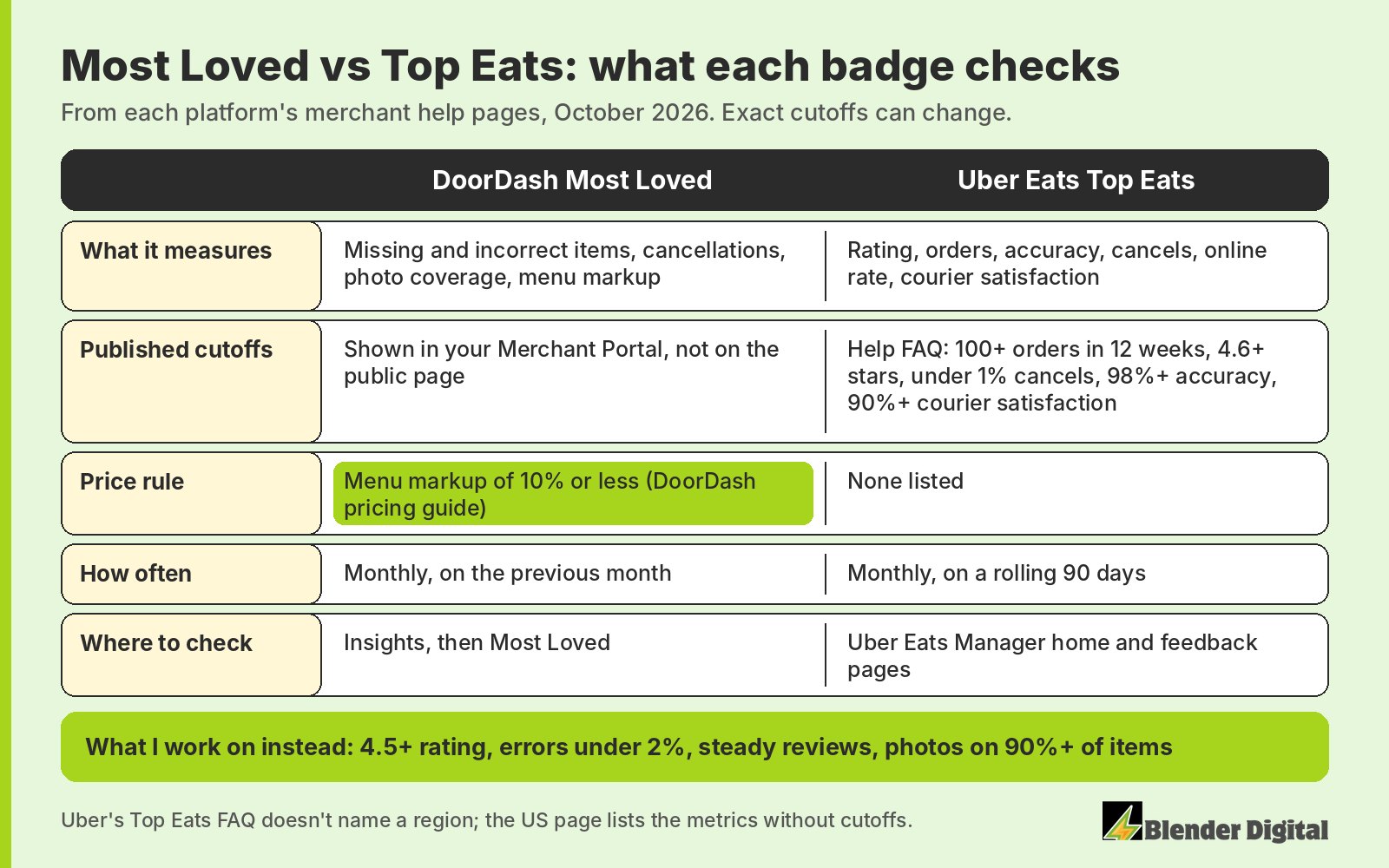
- Price: only DoorDash ties its badge to your menu prices.
- Photos: only DoorDash scores photo coverage. I'd chase that one anyway. Aim for a photo on 90% to 95% of items.
- Rating: Uber puts a hard 4.6 floor on it. DoorDash's current public list doesn't include star rating.
- Couriers and uptime: Uber counts courier satisfaction and how often you're online. DoorDash doesn't list either.
- Transparency: Uber publishes cutoffs. DoorDash keeps them in your portal.
Should you chase the badge?
Not directly. I've found it close to impossible to chase, and the lift is marginal next to good campaigns and reviews. A badge is a result of the inputs, and the inputs are what drive sales whether or not you get it.
Here's what I work on instead:
- Rating at 4.5 or higher, with 100+ reviews. That's where customers start to trust a store. More in how ratings affect your sales.
- Errors under 2%. Both apps measure missing and wrong orders, and DoorDash compares you with your peers. A daily routine helps; here's mine for error charges.
- A steady flow of reviews. A card in the bag and an offer on every reply. See how to get more reviews.
- Photos on 90%+ of items. It's an online medium. You have to have pictures to sell items.
These are reachable numbers. In September 2026, a smash-burger ghost kitchen we manage in Houston ran a 1.4% error rate (17 of 1,230 orders across Uber Eats, DoorDash and Grubhub) and got 60 Uber Eats reviews, 49 of them five-star, with replies on 59. That was with a BOGO running on most of its orders that month.
Is a 10% DoorDash markup worth it for the badge?
Sometimes. Run your menu through the markup parity calculator at the commission you actually pay and see what a 10% markup leaves you per item.
- If your margins hold up at 10% and you already pass the operations signals, try it for a full month and compare DoorDash sales and payout month over month.
- If 10% puts you underwater, keep your markup where it works and win on ratings, reviews and campaigns instead. A BOGO gives you room to price a bit higher anyway, since people don't blink when they're getting two for one.
Either way, change one thing at a time and judge it on a full month, not a good Tuesday.
FAQ
What are the requirements for DoorDash's Most Loved badge?
DoorDash scores each store monthly on missing and incorrect items, cancellations, photo coverage and menu markup, based on the previous month. The exact benchmarks are in the Merchant Portal under Insights, then Most Loved. DoorDash's pricing guide says menu markup must be 10% or less to qualify.
Does DoorDash Most Loved require price parity with my in-store menu?
No. DoorDash says price matching isn't required, but comparable pricing is one of the signals, and its pricing guide sets the Most Loved markup limit at 10%. Markup is measured on items that appear on both your DoorDash and in-store menus.
What are the Uber Eats Top Eats requirements?
Uber's Top Eats FAQ lists at least 100 completed orders over the last 12 weeks, a 4.6-star rating or higher, 98% or better order accuracy, cancellations under 1% and courier satisfaction of 90% or more. Pickup-only stores and stores that use only their own couriers aren't eligible.
How often are Most Loved and Top Eats updated?
Both refresh monthly. DoorDash bases Most Loved on the previous month's performance. Uber Eats assesses Top Eats on the 1st of each month using the past 90 days, and a store needs at least 90 days on Uber Eats to qualify.
Is it worth chasing the Most Loved or Top Eats badge?
Not directly. The badges add visibility, but I've found the lift small next to good campaigns and reviews. Work on the inputs instead: a 4.5+ rating, errors under 2%, steady reviews and photos on most items. Then decide whether a 10% DoorDash markup makes sense for your margins.
Want to know where your store stands on these signals? Send me your last full month from each app and I'll tell you what I'd fix first. Ratings and errors are a big part of our review management and error handling work, or you can get in touch here.