
DoorDash requires every virtual brand to have at least 50% different main menu items from every other DoorDash menu at the same address. It also caps a kitchen at 10 virtual brands and removes brands that fail its audits. I've watched a multi-brand client lose 6 of its 9 concepts on DoorDash with no notice.
Quick answer
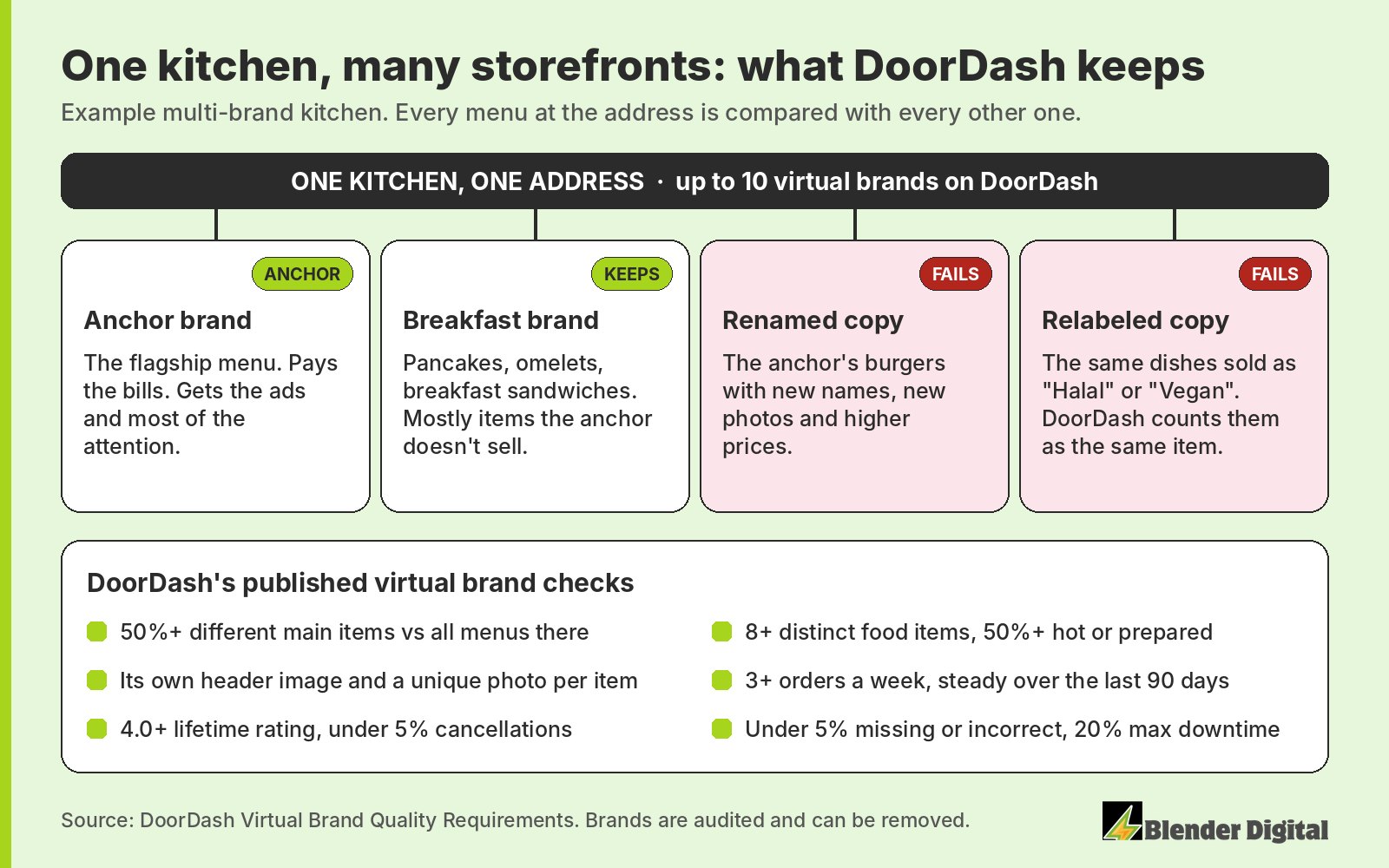
- The 50% rule: at least half of a brand's main items must differ from every other menu on DoorDash at that address, including your flagship. New names, new photos or higher prices don't make an item different.
- Limits: 10 virtual brands per address, at least 8 distinct food items per brand, and a unique photo for every item.
- Upkeep: 3+ orders a week over 90 days, a 4.0+ rating, and under 5% cancellations and under 5% missing or incorrect orders.
- Uber Eats: said 60% in 2023, but in my experience it enforces less strictly than DoorDash.
- What I do: one anchor brand, a few add-ons that are actually different, and pause (not delete) in your middleware.
Below is what the official rule says, what I've seen happen to operators, and how I set up a kitchen that runs several storefronts.
What is DoorDash's 50% rule for ghost kitchens and virtual brands?
DoorDash's written rule is that a virtual brand needs "at least 50% differentiation in main menu items" compared with "all other restaurant menus on DoorDash at that same address" (DoorDash Virtual Brand Quality Requirements).
Two parts of that sentence matter more than the number.
It's every menu at the address. Your new brand is compared with your flagship and with every other brand you already run there. Brand five has to be different from brands one through four. That's why the rule gets harder each time you add a concept.
DoorDash decides what "different" means. Items that differ only by "different item photos, names, or higher prices" don't count. Neither do different sizes or combos, different flavors or seasonings, adding or removing a minor ingredient, or relabeling a dish as gluten free, halal, vegetarian or vegan. So your burger brand's double cheeseburger and your diner's double cheeseburger are the same item, whatever you call them.
Example: does this wing brand pass?
The new brand has 10 main items. Six of them (wings in three flavors, tenders, a chicken sandwich and a combo) are already on your diner's menu under other names. That leaves 4 of 10 that are different, which is 40%. It fails. Swap in two items the kitchen doesn't sell anywhere else and it reaches 60%.
What else does DoorDash require from a virtual brand?
The 50% test is the one people hear about. The same DoorDash page lists more, and any of them can get a brand removed:
- Menu: at least 8 distinct food items, including appetizers and sides, and at least 50% hot or prepared food.
- Photos: a unique header image for each brand and a distinct photo for every item. No AI-generated or heavily altered images.
- Performance: at least 3 orders a week consistently over the last 90 days, a lifetime rating of 4.0 or higher, cancellations under 5% of orders, missing or incorrect orders under 5%, and no more than 20% downtime in the last 90 days.
- Limits: no more than 10 virtual brands per store address, unless you're an established commissary operator or get written approval.
- Kitchen: a licensed commercial kitchen. Residential and cottage food kitchens aren't allowed.
Brands that impersonate a real brick-and-mortar restaurant, or that repeatedly abuse cancellations or refunds, are "immediately deactivated" by DoorDash's fraud team. Everything else is "periodically audited," and DoorDash "reserves the right to remove virtual brands" that are out of compliance. The page doesn't mention a warning, a grace period or an appeal.
What happens when DoorDash decides a brand breaks the rule?
It goes away. One multi-brand client of ours lost 6 of its 9 concepts on DoorDash, and nobody told them first. The brands were just gone, over the 50% menu rule.
That lines up with the official page. Audits happen when DoorDash runs them, not when you're ready, and there's no notice period written down. So the time to check your brands is before you launch them, not after a slow week makes you wonder where a storefront went.
Is Uber Eats stricter or more lenient with virtual brands?
On paper Uber Eats asks for more. In 2023 it said a virtual brand's menu must be at least 60% different from its parent restaurant and from other virtual brands at the same location, with photos on at least five items, and it removed about 5,000 listings it saw as duplicates (Restaurant Business; Food On Demand). Food On Demand also reported a 4.3-star floor and limits of 5% on cancellations and inaccurate orders.
Uber's current US page for virtual restaurants doesn't publish a percentage. It says Uber Eats "supports restaurants that operate more than one brand out of one kitchen" (Uber Eats virtual restaurants).
In practice, I've found Uber more lenient than DoorDash with my clients' brands. That's my experience, not a policy, so build every brand to pass the stricter written rule on both apps. A brand that clears 60% on Uber clears 50% on DoorDash too.
How should you set up a multi-brand kitchen?
Think of it as one kitchen with many storefronts, and one of them carries the rest.
Anchor plus add-ons. The flagship brand pays the bills. The smaller brands add sales on top. A historic diner in San Francisco we manage runs 7 brands out of one kitchen, and the diner brand is still the biggest of them. In September 2026, its first month with us, the breakfast brand grew 73.5%, the steak brand 49.1% and the pie brand 43.6% over August. Those add-ons work because they sell different food, not the diner menu with a new logo.
Prune the dead ones. A brand with zero orders isn't helping, and DoorDash expects 3 orders a week over 90 days anyway. Pull it from your active lineup.
Pause, don't delete, in your middleware. The middleware I see on multi-brand kitchens is Otter. Pausing a brand there keeps the menu and setup ready if you want it back. Deleting it means building it again if you change your mind.
Let the kitchen set the ceiling. Seven storefronts can send more orders than one line can cook. If the kitchen can't keep up, you've paid for the promos and lost ranking, so read what to do when promos work and the kitchen can't keep up before you add brand number eight.
Treat each brand as its own store. Each one has its own header image, photos, rating and reviews. A good diner rating doesn't carry over to the wing brand. For the photo side, my image size guide covers what each app accepts.
One more for DoorDash: some multi-brand operators have campaigns DoorDash co-funds. Edit those rather than recreating them, or you lose the co-funding.
How do you check if your virtual brands would pass?
Do this once before launching a brand, and again any time you change a menu.
- Put the main items of every brand at the address in one sheet, one column per brand.
- Mark any item that's the same dish as something on another brand. Count flavors, sizes, combos and halal or vegan versions as the same dish, because DoorDash does.
- For each brand, divide the unmarked items by its total main items. Anything under 50% needs new items or a pause.
- Check that every brand has at least 8 food items, a unique header image and its own photo on every item.
- Check the last 90 days: 3+ orders a week, rating 4.0+, cancellations and missing or incorrect orders each under 5%.
If a brand is close to the line, fix it with new dishes, not new names. Your separate app menu in Toast is where that work happens; here's how I set up an app-only menu in Toast.
FAQ
What is DoorDash's 50% rule for virtual brands?
DoorDash requires each virtual brand to have at least 50% differentiation in its main menu items compared with all other restaurant menus on DoorDash at the same address. Items that only change the photo, the name or the price, and items relabeled as halal, vegan or gluten free, count as the same item.
How many virtual brands can one kitchen have on DoorDash?
DoorDash allows no more than 10 virtual brands per store address. It makes exceptions for established commissary kitchen operators or with written approval from DoorDash. Each brand also needs at least 8 distinct food items and its own photos.
Does DoorDash warn you before removing a virtual brand?
DoorDash's requirements page says brands are periodically audited and that it can remove brands that are out of compliance. It doesn't promise a warning or describe an appeal. I've seen a client lose 6 of its 9 concepts on DoorDash with no notice.
What are Uber Eats' rules for virtual brands?
In 2023 Uber Eats said virtual brand menus must be at least 60% different from the parent restaurant and other brands at the same location, and it removed about 5,000 duplicate listings. Its current US page doesn't publish a percentage. In my experience Uber has been more lenient than DoorDash.
Should I delete a virtual brand that isn't selling?
Pause it in your middleware rather than deleting it, so the menu and setup are there if you bring it back. Prune brands with zero orders from your active lineup, since DoorDash also expects at least 3 orders a week over 90 days.
Running several brands out of one kitchen and not sure which ones would survive a DoorDash audit? Send me the menus and I'll tell you where each one stands. Managing multi-brand kitchens is part of our campaign management work, or you can get in touch here.