
Are you struggling to get your Uber Eats rep to put any money behind your promos? Wondering how the chain down the street runs a BOGO all year? Sitting on DoorDash ad credits you didn’t know were about to expire? Or did a campaign your rep set up cost you money, and nobody has offered to fix it?
I’ve dealt with all four on client accounts. At a coffee shop in Philadelphia, an Uber Eats rep set up an offer as “$14 off $15” when it was meant to be “$14 off $55.” The owner saw $700 in discounts go out after a sales spike. I escalated it, and Uber refunded $380.80.
Co-funding, ad credits and credit-backs are real money, and the platforms rarely bring them up first. Below is how each one works, how to ask, and how to make sure you actually use what you get.
Quick answers and quick fixes
- Rep won’t co-fund? Ask with numbers: sales so far, your payout ratio, what you plan to spend, and the percentage you want.
- No Uber rep at all? Look for Uber-funded, limited-time campaigns you can join yourself in Uber Eats Manager.
- DoorDash says no? Expected. Ask for ad credits instead, and check your Marketing Wallet for credits you already have.
- Credits about to expire? Divide the balance by the days left and set the budget so it runs out on time.
- Rep’s campaign cost you money? Ask for a credit-back with the order IDs and the exact amount.
- Already have a co-funded DoorDash campaign? Edit it. Don’t recreate it, or the co-funding is lost.
Why won’t Uber Eats or DoorDash pay for my promos?
Usually because nobody asked, or the person asking had nothing to bargain with. Reps juggle a lot of accounts, which is also why they can be hard to reach. In my experience, a store starts getting noticed at around $10,000 to $15,000 a month on one platform, or when it’s part of a multi-unit group. Below that, unless you’re talking to them, they rarely talk to you.
The two apps also behave very differently. Uber Eats co-funds campaigns, usually somewhere between 10% and 25% of the discount depending on the rep, and more often when the account manager sets the campaign up. The way I read it, co-funding is a way for Uber to claw back market share from DoorDash. DoorDash is the market leader, so it doesn’t have the same reason. It rarely co-funds, and what you mostly get is a small credit at the beginning.
Remember: “They don’t work for you. They work for the company.” A rep will happily tell you to raise your budget. Co-funding and credits come out of their side of the ledger, so you have to ask for them.
What is co-funding actually worth?
Co-funding means the platform pays part of the discount. Say you run a BOGO on a $12 item. Every redemption gives away $12. At 20% co-funding, Uber covers $2.40 and you cover $9.60. If your BOGOs give away $3,000 in a month, 20% is $600 that stays in your payout instead of leaving it.
On a DoorDash statement, discounts are split into “funded by you” and “funded by DoorDash,” and only your part comes out of your payout. More in how to read your DoorDash and Uber Eats statements.
One caution. Co-funding helps a BOGO that already makes sense. If an item loses money every time it’s redeemed, 20% back won’t save it. Check the item first with the BOGO profit calculator, and see how I pick BOGO items for the 75% margin rule.
How do I ask Uber Eats to co-fund a promo?
This is how we got Uber to co-fund the ghost kitchen’s BOGO. It works for any store with real volume.
- Get a named account manager. If you don’t have one, ask for one through Uber Eats Manager support. When we’ve requested one, Uber treated it as a sensitive request and an admin on the account had to verify it within 72 hours, so make sure the owner is ready to respond.
- Lead with the numbers and the problem. Our email said the store had done “$20K so far,” the BOGO was “negatively impacting our payout (37%),” the store was “on track to generate $25K-$30K,” and plainly: “We are losing money on these BOGOs.”
- Keep the call on one topic. I opened with “I am well versed in the merchant portal… the only thing I want to discuss is promotion co-funding.”
- Ask for a number. In the plans I write for clients I expect around 15% to 20%. Ask for it out loud.
- Follow up. It took four follow-ups. The answer was 10% co-funding.
- Let the account manager build it, then check it. Co-funding is more likely on campaigns the account manager sets up. Open the live campaign and confirm the item, the threshold, the audience and the schedule match what you agreed.
- Put it in writing. After every call I send a short recap of the campaigns and terms, “so that there is a paper trail.”
Bring something to trade. You commit to running campaigns and a daily ad budget, and they give you a better deal. Strong sales on one app also help with the other: “we want to stick with you guys” lands differently when the rep knows you’re doing well on DoorDash.
A short ask you can copy
Subject: Promotion co-funding for [store name], store ID [ID]
We’ve done $[X] on Uber Eats since [date], and our BOGO on [items] is bringing in new customers. It’s pulling our payout ratio down to [X]%. We plan to keep it running and expect $[X] to $[Y] next month. We’d like Uber to co-fund this campaign at [X]%. Can we set up 15 minutes this week to discuss promotion co-funding only?
No rep yet? Uber now lists Uber-funded, limited-time offer campaigns in Uber Eats Manager that you can find and join yourself (Uber Eats). Uber’s own example was 30% funding on BOGO offers during a BOGO week. Read the dates and terms, and only join with items whose math already works.
Will DoorDash co-fund promos or give me ad credits?
Co-funding on DoorDash is rare. Some multi-brand operators do have co-funded DoorDash campaigns. If you have one, edit that campaign when something needs to change. Recreating it loses the co-funding.
Credits are where DoorDash gives. DoorDash says select US merchants can get up to $100 in Sponsored Listings credit on their first campaign, and stores that have run Sponsored Listings before aren’t eligible (DoorDash). On our accounts we’ve also seen store-level Smart Campaign credits for new stores (one was $150). Sponsored listing credits from reps have gone to new stores or stores on the 30% plan, were allocated quarterly, and sometimes needed a listing with no end date.
DoorDash describes three kinds of marketing credits: one-time trial credits, reward credits that pay 5% back on eligible Sponsored Listing spend (a pilot with select merchants), and general credits for “select operational needs.” They live in the Marketing Wallet, at the top right of the Run a Campaign or Campaigns page in the Merchant Portal. Credits a DoorDash sales rep issues may not show in the wallet. Those appear in Financials and in the campaign’s Performance tab once they’re used (DoorDash).
When should you ask? Early. At launch, when you change plans, and any time a rep calls with a pitch. That’s when you have their attention.
How do I keep ad credits from expiring?
“It’s free money. We’ll take it.” Expired credits are the easiest money to lose. This is how we pace them:
- Find the balance and the expiry date. On DoorDash, open the Marketing Wallet. DoorDash says reward credits expire at the end of Q1 the year after they’re issued. On Uber Eats, Uber Eats Manager has one view of ad spend, what Uber covered and when your credits expire.
- Make sure something live can use them. DoorDash applies credits automatically to eligible active campaigns before your own budget. They’re on by default for new campaigns, and you can switch them off in campaign settings, so check that nobody did. With no eligible campaign running, nothing gets used.
- Pace it. Divide the balance by the days left. $300 with 30 days to go is $10 a day. Set the budget just above that so the balance runs out before the date.
- Pace each brand on its own. If you run more than one brand, Uber ad credits are tied to one brand. A credit on one brand can’t fund another.
- Decide what happens after. Once credits run out, normal billing starts. Before that day, decide whether the campaign earns its keep on your own money. My rules for that are in how much to spend on DoorDash and Uber Eats ads.
What if a rep’s campaign costs me money?
Ask for a credit-back. Reps make setup mistakes too. The “$14 off $15” offer from the start of this post is a good example. I opened with “we need to discuss how [the store] can be made whole,” and Uber refunded $380.80. It was also a lesson for us. Since then we check every campaign once it’s live, including the ones a rep built.
A credit-back request that works has four parts:
- The exact problem, in one or two sentences.
- What you already tried to fix it.
- The order IDs affected.
- The exact credit you want. For a wrong discount amount we wrote: “credit back the extra $2 per order… $6 total.”
A broken sponsored listing is the other common one. Have the owner open the ticket, since it needs admin verification. Correct the rep’s framing if they’re talking about the wrong thing. Ours was “our biggest concern is that the Sponsored Listing hasn’t generated any impressions.” Then ask for any credits that expired while it was broken to be extended. And if support closes the ticket without fixing anything, say so: “we do not consider this support ticket closed.”
Example: what co-funding does to a month of BOGO discounts
A simple month with $3,000 in BOGO discounts, at three co-funding levels.
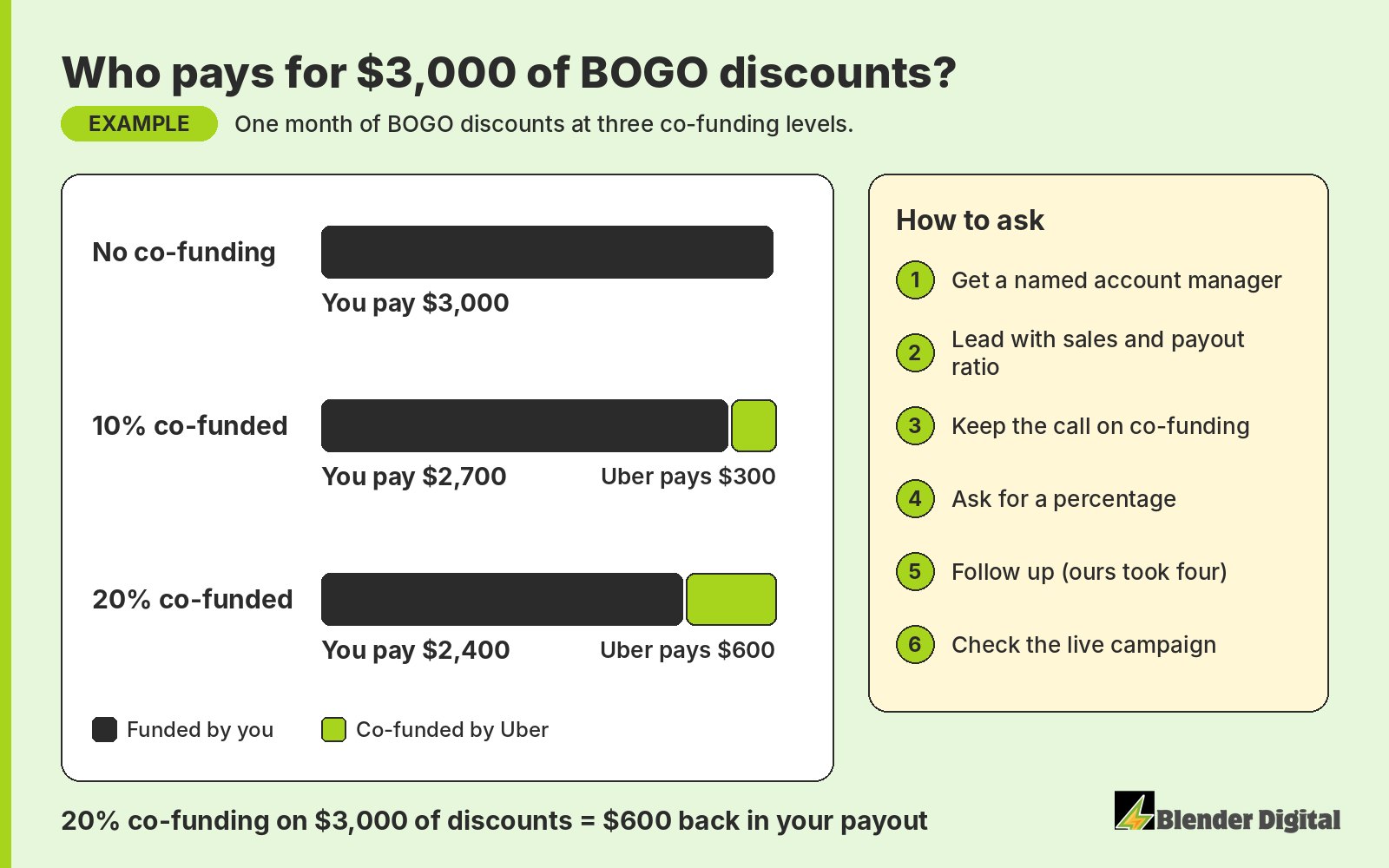
That’s $600 a month on the same promo, with nothing else changing, which is why I ask on every Uber account with real volume.
How does Blender handle co-funding and credits?
Working the reps is part of our campaign management. At kickoff we ask about co-funding and credits on every platform. We check every live offer against what the owner approved, rep-built ones included. Credits get paced weekly so they’re used before they expire, and when a rep’s campaign breaks we ask for the credit-back with order IDs attached.
The ghost kitchen from the top of this post is a good picture of the whole program. In September 2026, its first managed month, it did $57,375 in sales across Uber Eats, DoorDash and Grubhub from 1,230 orders. That beat its $31,700 goal by 81%, at a 42.7% payout ratio against a target of 40% or better. The offers came from the campaign strategy we wrote at the start, and co-funding made them cheaper to run.
If you’re running promos with no co-funding and credits you’ve never checked, that’s usually the first easy money we find. Blender’s here to help. Book a free 30-minute call and we’ll look at your setup with you.
FAQ
How much will Uber Eats co-fund a promotion?
In our experience, 10% to 25% of the discount, depending on the rep, and often 15% to 20% when the account manager sets the campaign up. One of our clients got 10% after four follow-ups. Uber also lists Uber-funded, limited-time campaigns you can join in Uber Eats Manager.
Does DoorDash co-fund promotions?
Rarely. DoorDash mostly offers credits instead, such as up to $100 in Sponsored Listings credit for select merchants running their first campaign. If you already have a co-funded DoorDash campaign, edit it rather than recreating it, or the co-funding is lost.
Where do I find my DoorDash ad credits?
In the Merchant Portal’s Marketing Wallet, at the top right of the Run a Campaign or Campaigns page. Credits issued by a DoorDash sales rep may not show there. Those appear in Financials and the campaign’s Performance tab once they’re used.
Do Uber Eats and DoorDash ad credits expire?
Yes. DoorDash says reward credits expire at the end of Q1 the year after they’re issued, and the Marketing Wallet shows the terms for other credits. Uber Eats Manager shows when your Uber ad credits expire. Pace the budget so the balance runs out before that date.
Can I get money back if a rep set up my campaign wrong?
Yes, ask for a credit-back. Give the exact problem, what you already tried, the order IDs and the exact amount you want back. Uber refunded one of our clients $380.80 after a rep set up “$14 off $15” instead of “$14 off $55.”